Weekly recap week 45, 2026: storage news and price per TB
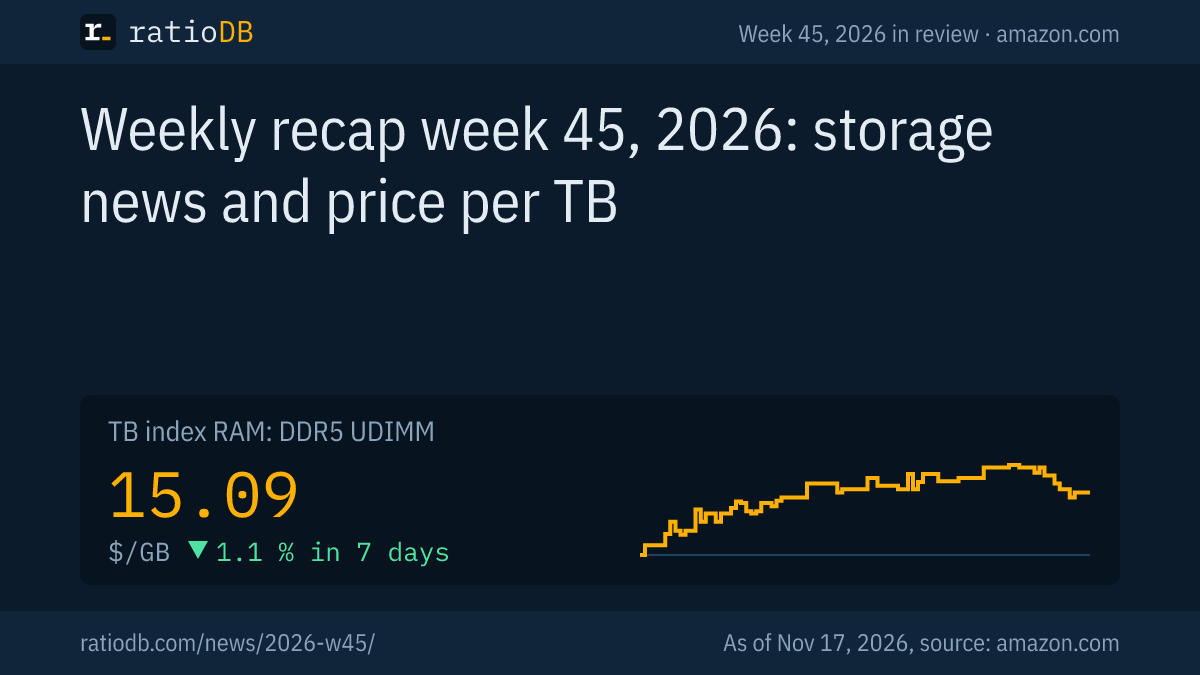
In calendar week 45 (November 2 to 8, 2026), 3 topics shaped the storage market: Kioxia and the DRAM market reported record revenue, Apple, AMD and Raspberry Pi feel the effects of high memory prices, and Teamgroup expects the hardest phase of the shortage to last until mid-2027. On amazon.com, 2 of 6 indexes rose in 7 days, M.2 NVMe SSDs the most at 1.5%. Over 30 days, 5 of 6 were up, internal 3.5" hard drives the most at 5.0% (as of Nov 9, 2026, 06:17 UTC).
As of November 9, 2026. ratioDB covers news on hard drives, SSDs and memory every day. This recap sums up the 34 stories of the week by topic and puts them next to the prices per TB and per GB from the ratioDB database.
What mattered in week 45?
Week 45 brought record results from the makers and the bill for it at the device level: Kioxia reports 453% more revenue, DRAM revenue rose 369% in the 3rd quarter according to Counterpoint, and Apple expects even higher memory costs. All 34 stories appeared on ratioDB between November 2 and November 8.
- Record revenue: Kioxia reached revenue of 2.48 trillion yen for July to September, up 453% from a year ago, according to Blocks & Files. Its output for the rest of 2027 is sold out. Global DRAM revenue grew 369% in the 3rd quarter according to Counterpoint, while bit shipments rose only about 4%. CXMT reports a gross margin of 89.53%.
- Effects on devices: Apple expects a gross margin of 45 to 46% in the December quarter instead of 47.9%, The Register reports. AMD CEO Lisa Su is planning for a double-digit drop in PC unit volumes in 2027, according to PC Games Hardware. The Mac Studio with 512 GB costs at least 22,299 US dollars, and the upgrade from 96 to 512 GB costs 15,500 US dollars, TechRadar reports. The Raspberry Pi 5 with 16 GB rises to 385 US dollars, around 220% above the launch price of 120 US dollars, according to ComputerBase.
- How long the shortage lasts: Teamgroup CEO Gerry Chen sees the hardest phase between the 4th quarter of 2026 and the end of the 2nd quarter of 2027. According to TrendForce, refurbished memory in smartphones is set to rise to 7 to 9% in 2027. MediaMarktSaturn expects further price adjustments in the holiday season, heise online reports.
- Makers and fabs: Micron halted construction of Fab 11E in Taoyuan over a dispute with the union, according to Tom's Hardware, and showed a roadmap with its 1δ process from the 2nd half of 2027. Macronix is ending ROM chips for Switch cartridges, according to a report, and is investing 37.8 billion NT dollars in NOR and NAND flash.
- New memory technology: Qualcomm has validated its HBC stacked memory for the first time, with samples of the AI250 accelerator due in the 1st half of 2027. Sandisk backs the High-Bandwidth Flash approach, while Kioxia takes a different path. Aisin and Tohoku University showed an AI chip with 32 MiB of MRAM.
- Products and tests: mLogic announced Vault LTO, a desktop tape drive with Thunderbolt 5. The TeamGroup GA Pro with 2 TB fell short of what is expected from a PCIe 5.0 drive at Tom's Hardware. Microsoft promises up to 40% faster multitasking for Windows 11 on PCs with 8 GB of RAM.
How did prices per TB move in week 45?
On amazon.com, 2 of 6 product types rose in the 7 days to November 9, M.2 NVMe SSDs the most at 1.5%, while DDR4 desktop fell 2.0%. Over 30 days, 5 of 6 indexes are up, internal 3.5" hard drives the most at 5.0% (as of Nov 9, 2026, 06:17 UTC, source: amazon.com).
The TB index is the median of the 10 cheapest new listings in a product type, converted to the price per TB or GB. The changes compare the same products over the period. Used and refurbished listings are not counted. How ratioDB calculates is explained in the methodology.
TB index by product type, as of Nov 9, 2026, 06:17 UTC, source: amazon.com:
| Product type | Now | 7 days | 30 days |
|---|---|---|---|
| Hard drive internal 3.5" | $38.72/TB | +0.6% | +5.0% |
| Hard drive external 3.5" | $43.04/TB | -1.1% | -2.2% |
| SSD M.2 NVMe | $133.99/TB | +1.5% | +2.0% |
| SSD 2.5" SATA | $120.33/TB | -0.9% | +1.7% |
| DDR5 desktop | $15.62/GB | -0.7% | +2.7% |
| DDR4 desktop | $6.27/GB | -2.0% | +1.7% |
The stories of the week name no cause for the moves of individual product types.
What do the news of week 45 mean for buyers?
For buyers of memory and SSDs, the stories of week 45 point to lasting high prices: Counterpoint expects high prices in 2027 as well because large new fabs only start production in 2028, and Teamgroup sees the hardest phase lasting until mid-2027. On amazon.com, DDR5 desktop stood 2.7% above its level of 30 days ago.
Memory remains the topic with the clearest direction over the month, although the 7-day moves on amazon.com were slightly negative. The guide why are RAM prices so high explains the background, current listings are under DDR5 desktop and DDR4 desktop.
For SSDs, M.2 NVMe on amazon.com stood 2.0% above its level of 30 days ago, 2.5" SATA 1.7%. The guide SSD prices shows how SSD prices have moved, and best SSD picks drives by price per TB.
For hard drives, internal 3.5" drives rose 5.0% in 30 days, while external ones fell 2.2%. Prices per TB are under hard drives, background in the guide hard drive prices.
Frequently asked questions about week 45
How long will memory stay scarce?
Teamgroup CEO Gerry Chen sees the hardest phase of the shortage between the 4th quarter of 2026 and the end of the 2nd quarter of 2027, PC Games Hardware reports. Counterpoint research director MS Hwang expects high prices in 2027 as well because large new fabs only start production in 2028, according to The Register. Gartner expects relief in 2 years at the earliest, heise online reports.
Why are devices like the Raspberry Pi and the Mac Studio getting more expensive?
Raspberry Pi is raising the price of the 16 GB model from 305 to 385 US dollars, the 4th increase since December 2025, heise online reports. CEO Eben Upton says there is no alternative supplier for the 16 GB chip. Apple calls memory prices unprecedented, according to The Register, and expects even higher memory costs in the December quarter.
Did memory get more expensive in week 45?
Over 7 days, no: on amazon.com, the index for DDR5 desktop fell 0.7% to $15.62 per GB and for DDR4 desktop 2.0% to $6.27 per GB. Over 30 days, both are up, DDR5 by 2.7% and DDR4 by 1.7% (as of Nov 9, 2026, 06:17 UTC, source: amazon.com). The stories of the week name no cause for these moves.
Sources
- Blocks & Files: Kioxia, HBF at Sandisk and Kioxia
- The Register: Counterpoint on DRAM revenue, Apple and memory costs, Windows 11 with 8 GB RAM
- ComputerBase: CXMT and 4F2 (German), Qualcomm HBC (German)
- PC Games Hardware: AMD and the PC market in 2027 (German), Teamgroup (German), Aisin and MRAM (German)
- heise online: Raspberry Pi 5 with 16 GB (German), Holiday season (German)
- TechRadar: Mac Studio with 512 GB
- ComputerBase: Raspberry Pi to cut prices again (German)
- Tom's Hardware: Micron and Taoyuan, Micron roadmap, Macronix, TeamGroup GA Pro review
- TrendForce: Refurbished memory in smartphones
- ServeTheHome: Qualcomm HBC
- StorageNewsletter: mLogic Vault LTO
- ratioDB: amazon.com prices, methodology
All stories of this week
CPU-Z data: first-ever drop in PCs with 32 and 64 GB of memory
According to Tom's Hardware, data from the CPU-Z diagnostic tool shows the first decline in large memory configurations: systems with 32 GB fell 2.5% year over year and those with 64 GB fell 18%. In contrast, 16 GB rose 12.9%, 8 GB rose 5.5% and 24 GB rose 19.7%. At 37.2%, 32 GB is still the most common configuration, ahead of 16 GB at 33%. DDR4 holds 54.5% (up 6%), DDR5 32.9% (down 2.9%). The data comes from the active user base of CPU-Z and is not sales data.
For buyers: Tom's Hardware links the trend to high DRAM prices. When upgrading, you can compare the price per GB by capacity and by memory type (DDR4 or DDR5).
TB index RAM 5.94 $/GB▲ 1.5 % since this story(as of Nov 17, 2026, 8:17 PM UTC, Source: amazon.com)
Source: Tom's Hardware
Retailers and analysts: memory prices weigh on the holiday season
According to heise online, a spokesperson for MediaMarktSaturn says the shortage of memory components makes PCs, smartphones and SSDs more expensive and further price adjustments cannot be ruled out. Market researcher NIQ reports that average graphics card prices in September were almost double those of the previous year, and desktop PCs cost 41% more. heise also notes that SK Hynix has sold half of its production through 2028 and that Gartner expects relief in 2 years at the earliest. According to heise, large-capacity hard drives have roughly doubled in price since the start of the year.
For buyers: According to heise, consumer advocates advise comparing Black Friday discounts with the price history of recent months and watching for smaller storage sizes sold at the old price.
TB index RAM 5.94 $/GB▲ 1.5 % since this story(as of Nov 17, 2026, 8:17 PM UTC, Source: amazon.com)
Source: heise online
ASRock Rack shows server board with 16 DDR5 slots for Intel Diamond Rapids
ASRock Rack is showing the DMRD16-2L+ server board for Intel's Diamond Rapids Xeon platform at OCP Summit 2026, ServeTheHome reports. The board offers 16 memory channels with 1 slot each. According to ASRock Rack it takes RDIMMs (server memory with a buffer chip) up to 128 GB at up to 8000 MT/s (million transfers per second), plus MRDIMMs up to 128 GB and, in the 2U form factor, up to 256 GB, each at up to 12800 MT/s. Instead of standard PCIe slots it has up to 16 MCIO connectors, 128 PCIe 6.0 lanes (data lines) in total.
For buyers: The news concerns data centers and has no direct effect on retail prices. More memory channels per processor can raise the DRAM demand of each server.
TB index RAM 5.94 $/GB▲ 1.5 % since this story(as of Nov 17, 2026, 8:17 PM UTC, Source: amazon.com)
Source: ServeTheHome
Raspberry Pi 5 with 16 GB now costs over triple its launch price, TechRadar says
TechRadar puts the Raspberry Pi 5 price rise to $385 for the 16 GB model into context: that is more than triple the $120 at launch in January 2025. The November increase alone amounts to roughly 26%, the rest adds up from 3 earlier rounds since December 2025. The 8 GB model costs $175, so the extra 8 GB of the 16 GB version cost $210. According to TechRadar the boards are locked by firmware to the memory size they shipped with, so upgrading the memory is not possible. Direct sales of the Pi 5 rose 47% in the half, TechRadar writes.
For buyers: Buyers who do not need 16 GB can save a lot with a smaller model, according to TechRadar. CEO Eben Upton advises choosing only as much memory as needed. Retailer prices can differ from the list price.
TB index RAM 5.94 $/GB▲ 1.5 % since this story(as of Nov 17, 2026, 8:17 PM UTC, Source: amazon.com)
Source: TechRadar
TSMC rejects report on 3D DRAM plans for Nvidia
The Information reported, citing 2 people familiar with the matter, that TSMC has started preparing plans to manufacture 3D DRAM (memory with several vertically stacked cell layers) at the request of Nvidia. TSMC told Tom's Hardware that it focuses on its core business as a contract manufacturer of logic chips. Tom's Hardware notes that 3D DRAM is still years away even for the big makers Micron, Samsung and SK hynix, so it could not ease the memory shortage for at least 5 years. TSMC also lacks its own DRAM process.
For buyers: For RAM buyers the report changes nothing in the short term, because even if true, extra production would matter only many years from now, according to Tom's Hardware.
TB index RAM 5.94 $/GB▼ 0.2 % since this story(as of Nov 17, 2026, 8:17 PM UTC, Source: amazon.com)
Source: Tom's Hardware
Review: TeamGroup GA Pro 2TB falls short of PCIe 5.0 expectations
Tom's Hardware reviewed the 2TB TeamGroup GA Pro, a PCIe 5.0 drive (fast interface of the latest generation) with the InnoGrit IG5666 controller. The line comes in 1, 2, 4 and 8TB, rated up to 10,000 MB/s read and 8,500 MB/s write, with a 5 year warranty and up to 600 TB of writes per TB of capacity. In testing, overall performance was very low according to Tom's Hardware, power draw peaked above 12.5 W against 8.25 W on the label, and the drive ran hot. Its verdict is that the drive mostly misses and is only worth considering on a steep discount.
For buyers: Anyone shopping for a PCIe 5.0 drive should, according to this review, watch sustained performance and plan on a heatsink. M.2 models can be compared in the M.2 NVMe category.
TB index SSD M.2 NVMe 131.49 $/TB▲ 0.2 % since this story(as of Nov 17, 2026, 8:17 PM UTC, Source: amazon.com)
Source: Tom's Hardware
Altman meets Samsung and SK hynix in South Korea, no memory deal announced
OpenAI CEO Sam Altman met around 50 Samsung executives, including the head of its chip business, and then had lunch with the chairman of SK Group, TechRadar reports. Samsung called the visit a seminar on AI in management and announced no new memory supply agreement. Bloomberg, by contrast, described the meeting as an effort to deepen cooperation on memory chips. According to TechRadar, Samsung's 2027 HBM (stacked high-bandwidth memory) supply is sold out, and SK hynix says its DRAM and HBM output is effectively spoken for through 2029. TrendForce data gives Samsung and SK hynix together roughly 64 % of DRAM revenue in the second quarter.
For buyers: For RAM buyers the report changes nothing for now, as there is no agreement and no price figure. It shows AI providers competing for scarce memory volumes, which market observers say keeps pressure on prices.
TB index RAM 5.94 $/GB▼ 0.2 % since this story(as of Nov 17, 2026, 8:17 PM UTC, Source: amazon.com)
Source: TechRadar
Aisin and Tohoku show AI chip with 32 MiB MRAM instead of DRAM and SSD
Toyota supplier Aisin and Tohoku University have presented an AI chip with 32 MiB of embedded STT-MRAM (magnetic memory that keeps data without power), PC Games Hardware reports. From power-on to the first object detection it takes 124.2 milliseconds, while a comparison system with DRAM and SSD needs 3,129.9 milliseconds. The developers cite about 98 % less energy per image (50.7 millijoules). The figures come from an evaluation board running one small image recognition model, and no date for volume production exists.
For buyers: According to PC Games Hardware the chip is no replacement for PC memory, as 32 MiB is about one thousandth of a 32 GiB DDR5 kit. For buyers nothing changes for RAM and SSDs for now.
TB index RAM 5.94 $/GB▼ 0.2 % since this story(as of Nov 17, 2026, 8:17 PM UTC, Source: amazon.com)
Source: PC Games Hardware
Nagare Labs unveils Z2RAM: stacked memory for AI chips, still at lab stage
Nagare Labs, a Georgia Tech spinout, presents Z2RAM, a capacitorless memory meant to be stacked directly on AI chips, Tom's Hardware reports. For its first generation the company projects 5 times the density of SRAM (fast cache memory) with 6 layers, 14 times the speed of DRAM and 3 times less read energy than SRAM. A cell published by the founders held data for over 300 seconds at 85 degrees Celsius. Nagare shares no measured figures for Z2RAM itself and, according to the report, has no fab yet. Co-founder Suman Datta targets samples within 4 years and volume shipments only within the next decade.
For buyers: Buying RAM or SSDs is unaffected for now, because these are lab prototypes. The report shows the industry looking for alternatives to HBM (stacked high-bandwidth memory).
TB index RAM 5.94 $/GB▼ 0.7 % since this story(as of Nov 17, 2026, 8:17 PM UTC, Source: amazon.com)
Source: Tom's Hardware
WoW: Forever runs on 3,924 virtual servers with 251,136 GB of RAM, Blizzard says
After the launch of World of Warcraft: Forever on 4 November 2026, Blizzard shared technical details on X, PC Games Hardware reports. According to the post, 3,924 virtual servers with a combined 251,136 gigabytes of memory and 70,480 CPU cores are in use. PC Games Hardware converts this to about 7,848 ordinary PCs with 32 GiB of RAM each. Early player feedback says the launch ran largely reliably, though queues and disruptions were not fully avoided.
For buyers: An example of how much memory a large online game ties up in the data center. It is only a rough scale next to the RAM shortage, as Blizzard names no memory types or prices.
TB index RAM 5.94 $/GB▼ 0.7 % since this story(as of Nov 17, 2026, 8:17 PM UTC, Source: amazon.com)
Source: PC Games Hardware
Counterpoint: DRAM revenue up 369% in Q3 2026
Global DRAM revenue (system memory) grew 369% year over year in the third quarter of 2026, according to Counterpoint Research, The Register reports. Bit shipments rose only about 4%. Counterpoint puts the average selling price at $1.90 per gigabit. Price increases have slowed compared with the first half of the year. Samsung led with a 38% share of revenue. Counterpoint research director MS Hwang expects prices to stay high in 2027 because major new fabs will not start production until 2028.
For buyers: Counterpoint expects persistently high memory prices and tight supply until at least 2028. By this assessment, buyers who need RAM can hardly count on prices falling soon.
TB index RAM 5.94 $/GB▼ 0.7 % since this story(as of Nov 17, 2026, 8:17 PM UTC, Source: amazon.com)
Source: The Register
AMD plans for double-digit PC market decline in 2027 due to memory prices
AMD CEO Lisa Su said on the third-quarter 2026 earnings call, according to PC Games Hardware, that AMD is planning for a double-digit percentage decline in PC unit volumes in 2027. She cites rising prices for memory and other components, which make complete PCs more expensive. According to PC Games Hardware, Intel expects a decline of about 10% in 2027, while HP, Omdia and Counterpoint expect a smaller decline or stagnation. PC Games Hardware describes the figure as an AMD planning assumption rather than a measured market development.
For buyers: According to the report, AMD and Intel assume that expensive memory will keep making PCs pricier in 2027. How far the market shrinks depends largely on RAM prices, says PC Games Hardware.
TB index RAM 5.94 $/GB▼ 0.7 % since this story(as of Nov 17, 2026, 8:17 PM UTC, Source: amazon.com)
Source: PC Games Hardware
TrendForce: reballed memory in smartphones to reach 7-9% in 2027
According to TrendForce, smartphone makers are increasingly turning to reballed memory, meaning memory chips reworked with new solder balls, as mobile DRAM contract prices keep rising. TrendForce estimates its share of the smartphone market at about 3-4% in 2026 and 7-9% in 2027. Most of it is LPDDR4X 4 GB in 4G phones priced below CNY 1,299. TrendForce says this is unlikely to slow the upward trend in DRAM contract prices. It expects further price increases in the first quarter of 2027.
For buyers: TrendForce names quality risks and shorter device lifespans as possible downsides of reballed chips. Buyers of budget smartphones may see compromises in memory specs more often.
TB index RAM 5.94 $/GB▼ 0.7 % since this story(as of Nov 17, 2026, 8:17 PM UTC, Source: amazon.com)
Source: TrendForce
Micron halts construction of Fab 11E in Taoyuan amid union dispute
According to Tom's Hardware, Micron has paused construction of its Fab 11E in Taoyuan, Taiwan, because the company and the local labor union have not agreed on clearer profit-sharing terms. Tom's Hardware cites Bloomberg: work on the site has all but stopped apart from minor safety work. Micron said its operations in Taiwan continue as normal. The next round of talks is set for November 6. The union held a one-day strike in October. Micron has already reached a deal with the larger Taichung union.
For buyers: The report concerns the build-out of future manufacturing capacity. According to Micron, current production continues, and the source names no effect on today's supply.
TB index RAM 5.94 $/GB▲ 2.1 % since this story(as of Nov 17, 2026, 8:17 PM UTC, Source: amazon.com)
Source: Tom's Hardware
Altman backpedals on RAM remark: users should be able to install as much RAM as they want
According to heise online, OpenAI chief Sam Altman responded on Wednesday to criticism of his remark about memory. On the Cheeky Pint podcast he had said that, from a global resource allocation view, it is bad that everyone holds part of the limited DRAM supply in their own computer, where it is used only 5% of the time. On X he now wrote that his comment was taken out of context. He said he wants there to be vast amounts of memory worldwide and for users to install as much as they like. He added that he has long pushed for higher memory production.
For buyers: According to the source, the remark changes nothing about the situation: market watchers expect the memory shortage to last at least into next year.
TB index RAM 5.94 $/GB▲ 2.1 % since this story(as of Nov 17, 2026, 8:17 PM UTC, Source: amazon.com)
Source: heise online
Report: Macronix phases out Switch ROM chips and shifts to NOR and NAND flash
According to Tom's Hardware, MST Financial analyst David Gibson reports that Macronix is phasing out its ROM (read-only memory) chip business for Nintendo Switch and Switch 2 game cartridges. There will be no new ROM products. ROM accounted for 5% of sales in the third quarter of 2026, compared with 26% a year earlier. The planned capital spending of NT$37.8 billion goes to NOR and NAND flash, according to the report, with NT$22 billion for capacity and NT$15.8 billion for NAND used in eMMC storage and 3D NAND. According to Tom's Hardware, Taipei Times corroborates the figures.
For buyers: The report shows manufacturers redirecting fab capacity to flash memory for data centers. According to Tom's Hardware this could make game cartridges more expensive, but Nintendo has other ROM suppliers.
TB index SSDs 111.25 $/TB▲ 0.3 % since this story(as of Nov 17, 2026, 8:17 PM UTC, Source: amazon.com)
Source: Tom's Hardware
Report: Apple's markup on iPhone storage falls from 1,233% to 203%
According to a Wall Street Journal report picked up by Notebookcheck, Apple still charges $200 for the step from 256 GB to 512 GB on the iPhone 18 Pro. The cost of the extra storage is reportedly $66, compared with $15 on the iPhone 17 Pro. The markup therefore drops from 1,233% to 203%. From 512 GB to 1 TB the price rises from $400 to $600, the cost grows from $42 to $192 and the markup falls from 852% to 212%. Apple's gross margin fell from 50.1% to 47.9% in the third quarter of 2026.
For buyers: The figures show how strongly higher NAND flash prices (the memory chips in SSDs) also hit large manufacturers. According to Notebookcheck, a 2 TB M.2 SSD currently costs $299 on Amazon, while Apple charges $1,200 for 2 TB in the iPhone 18 Pro.
TB index SSDs 111.25 $/TB0.0 % since this story(as of Nov 17, 2026, 8:17 PM UTC, Source: amazon.com)
Source: Notebookcheck
Micron outlines DRAM roadmap: 1δ production from H2 2027, then 3D DRAM
According to Tom's Hardware, Micron has presented its DRAM and NAND flash plans for the coming years. The current 1γ process is in volume production and is the first to use EUV lithography (exposure with extreme ultraviolet light). Its successor 1δ is due to enter mass production in the second half of 2027, raising bit density by a mid-20% range over 1γ, and will be made in the US. Unlike CXMT, Samsung and SK hynix, Micron plans to skip 4F2 cells. Work on 2 generations of 3D DRAM is under way, with no date given. From HBM4E on, custom HBM variants are planned as well.
For buyers: According to the report, Micron names a firm production date only for 1δ in the second half of 2027. No effect on retail DDR5 module prices can be derived from this.
TB index RAM 5.94 $/GB▼ 0.7 % since this story(as of Nov 17, 2026, 8:17 PM UTC, Source: amazon.com)
Source: Tom's Hardware
mLogic launches Vault LTO: desktop tape drive with Thunderbolt 5
According to StorageNewsletter, manufacturer mLogic has announced Vault LTO, a desktop tape archiving system with Thunderbolt 5 connectivity. It comes with an LTO-7, LTO-8 or LTO-9 drive. It also offers a SAS port for additional LTO or SAS RAID devices and includes the LTFS-based software Hedge Canister for macOS and Windows. LTFS is a file system for tape that allows drag-and-drop of files. mLogic CEO Roger Mabon targets creative professionals and production studios. The report gives no price or release date.
For buyers: LTO tape remains an option for archives with large data volumes. Anyone looking to buy tapes can find the offers for the tape (LTO) product type on ratioDB.
TB index Tape (LTO) 10.64 $/TB▼ 1.3 % since this story(as of Nov 17, 2026, 8:17 PM UTC, Source: amazon.com)
Source: StorageNewsletter
Mac Studio with 512 GB memory: $15,500 upgrade, about 3.9 times more per GB than in 2025
Apple now offers the M5 Ultra Mac Studio with 512 GB of unified memory, reports TechRadar. The configuration costs at least $22,299, or $29,799 with a 16 TB SSD. The memory upgrade from 96 to 512 GB costs $15,500. On the M3 Ultra model from March 2025, the same step cost $4,000. TechRadar calculates about $37.26 per GB for the step from 96 to 512 GB, against about $9.62 per GB on the M3 Ultra, roughly 3.9 times as much. Orders are quoted for delivery between late November and early December 2026.
For buyers: TechRadar sees the price jump as roughly in line with rising memory prices in the PC market. Anyone who needs a lot of memory in an Apple computer currently pays much more than a year ago.
TB index RAM 5.94 $/GB▼ 0.7 % since this story(as of Nov 17, 2026, 8:17 PM UTC, Source: amazon.com)
Source: TechRadar
Microsoft: Windows 11 on 8 GB RAM PCs up to 40% faster at multitasking
On November 3, Microsoft announced improvements to Windows 11 on PCs with 8 GB of memory. According to Microsoft, such a machine is now up to 20% more responsive and up to 40% faster at multitasking. Windows keeps up to 2 GB more active data in memory before moving it to slower storage, reports The Register. The changes are in Windows 11 26H2 from build 26300.9818, and some improvements arrive through app updates. Tom's Hardware sees the announcement as a result of the ongoing PC component shortage, which is forcing manufacturers to cut memory specs.
For buyers: Microsoft calls 8 GB a good fit for everyday tasks but recommends 16 GB or more for 3D modeling, demanding video editing and large data processing. These are manufacturer claims; the measurements come from Microsoft.
TB index RAM 5.94 $/GB▼ 0.7 % since this story(as of Nov 17, 2026, 8:17 PM UTC, Source: amazon.com)
Sources: The Register, Tom's Hardware
Teamgroup expects the toughest phase of the memory shortage to last until mid-2027
Teamgroup chairman Gerry Chen sees the toughest phase of the memory shortage between Q4 2026 and the end of Q2 2027, reports PC Games Hardware, citing Next Apple. Memory is currently expensive but available; in a few months even customers willing to pay could go empty-handed. Contract prices for some products rose 30% to 40% per quarter recently, and Chen expects similar increases for Q4 2026 and Q1 2027. According to a TrendForce series in Teamgroup's presentation, the contract price of a 16 Gbit DDR5 chip rose from $8.70 in October 2025 to $48 in September 2026. TrendForce itself expects conventional DRAM contract prices to rise 10% to 15% in Q4 2026.
For buyers: According to PC Games Hardware, older inventory still dampens shelf prices; as stock shrinks, that buffer could get smaller. Buyers of DDR5 should expect prices to stay high and supply tight.
TB index DDR5 UDIMM 15.09 $/GB▼ 0.9 % since this story(as of Nov 17, 2026, 8:17 PM UTC, Source: amazon.com)
Source: PC Games Hardware
HBF: Sandisk backs the SK hynix approach, Kioxia takes a different path
According to Blocks & Files, Sandisk supports the High-Bandwidth Flash (HBF) initiative led by SK hynix, which is stacked NAND with very high bandwidth for AI accelerators. Kioxia, Sandisk's fab partner, has not joined the consortium so far. The first open specification, released through the Open Compute Project in August 2026, covers stacks of 8 or 16 dies and up to 512 GB. Sandisk reported in October the tape-out (completion of the chip design) of its first HBF die, with samples of first products due next calendar year. Kioxia showed a 5 TB, 64 GB/s module without stacked dies in August 2025. Blocks & Files has asked Sandisk where its HBF wafers would come from.
For buyers: HBF targets data centers, not consumer SSDs. For buyers the report mainly hints at where NAND makers direct development and capacity.
TB index SSDs 111.25 $/TB▲ 0.5 % since this story(as of Nov 17, 2026, 8:17 PM UTC, Source: amazon.com)
Source: Blocks & Files
Report: HBM reaches China via a rules loophole, about $4,000 per stack
The Information reports how traders get around export controls on HBM (High Bandwidth Memory, stacked memory for AI accelerators). HBM from Samsung and SK hynix is paired with cheap, low-performance processors, because export rules only assess the processor's computing power. In China, workshops solder the memory off again, with a high failure rate. A Shenzhen broker says a single HBM3E stack sold for a few hundred dollars a year ago and now goes for about $4,000. At 6 to 8 stacks per AI accelerator, that is $24,000 to $32,000 for the memory alone. According to ComputerBase, Chinese maker CXMT reportedly reaches only 20% to 30% yield on HBM3E.
For buyers: Demand for HBM stays high even beyond official channels. That keeps manufacturing capacity at memory makers tied up, which industry warnings say leaves little room for consumer memory.
TB index RAM 5.94 $/GB▼ 0.1 % since this story(as of Nov 17, 2026, 8:17 PM UTC, Source: amazon.com)
Sources: Tom's Hardware, ComputerBase
Apple expects even higher memory costs in the December quarter
On its November 2 earnings call, Apple CEO John Ternus called current memory pricing "unprecedented". For the December quarter Apple expects even higher memory costs, and more beyond the end of the year. According to The Register, gross margin fell by about 1 percentage point between the June and September quarters because of memory alone, and is expected to drop from 47.9% to between 45% and 46% in the December quarter. Ternus said Apple's manufacturing purchase obligations rose by $33 billion between June and September. COO Sabih Khan expects supply constraints on Mac and iPad, driven primarily by memory.
For buyers: Apple raised Mac and iPad prices in June and iPhone prices in September and has announced no further round. Based on Apple's statements, buyers planning a device with a lot of memory should expect tight availability.
TB index RAM 5.94 $/GB▼ 0.1 % since this story(as of Nov 17, 2026, 8:17 PM UTC, Source: amazon.com)
Sources: Tom's Hardware, The Register
Qualcomm HBC: stacks should exceed HBM4 capacity, samples due in first half of 2027
ComputerBase has further details from Qualcomm on the first validation of its HBC (High Bandwidth Compute) stacked memory. A stack is meant to hold more than current HBM4 implementations, though concrete capacity and bandwidth figures are still missing. The Dragonfly AI250 is planned to sample in the first half of 2027. Because part of the computing happens directly beneath the memory, the link to the main processor needs less bandwidth; Qualcomm says cheaper organic 2D substrates (carrier boards for chips) could therefore be enough. The validation also looked at heat, but the company gave no details on that.
For buyers: The technology targets AI accelerators first. ComputerBase says it is still open when it will reach Snapdragon products for end users.
TB index RAM 5.94 $/GB▼ 0.1 % since this story(as of Nov 17, 2026, 8:17 PM UTC, Source: amazon.com)
Source: ComputerBase
Kioxia: quarterly revenue up 453%, 2027 production is sold out
NAND maker Kioxia (flash memory for SSDs) reports record revenue of 2.48 trillion yen for July to September, about $15.8 billion and 453% more than a year earlier, Blocks & Files writes. Net profit came to 1.35 trillion yen. Kioxia attributes the rise over the previous quarter mainly to much higher average selling prices on demand from datacenter customers focused on generative AI, plus higher bit shipments. Production for the rest of 2027 is sold out, and multi-year supply agreements cover more than 50% of 2028 volume. Mass production of the LC9 QLC SSD series, including a 245 TB model, has started.
For buyers: The report says higher costs are weighing on PC shipments and PC NAND demand is expected to decline during 2027. It does not say what this means for retail SSD prices.
TB index SSDs 111.25 $/TB▲ 0.1 % since this story(as of Nov 17, 2026, 8:17 PM UTC, Source: amazon.com)
Source: Blocks & Files
Single test: WhatsApp uses more than 2 GiB of RAM on Windows 11
WhatsApp for Windows 11 used 2,157.8 MiB of RAM in a single test by Windows Latest while scrolling through chats, PC Games Hardware reports. That was spread across 10 processes, with the WebView2 chat view (embedded Edge technology for web apps) alone at 1,234.7 MiB. WhatsApp Web took about 700 MiB in a tab of an already open Edge, and 579.6 MiB in the Edge process as an installed Edge app. The report calls this a snapshot on 1 PC, neither an average nor proof of a memory leak. Earlier measurements of about 1.2 GiB come from a different test date.
For buyers: The browser version used less RAM in the test, though the report says no fixed saving can be derived from that. When measuring yourself, count the whole group of processes, since single Task Manager entries can mislead.
TB index RAM 5.94 $/GB▼ 0.6 % since this story(as of Nov 17, 2026, 8:17 PM UTC, Source: amazon.com)
Source: PC Games Hardware
Raspberry Pi plans to cut prices again once the memory crisis is over
Raspberry Pi calls the market situation temporary and says it will reverse the increases when memory prices fall again, ComputerBase and Notebookcheck report. This adds to the news of the Raspberry Pi 5 with 16 GB rising to $385. According to ComputerBase, the list price is now $265 or about 220% above the original $120. The Compute Module 5 with 16 GB can cost 365 euros depending on configuration. In April the company spoke of LPDDR4 costs rising sevenfold within 1 year.
For buyers: Raspberry Pi advises checking memory needs carefully and choosing a model with less RAM where possible. Notebookcheck says the company warns against unofficial sellers, some of whom charge inflated prices or overstate the RAM.
TB index RAM 5.94 $/GB▼ 0.6 % since this story(as of Nov 17, 2026, 8:17 PM UTC, Source: amazon.com)
Sources: ComputerBase, Notebookcheck
CXMT: 89.53% gross margin tops Micron, SK Hynix and Samsung
Chinese memory maker CXMT has reached a gross margin of 89.53%, above Micron, SK Hynix and Samsung, ComputerBase reports. For January to September the company states revenue of 269 billion yuan, up from 150 billion yuan by the end of June. That leaves about 119 billion yuan for the last 3 months, or roughly 15.3 billion euros. CXMT is shipping LPDDR6 and has built first prototypes using the 4F² cell approach, a more densely packed DRAM design with a vertically arranged transistor. The current standard is 6F². According to the report, Micron shelved 4F² for now last week.
For buyers: ComputerBase reads the margin as a sign that cheap Chinese memory is unlikely to bring relief to the consumer business for now. The report gives no specific prices for buyers.
TB index RAM 5.94 $/GB▼ 0.6 % since this story(as of Nov 17, 2026, 8:17 PM UTC, Source: amazon.com)
Source: ComputerBase
Qualcomm: HBC stacked memory passes first validation, AI250 samples due in 2027
Qualcomm has completed initial validation of its HBC (High Bandwidth Compute) memory technology, ServeTheHome reports. HBC places several layers of LPDDR5X DRAM directly on top of a small compute die. HBM (stacked memory for AI accelerators) uses a base die in that position. The test used an early stack with 2 layers; shipping products are meant to have 4. Qualcomm says HBC delivers more than 5 times the bandwidth per watt of the HBM4 specification and 18 times the bandwidth of external LPDDR5X. The company had hoped for a factor of 6 over HBM4. The first product will be the Dragonfly AI250 AI accelerator.
For buyers: HBC targets data centers; Qualcomm has announced the technology for Snapdragon products too, without a date. For now the news is unlikely to have a direct effect on memory sold at retail.
TB index RAM 5.94 $/GB▼ 0.6 % since this story(as of Nov 17, 2026, 8:17 PM UTC, Source: amazon.com)
Source: ServeTheHome
RAM costs: Raspberry Pi 5 with 16 GB rises to $385 list price
Raspberry Pi is raising the list price of the Raspberry Pi 5 with 16 GB of LPDDR4 RAM from $305 to $385 because of rising RAM prices, heise online reports. It is the 4th increase after December 2025, February 2026 and April 2026. The Compute Module 5 with 16 GB goes up by $40, while the Raspberry Pi 500+ keeps its current price, according to CEO Eben Upton. He says there is no alternative supplier for the 16 GB chip. For several other products the company has added new assembly options so it can use chips from further manufacturers.
For buyers: The increase mainly affects buyers of the 16 GB version, and heise says some other Raspberry Pi models are getting more expensive too. Retail prices can differ from the list price.
TB index RAM 5.94 $/GB▼ 0.6 % since this story(as of Nov 17, 2026, 8:17 PM UTC, Source: amazon.com)
Source: heise online
Report: Apple loses NAND bargaining power as AI giants buy twice as much
Apple has lost its position as the dominant NAND flash buyer to the AI companies, heise online reports, citing the Wall Street Journal. 2 years ago Apple reportedly still bought more NAND than Microsoft, Amazon, Meta and Google combined; these hyperscalers (operators of very large data centers) now buy twice as much as Apple. NAND prices have risen fivefold, according to the report. Apple is said to have ordered at very low prices in the past and refused delivery if prices had fallen by then, leaving suppliers with stock made specifically for it. Today Apple accepts considerably higher prices, while the hyperscalers sign long-term contracts. Apple said it values its long-standing partnership with suppliers.
For buyers: According to heise, the higher purchase prices reach Apple customers, with Apple raising prices since the summer. The report does not say what this means for retail SSDs.
TB index SSDs 111.25 $/TB▲ 0.1 % since this story(as of Nov 17, 2026, 8:17 PM UTC, Source: amazon.com)
Source: heise online