Weekly recap week 46, 2026: storage news and price per TB
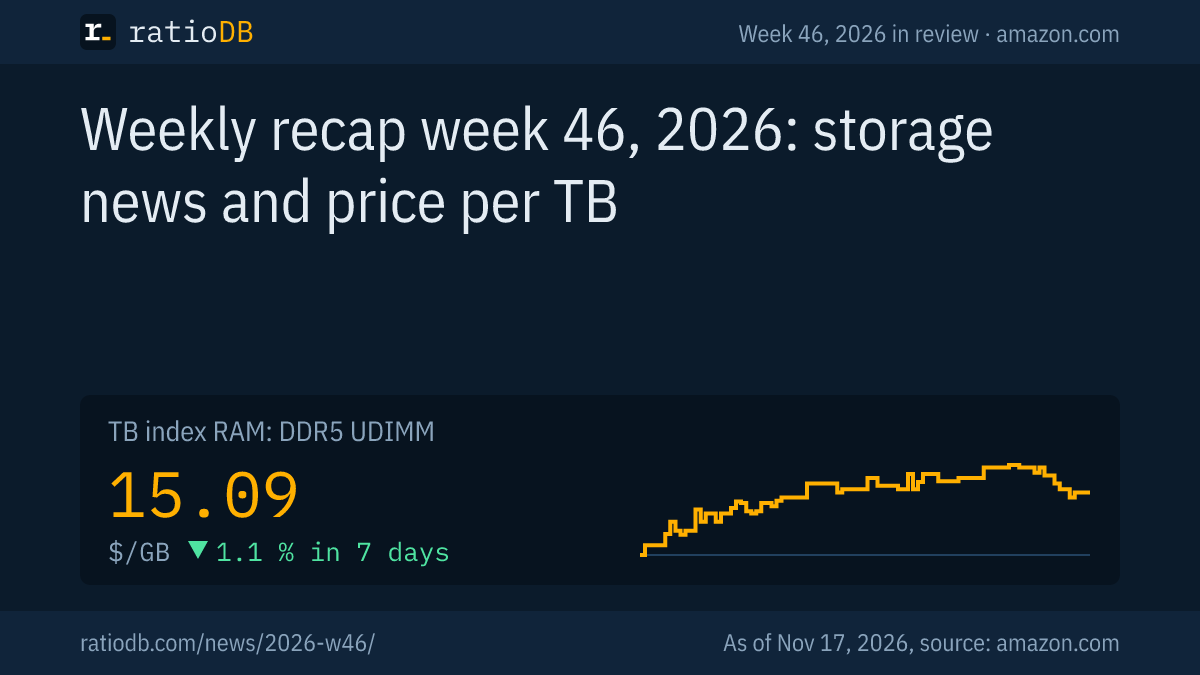
In calendar week 46 (November 9 to 15, 2026), 3 topics shaped the storage market: Sandisk reported $11.0 billion in revenue, TrendForce expects DRAM contract prices to rise more slowly, and makers look for ways to get by with less memory. On amazon.com, 2 of 6 indexes rose in 7 days, DDR5 desktop and M.2 NVMe SSDs the most at 0.5%. Over 30 days, all 6 were up, M.2 NVMe the most at 2.5% (as of Nov 16, 2026, 03:17 UTC).
As of November 16, 2026. ratioDB covers news on hard drives, SSDs and memory every day. This recap sums up the 18 stories of the week by topic and puts them next to the prices per TB and per GB from the ratioDB database.
What mattered in week 46?
Week 46 brought figures and forecasts on demand: Sandisk expects 12.2 to 12.6 billion dollars in revenue for the 2nd quarter, TrendForce sees PC makers slowing their memory purchases, and Kioxia and Dell showed 157 petabytes in 1 server rack. All 18 stories appeared on ratioDB between November 9 and November 15.
- Figures and forecasts: Sandisk reported revenue of 11.0 billion dollars for its 1st fiscal quarter of 2027, up 23% from the previous quarter. According to TrendForce, PC makers' inventories are full, and notebook shipments fell 15.8% from the previous quarter in the 3rd quarter of 2026. For PC DRAM, TrendForce expects contract prices of plus 13 to 18% in the 4th quarter, which is slower than before.
- Using less memory: According to Tom's Hardware, AMD presented the software MEXT, which moves rarely used data from DRAM to flash and, according to the company, can save 20 to 75% of DRAM. According to TrendForce, some smartphone makers use recycled memory, with the share set to rise from 3 to 4% to 7 to 9% in 2027.
- Makers' plans: According to ComputerBase, citing Nikkei, Terafab plans 1 million wafers per month from 2032, of which 700,000 are for memory, with first mass production in the 3rd quarter of 2028. According to StorageReview, HPE is using 32 TB hard drives in the Cray E2000 because of higher prices for large SSDs, with delivery in early 2027.
- Large drives and controllers: According to ComputerBase, Kioxia and Dell installed 640 SSDs of 245.76 TB each in 16 servers, around 157 petabytes in total. Silicon Motion is showing the PCIe 6.0 controller SM8466 with up to 28 GB/s at SC26. DapuStor introduced the server boot SSD J5101 with up to 1.92 TB, and QNAP the all-flash NAS ES2486AFdc with 24 NVMe bays.
- Products for buyers: Seagate showed the FireCuda Forge, an external hard drive with 8 or 20 TB from 699 dollars, into which buyers install an M.2 SSD themselves. Beelink and Bosgame offer mini PCs with up to 192 GB of soldered memory.
- Tests and fixes: Tom's Hardware measured peaks of 3.7 GB/s from the SSD in Gears of War: E-Day, about 2 GB of RAM saved with NVMe, and visual glitches on SATA. With the driver Adrenalin 26.11.1, AMD fixed continuous writes to the SSD on Radeon cards.
How did prices per TB move in week 46?
On amazon.com, 2 of 6 product types rose in the 7 days to November 16, DDR5 desktop and M.2 NVMe SSDs the most at 0.5%, while internal 3.5" hard drives fell 3.1%. Over 30 days, all 6 indexes are up, M.2 NVMe the most at 2.5% (as of Nov 16, 2026, 03:17 UTC, source: amazon.com).
The TB index is the median of the 10 cheapest new listings in a product type, converted to the price per TB or GB. The changes compare the same products over the period. Used and refurbished listings are not counted. How ratioDB calculates is explained in the methodology.
TB index by product type, as of Nov 16, 2026, 03:17 UTC, source: amazon.com:
| Product type | Now | 7 days | 30 days |
|---|---|---|---|
| Hard drive internal 3.5" | $36.21/TB | -3.1% | +2.0% |
| Hard drive external 3.5" | $42.50/TB | -0.3% | +0.1% |
| SSD M.2 NVMe | $133.99/TB | +0.5% | +2.5% |
| SSD 2.5" SATA | $123.25/TB | -2.2% | +1.2% |
| DDR5 desktop | $15.52/GB | +0.5% | +1.7% |
| DDR4 desktop | $6.30/GB | -0.6% | +0.3% |
The stories of the week do not name a cause for the moves of individual product types.
What do the week 46 news mean for buyers?
For buyers of memory and SSDs, the stories of week 46 point to prices that keep rising but more slowly: TrendForce cites contract prices of plus 13 to 18% for PC DRAM in the 4th quarter and less than 5% for client SSDs. On amazon.com, M.2 NVMe was 2.5% above its level of 30 days ago.
Contract prices apply between makers and large customers and reach retail with a delay. The guide why RAM prices are so high explains the background, and current offers are listed under DDR5 desktop and DDR4 desktop.
For SSDs, M.2 NVMe was 2.5% above its level of 30 days ago and 2.5" SATA 1.2%. The guide SSD prices shows how SSD prices have developed, and the guide best SSD offers a selection by price per TB.
For hard drives, internal 3.5" drives rose 2.0% in 30 days and external ones 0.1%, while internal drives fell 3.1% in the last 7 days. Prices per TB are listed under hard drives, with background in the guide hard drive prices.
Frequently asked questions about week 46
Will memory prices keep rising?
According to TrendForce, contract prices for PC DRAM rise 13 to 18% from the previous quarter in the 4th quarter of 2026, which is slower than before. For SSDs in client PCs, TrendForce expects less than 5%. These are estimates for contract prices and no promise for retail prices.
Why are makers turning to hard drives and less memory?
HPE names higher prices for large SSDs over the past 12 to 18 months as the reason for the 32 TB hard drives in the Cray E2000, StorageReview reports. With MEXT, AMD wants to save 20 to 75% of server DRAM by its own account, and Tom's Hardware advises skepticism toward these first-party numbers.
Did memory get more expensive in week 46?
Over 7 days, DDR5 desktop rose 0.5% to $15.52 per GB on amazon.com and DDR4 desktop fell 0.6% to $6.30 per GB. Over 30 days, both are up, DDR5 by 1.7% and DDR4 by 0.3% (as of Nov 16, 2026, 03:17 UTC, source: amazon.com). The stories of the week do not name a cause for these moves.
Sources
- TrendForce: PC makers and DRAM contract prices
- StorageNewsletter: Sandisk quarterly results, Silicon Motion at SC26
- Tom's Hardware: AMD MEXT, Recycled memory in smartphones, Gears of War: E-Day
- ComputerBase: Terafab, Kioxia and Dell
- StorageReview: HPE Cray E2000, DapuStor J5101, QNAP ES2486AFdc
- Blocks & Files: Seagate FireCuda Forge
- Notebookcheck: Beelink GTR9 Pro
- TechRadar: Bosgame M5 MAX
- PC Games Hardware: AMD Adrenalin 26.11.1
- ratioDB: amazon.com prices, methodology
All stories of this week
Test: Gears of War E-Day uses the SSD as a RAM extension, SATA falls short
Tom's Hardware measured how the game Gears of War: E-Day uses the SSD as an extension of system memory (RAM). Testing ran at 4K with DLSS Quality (AI upscaling) across all graphics presets, with SSD activity logged by HWInfo at a 20 millisecond polling period. At higher settings the game reads a little over 1 GB/s from the SSD continuously, according to the test, with peaks of 3.7 GB/s. Earlier games in Tom's Hardware testing averaged no more than 366 MB/s (Forspoken). With an NVMe SSD the game saves about 2 GB of system RAM in the measurements, regardless of SSD generation. On a SATA SSD, Tom's Hardware expects and observes visual issues, because its speed cannot keep up with the average read rate.
For buyers: According to this test, players short on RAM can offset part of the shortage in this game with an NVMe SSD. The result applies to 1 game and the systems tested.
TB index SSD M.2 NVMe 131.49 $/TB▲ 0.6 % since this story(as of Nov 17, 2026, 8:17 PM UTC, Source: amazon.com)
Source: Tom's Hardware
Silicon Motion shows PCIe 6.0 controllers for server SSDs beyond 512 TB at SC26
Silicon Motion, a designer of controllers (the control chips) for NAND flash storage, will present new server SSD controllers at the SC26 supercomputing show in Chicago from 16 to 19 November 2026. According to the company, the PCIe 6.0 SM8466 reaches up to 28 GB/s sequential and 7 million input and output operations per second and is meant to enable SSD capacities beyond 512 TB. The PCIe 5.0 SM8366 supports U.2, E1.S, E3.S and E1.L with TLC and QLC flash and up to 256 TB per SSD. The SM8388 targets large nearline SSDs that are meant to take over from hard drives in data centers.
For buyers: The controllers are meant for data centers and are not sold at retail. They show where server SSDs with very high capacities are heading.
Source: StorageNewsletter
Beelink GTR9 Pro: mini PC with up to 192 GB LPDDR5X and 4 TB SSD from $4,799
According to Notebookcheck, Beelink is bringing its revised GTR9 Pro mini PC to the international market. It uses the Ryzen AI Max+ 495 processor and 128 GB or 192 GB of LPDDR5X-8533, which is soldered and therefore not upgradeable. 2 M.2 2280 slots with PCIe 4.0 x4 take SSDs of up to 8 TB, and the system ships with 2 TB or 4 TB. Prices are $4,799 (128 GB, 2 TB), $7,399 (192 GB, 2 TB) and $7,799 (192 GB, 4 TB).
For buyers: The memory is soldered, so the capacity has to be right at purchase. The SSD can be swapped later, since the slots allow up to 8 TB.
TB index RAM 5.94 $/GB0.0 % since this story(as of Nov 17, 2026, 8:17 PM UTC, Source: amazon.com)
Source: Notebookcheck
AMD Adrenalin 26.11.1 ends constant SSD writes on Radeon RX 7000 and 9000
AMD released the optional Radeon driver Adrenalin 26.11.1 on 12 November 2026. According to its release notes it fixes 2 bugs in the AMD External Events Utility (a background service of the driver), including continuous writes to the system drive at idle. Users reported 0.3 to 5 MB/s for the atieclxx.exe process, and PC Games Hardware calculates roughly 432 GB per day at a constant 5 MB/s. AMD names mainly Radeon RX 7000 and RX 9000 as affected, and PC Games Hardware says it is unclear whether the fix will also come to RX 5000 and RX 6000. The write load can be checked in the Windows Resource Monitor.
For buyers: Owners of a Radeon RX 7000 or RX 9000 can install the update, according to the reports, before replacing an SSD because of the write load. PC Games Hardware points out that an unnecessary SSD swap would be expensive at current prices.
TB index SSD M.2 NVMe 131.49 $/TB0.0 % since this story(as of Nov 17, 2026, 8:17 PM UTC, Source: amazon.com)
Sources: PC Games Hardware, ComputerBase
HPE Cray E2000: supercomputer hybrid storage moves to 32TB SAS-4 hard drives
According to StorageReview, HPE has announced hybrid configurations of its Cray E2000 storage system that pair SSDs with new 32TB hard drives (SAS-4, a server interface) in enclosures holding 74 or 100 drives. The hybrid option previously topped out at 24TB per drive. HPE cites up to 32% more usable capacity per rack and up to 116GB/s read and 92GB/s write throughput per rack, based on roughly 10% flash and 90% hard drive capacity. HPE gives higher prices for high-capacity SSDs over the past 12 to 18 months as the reason. Shipping is planned for early 2027, HPE gave no prices, and StorageReview did not verify the competitor comparisons.
For buyers: The announcement suggests that large hard drives may regain appeal among data center storage buyers because of SSD prices, as HPE puts it. The product is not aimed at consumers.
TB index HDD Internal SAS 72.92 $/TB0.0 % since this story(as of Nov 17, 2026, 8:17 PM UTC, Source: amazon.com)
Source: StorageReview
Nvidia CMP 170HX: developer unlocks all 80GB of HBM2e through a hardware mod
According to ComputerBase, developer Kate published a hardware hack on 10 November 2026 that unlocks the full memory on the Nvidia CMP 170HX mining card. The 8GB variant carries 5 HBM2e memory stacks (fast stacked memory) totaling 80GB, of which only a tenth is usable from the factory. On 9 of 10 cards examined all 80GB worked, while one card managed only 64GB. The open-source tool cmpunlocker previously reached up to 64GB. In an FP16 test the modified card reached 85.9 TFLOPS, against 72.5 TFLOPS for a regular A100.
For buyers: ComputerBase stresses that the results do not apply to every CMP 170HX and that the test is a special OpenCL benchmark. The report describes a modification on individual cards and is not a recommendation.
TB index RAM 5.94 $/GB▼ 0.1 % since this story(as of Nov 17, 2026, 8:17 PM UTC, Source: amazon.com)
Source: ComputerBase
TrendForce: PC makers cut memory buying, DRAM contract prices up 13% to 18%
According to TrendForce, finished-goods inventories at PC makers and in North American distribution are rising because higher prices have dampened sales in Asia and Europe. Notebook shipments fell 15.8% quarter over quarter in Q3 2026, and a further single-digit decline is possible in Q4. Some manufacturers therefore plan to adjust memory purchasing for Q4 2026 and partly Q1 2027. TrendForce expects PC DRAM contract prices (prices between makers and large buyers) to rise 13% to 18% quarter over quarter in Q4 2026, slower than before. For client PC SSDs it expects an increase of less than 5%, because PC brands are sharply limiting SSD purchases.
For buyers: TrendForce describes a slower rise in contract prices but still expects increases. The report does not say how quickly this will show up in retail.
TB index RAM 5.94 $/GB▼ 0.6 % since this story(as of Nov 17, 2026, 8:17 PM UTC, Source: amazon.com)
Source: TrendForce
AMD MEXT: servers to keep 95% of performance with half the DRAM
According to Tom's Hardware, AMD has presented MEXT, software that moves rarely used memory pages from DRAM to flash storage and brings them back in time using an AI model. AMD and the MEXT founder cite possible savings of 20% to 75% of physical DRAM, depending on the workload. In an internal test with Synopsys PrimeTime, a server with 50% of its DRAM capacity reached 95% of the performance, and with 25% still 80%. AMD uses MEXT internally on 145 servers and plans to expand to 2,000 servers by 2027. There is also a partnership with HPE. The figures come from AMD itself, and Tom's Hardware advises skepticism toward first-party numbers.
For buyers: The technology targets Linux servers, not home PCs. According to the report, no date for the licenses has been set yet.
TB index RAM 5.94 $/GB▼ 0.6 % since this story(as of Nov 17, 2026, 8:17 PM UTC, Source: amazon.com)
Source: Tom's Hardware
Kioxia and Dell fit 157 petabytes of SSD storage into one server rack
According to ComputerBase, Kioxia and Dell installed 640 LC9-series SSDs with 245.76 TB of usable capacity each into 16 Dell PowerEdge R7725xd servers. Together they reach about 157 petabytes in a 42U server rack, a first in the industry according to the report. The LC9 uses QLC flash (4 bits per cell) of the BiCS8 generation in the E3.L format. For the same amount, roughly 6 times as many 44 TB hard drives would be needed, which take more space and power, ComputerBase says. Prices for these systems are not published.
For buyers: The product targets data centers. ComputerBase points out that the largest SSD available at retail, at 122.8 TB, currently costs over 86,000 euros.
TB index SSDs 111.25 $/TB▲ 0.1 % since this story(as of Nov 17, 2026, 8:17 PM UTC, Source: amazon.com)
Source: ComputerBase
Seagate FireCuda Forge: external hard drive with 8 or 20 TB and your own M.2 SSD as cache
Seagate has introduced the FireCuda Forge, an external hard drive with 8 TB or 20 TB that requires buyers to install their own M.2 2280 NVMe SSD. According to Blocks & Files, Seagate recommends 1 TB with a DRAM cache; the Alkemi software keeps frequently used files on the SSD and presents both as 1 drive. The report says the device does not use more than 1 TB of SSD capacity. The connection is USB 4 with up to 2,400 MB/s read and 2,000 MB/s write. Seagate says the Forge is available now, starting at $699 (8 TB) and $899 (20 TB), both without an SSD. Tom's Hardware sees the device as a response to high SSD prices.
For buyers: Anyone who wants to add an SSD pays for it on top of the device price. For comparison, Blocks & Files cites up to $700 for an external 20 TB hard drive and up to $330 for an 8 TB one.
TB index HDD External 3.5" 42.50 $/TB▼ 0.9 % since this story(as of Nov 17, 2026, 8:17 PM UTC, Source: amazon.com)
Sources: Blocks & Files, Tom's Hardware
Sandisk reports $11.0 billion revenue for fiscal first quarter 2027
Sandisk has reported results for its fiscal first quarter 2027. Revenue was $11.0 billion, up 23% from the previous quarter. GAAP (US accounting standard) net income was $8.1 billion. For the second quarter the company expects revenue of $12.2 billion to $12.6 billion. Sandisk also announced an 8-for-1 stock split that takes effect on November 19, 2026. CEO David Goeckeler names growing demand and outpaced growth in the data center business as the driver.
For buyers: The figures concern Sandisk as a company, not retail prices. The outlook shows the maker still expects strong demand.
TB index SSDs 111.25 $/TB▲ 0.3 % since this story(as of Nov 17, 2026, 8:17 PM UTC, Source: amazon.com)
DapuStor J5101: M.2 server boot SSD with up to 1.92 TB
According to StorageReview, DapuStor has introduced the J5101, an M.2 2280 NVMe SSD with PCIe Gen4 for booting servers. It comes in 480 GB, 960 GB and 1.92 TB, each with power loss protection and 1 DWPD (drive writes per day) endurance. DapuStor lists up to 3,800 MB/s sequential read and up to 650,000 IOPS (input/output operations per second) for 4K random reads. The maker rates it at 2 W idle and from 4.5 W active; StorageReview notes it did not verify these vendor figures. DapuStor has not published write performance or the NAND type. The drive is in volume production, according to DapuStor.
For buyers: The SSD targets data centers and is not meant for retail buyers. The report gives no price.
TB index SSD M.2 NVMe 131.49 $/TB▼ 0.2 % since this story(as of Nov 17, 2026, 8:17 PM UTC, Source: amazon.com)
Source: StorageReview
QNAP ES2486AFdc: all-flash storage with 24 NVMe bays and 2 controllers
According to StorageReview, QNAP has introduced the ES2486AFdc as the new flagship of its enterprise NAS (network attached storage) line. The 2U system has 24 bays for U.2/U.3 NVMe SSDs, each with a PCIe Gen4 x4 connection, and 2 controllers that work at the same time. If one fails, the other takes over all drives. QNAP rates it at more than 616,000 IOPS (input/output operations per second) for 4K random reads over iSCSI and up to 15 GB/s; StorageReview says QNAP has not published the test configuration behind these figures. Each controller ships with 64 GB of DDR4 ECC memory and can be expanded to 512 GB. QNAP says the system is available now and has not published a price.
For buyers: The system targets businesses. Shoppers buying SSDs at retail are not affected, but it shows that U.2/U.3 drives keep gaining importance in the server market. Without a manufacturer price there is nothing to compare with shop prices.
Source: StorageReview
Terafab plans 700,000 memory wafers a month by 2032
According to ComputerBase, citing the Japanese newspaper Nikkei, Terafab, the joint chip project of Tesla and SpaceX, has briefed equipment suppliers on its expansion plans. From 2032 it aims to produce 1 million wafers a month (the silicon discs chips are cut from), of which 700,000 are for memory and 300,000 for logic chips. ComputerBase puts Samsung's current monthly DRAM capacity at roughly 650,000 to 700,000 wafers. Mass production of usable chips is planned to start in the 3rd quarter of 2028. ComputerBase points out that investments of 16.8 billion US dollars have so far been planned for the Texas site and that it is unclear how the volume is to be reached.
For buyers: These are plans and not existing production. The report has no effect on shop prices for the foreseeable future, but it shows how large manufacturers expect memory demand to be in the coming years.
TB index RAM 5.94 $/GB▼ 0.5 % since this story(as of Nov 17, 2026, 8:17 PM UTC, Source: amazon.com)
Source: ComputerBase
TrendForce: recycled memory in smartphones set to grow sharply in 2027
According to a TrendForce report covered by Tom's Hardware, some smartphone makers are using recycled memory because of high DRAM prices. In reballing (melting the solder balls again), a used chip is removed from an old device and soldered onto a new board. The share is currently estimated at 3 to 4 percent and is expected to rise to 7 to 9 percent in 2027. It is mostly used 4 GB LPDDR4X chips in 4G smartphones priced below CNY 1,299 (about 200 dollars). TrendForce expects DRAM prices to keep rising in the 1st quarter of 2027.
For buyers: Buyers of cheap smartphones may increasingly meet used memory chips. WinFuture names varying quality and in some cases lower durability as a possible consequence.
TB index RAM 5.94 $/GB▼ 0.5 % since this story(as of Nov 17, 2026, 8:17 PM UTC, Source: amazon.com)
Sources: Tom's Hardware, WinFuture
Maxsun shows NAS motherboards with 5 M.2 slots and up to 128 GB of DDR5
According to Notebookcheck, Maxsun has detailed 2 NAS motherboards. The SK-PTLNAS (244 × 244 mm) takes up to 128 GB of DDR5-7200 through 2 SO-DIMM slots and offers 5 M.2 NVMe slots (2 at PCIe 5.0 x2, 1 at PCIe 4.0 x2, 2 at PCIe 4.0 x1) plus 3 Mini SAS ports (SFF-8643). The smaller SK-WCLAIO (90 × 165 mm) supports up to 48 GB of DDR5-6400 through 1 slot, has 4 M.2 slots and 1 TB of soldered UFS 3.1 storage. VideoCardz reportedly says both launch in November, and Notebookcheck notes Maxsun has not yet given pricing or international availability.
For buyers: Anyone building a NAS (network attached storage) can fit many SSDs with 4 to 5 NVMe slots. Without a price, the boards cannot yet be compared with ready-made NAS units.
TB index SSD M.2 NVMe 131.49 $/TB▼ 0.4 % since this story(as of Nov 17, 2026, 8:17 PM UTC, Source: amazon.com)
Source: Notebookcheck
Bosgame M5 MAX: mini PC with 192 GB LPDDR5 and a 2 TB SSD for $6,199
According to TechRadar, Bosgame has opened orders for its M5 MAX mini PC, priced at $6,199. It uses the Ryzen AI Max+ PRO 495 processor and 192 GB of LPDDR5 soldered to the motherboard. It also has a 2 TB SSD on PCIe 4.0 and a free M.2 2280 slot for a second PCIe 4.0 drive. TechRadar says Bosgame has not yet announced a shipping date.
For buyers: Soldered memory cannot be upgraded later, while the SSD can be expanded through the free M.2 slot. The price per GB of memory helps when comparing with other machines.
TB index RAM 5.94 $/GB▼ 0.2 % since this story(as of Nov 17, 2026, 8:17 PM UTC, Source: amazon.com)
Source: TechRadar