Intel Optane: What It Was, Why It Was Discontinued and What Fits Now
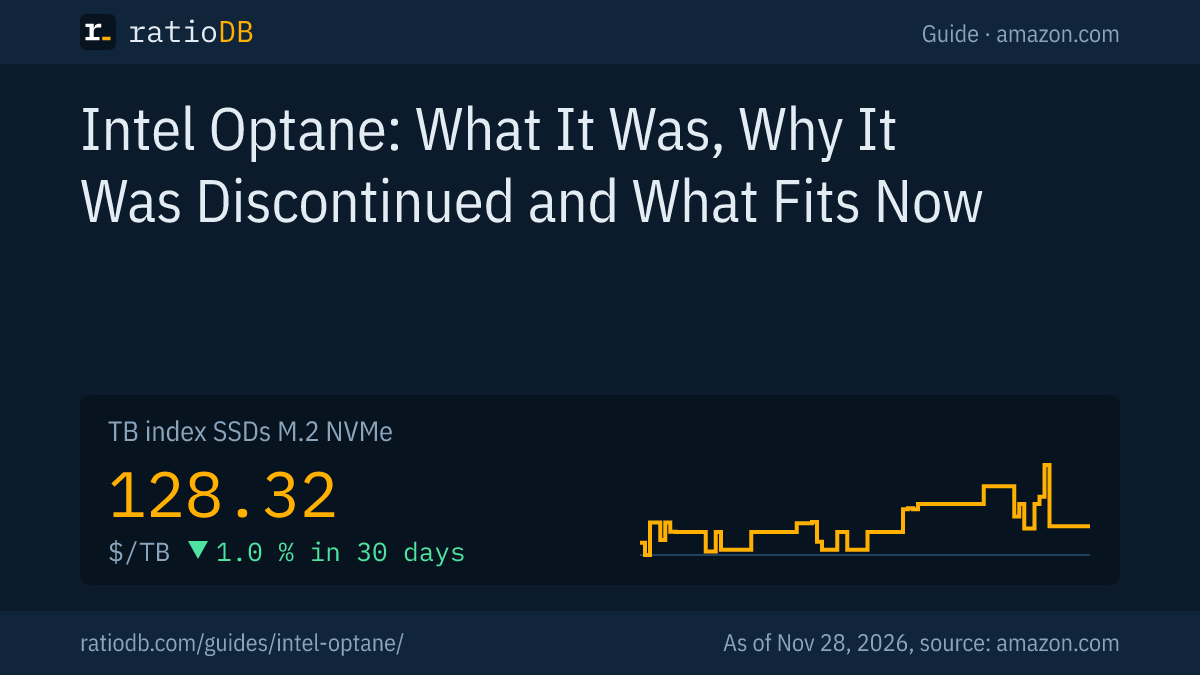
Intel Optane is the brand name for Intel's 3D XPoint memory technology, which Intel developed together with Micron. Intel began winding down its Optane business in the second quarter of 2022 and, according to Tom's Hardware, took a $559 million inventory write-off. For new purchases the only open question today is what replaces Optane. On amazon.com the TB index for M.2 NVMe SSDs currently stands at $128.32 per TB according to ratioDB (as of Nov 28, 2026 at 9:18 AM UTC).
Optane was a promise: memory faster than an SSD and more durable than flash. The market did not take it up. This guide explains what Optane was, why Intel gave up and what you use today for comparable jobs. ratioDB does not test SSDs, we compare prices and spec sheets.
What was Intel Optane?
Optane was Intel's brand name for products built on 3D XPoint. According to Tom's Hardware, Intel used it to build both storage and memory products. There were 3 product lines: Optane Memory (accelerator), Optane Persistent Memory (memory modules for servers) and Optane SSDs.
3D XPoint was introduced in 2015. According to Tom's Hardware, Intel and Micron touted it as 1000 times the performance and 1000 times the endurance of flash memory (NAND) and 10 times the density of DRAM. Those were manufacturer promises at launch. AnandTech describes the technology like this: it offers very high endurance on the order of millions of writes and very high random performance, because data does not have to be organized into large blocks.
How endurance is rated on ordinary SSDs is explained in the guide SSD TBW and DWPD.
Why did Intel discontinue Optane?
AnandTech names the cost: 3D XPoint was more expensive to make per bit than NAND, so the products cost much more than even high-performance SSDs. According to Tom's Hardware, Intel CEO Pat Gelsinger also pointed to the industry shift to CXL.
According to IT Brew, Optane memory modules offered slower performance than DRAM at a higher price and suited only extremely memory-intensive workloads. The storage products could not compete on price with fast NAND SSDs. AnandTech also cites reports of an oversupply of 3D XPoint chips amounting to roughly 2 years of inventory.
Micron, until then a high-volume maker of the chips, ended its work with Intel back in 2018 (TechCentral). According to Tom's Hardware, Intel had already stopped its Optane drives for client PCs and was selling its NAND business to SK hynix. In July 2022, Intel CEO Gelsinger confirmed the wind-down with the quarterly results. According to AnandTech, Intel intends to keep meeting existing customer commitments.
According to Tom's Hardware, Gelsinger named CXL (Compute Express Link, an interface for memory expansion) as an industry trend shifting the focus.
Is Optane still worth it today?
For new purchases the price speaks against it: 3D XPoint cost more per bit than NAND, and Intel has ended the business. Anyone who finds Optane on the used market buys a discontinued product without further development. A fast NVMe SSD works as a replacement.
What Optane was meant for can be solved with ordinary means: as an accelerator for slow storage, today an SSD cache serves, which the guide SSD cache explains. As a fast drive for servers and workstations, SSDs with the U.2 connector are an option, presented in the guide U.2 SSDs. The fastest class of M.2 SSDs uses PCIe 5.0, more in the guide PCIe 5.0 SSDs.
Used and refurbished Optane offers on amazon.com are labeled at ratioDB and never count toward the index.
Which NVMe SSDs cost the least per TB?
ratioDB does not list Optane as its own product type. Anyone solving the job without Optane compares NVMe SSDs by price per TB: the TB index on amazon.com stands at $128.32 per TB (as of Nov 28, 2026 at 9:18 AM UTC). The cheapest new NVMe SSD from known brands per TB is currently Crucial E100 2 TB with 2 TB for $247.96.
Cheapest NVMe SSD per size on amazon.com, as of Nov 28, 2026 at 9:18 AM UTC
| Capacity | Cheapest offer | Price | Price per TB |
|---|---|---|---|
| 500 GB | Patriot P320 512 GB | $79.99 | $156.23 |
| 1 TB | Adata Legend 710 1 TB | $147.99 | $147.99 |
| 2 TB | Crucial E100 2 TB | $247.96 | $123.98 |
Used and refurbished offers are not included in the table. The 3 cheapest new SSDs per TB:
All offers are under M.2 NVMe SSDs and U.2 SSDs, all types under SSDs.
How does ratioDB compare SSDs?
ratioDB regularly pulls the amazon.com prices of all listed SSDs and converts them to price per TB, with 1 TB equal to 10^12 bytes. The TB index is the median of the 10 cheapest new offers per product type.
ratioDB divides multipacks by capacity times piece count. Used and refurbished offers are labeled and never count toward the index. The statements about Optane come from the linked sources, ratioDB did not test Optane itself. All rules are on the Methodology page.
Frequently asked questions about Intel Optane
What is Intel Optane?
The brand name for Intel's products built on 3D XPoint, a memory technology Intel developed with Micron. There were accelerators, memory modules for servers and SSDs.
Was Intel Optane discontinued?
Yes. Intel began the wind-down in the second quarter of 2022 and, according to Tom's Hardware, took a $559 million inventory write-off. According to AnandTech, Intel intends to keep meeting existing customer commitments.
Why was Optane so expensive?
According to AnandTech, 3D XPoint was more expensive to make per bit than NAND. The products therefore cost more than even fast SSDs.
What replaces Intel Optane?
An SSD cache serves for acceleration, and an NVMe or U.2 SSD for fast drives. The tables above show which ones are cheap per TB.
Can you still buy Optane?
Intel has ended the business. Offers are therefore usually leftover stock or used. At ratioDB, used offers are labeled and never count toward the index.
What is CXL?
CXL (Compute Express Link) is an interface for expanding memory. According to Tom's Hardware, Intel CEO Pat Gelsinger named the shift to CXL-based architectures as a reason for winding down Optane.
Sources
- Tom's Hardware: Intel kills Optane memory business
- AnandTech: Intel to wind down Optane memory business
- TechCentral: Intel kills off Optane Memory business with $559m loss
- IT Brew: Intel finally shuts down its Optane business
- ratioDB: amazon.com prices, Methodology