Helium Hard Drives: How They Work and What They Offer
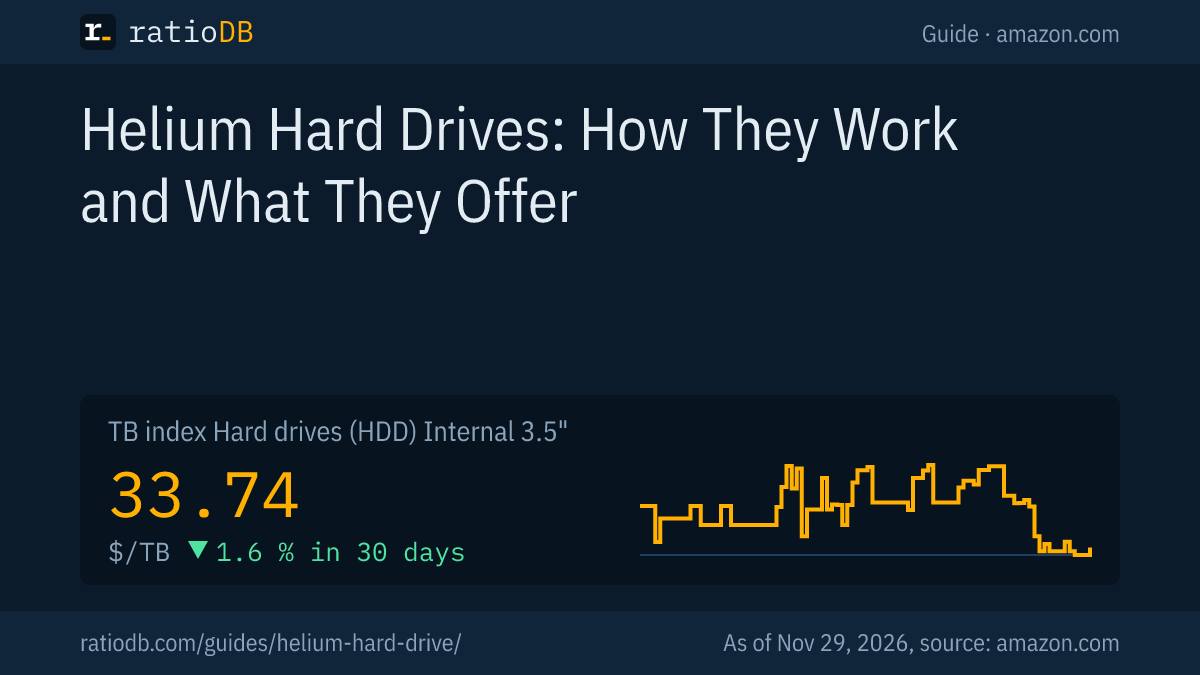
A helium hard drive is a hermetically sealed hard drive filled with helium instead of air. According to geology.com, helium has just one seventh the density of air. The platters spin with less turbulence, which saves power, heat, vibration and noise and allows 7 platters instead of 5 in a 3.5-inch housing. On amazon.com the TB index for internal 3.5-inch hard drives currently stands at $33.74 per TB according to ratioDB (as of Nov 29, 2026 at 9:17 PM UTC).
The technology comes from the data center, where power and space count. Western Digital and its subsidiary HGST brought it to mass production, and according to AMI, Seagate and Toshiba now build sealed helium drives too. This guide explains how it works, which figures the makers have named and what to look for when buying. ratioDB does not test hard drives, we compare prices and spec sheets.
How does a helium hard drive work?
The magnetic platters spin in a tightly sealed housing full of helium. Because helium is only one seventh as dense as air, it slows the spinning platters less, as StorageReview describes. The motor needs less force, and there is less vibration.
According to geology.com, Western Digital names less air turbulence as the consequence. That lowers power draw, heat, vibration and noise. It also lets 7 platters fit into a 1 inch high housing instead of 5. More platters mean more capacity in the same form factor.
The technology itself is old: according to Network Computing, Maxtor and Seagate were granted a patent on inert gas filled drives back in 1994. Sealing held it back for a long time. Western Digital itself writes that helium escapes from a balloon within days. Only when sealing worked for mass production did the drives reach the market. According to Face of IT, HGST and Western Digital weld the housing shut with a laser.
HGST announced the platform in September 2012. The first model was the Ultrastar He6 with 6 TB, whose shipments began in November 2013.
Which benefits do the makers name?
For the Ultrastar He6, Western Digital named 49% lower power per TB, and TechCentral cites 23% less power for the motor. For a prototype with 7 platters, HGST named 45% less power per TB and a temperature 4 degrees Celsius lower.
The figures differ because they measure different things and date from the early days of the technology. Scientific American cites the 49% per TB, TechCentral the 23% for the spindle motor, Network Computing the 45% and the 4 degrees from the prototype. ratioDB has no current measurement. For a purchase, the values on the drive's spec sheet count.
| Property | Makers' statement | Source |
|---|---|---|
| Density of helium | one seventh of air | geology.com, StorageReview |
| Platters in a 3.5-inch housing | 7 instead of 5 | geology.com, Engadget |
| Power per TB | 49% less (Ultrastar He6) | Scientific American |
| Motor power | 23% less | TechCentral |
| Temperature | 4 degrees Celsius lower (prototype) | Network Computing |
What speaks against helium hard drives?
According to geology.com, the drives are costly to manufacture. In the data center they win the extra cost back through energy savings and performance. Whether that also pays off for 1 drive in a home PC or NAS depends on price and use.
Another open question is tightness. Western Digital itself points out that helium escapes from balloons. According to AMI, the makers solved the problem for mass production. ratioDB has not measured how long a sealed drive lasts. Hard drive lifespan in general is explained in the guide Hard drive lifespan.
For everyday use the price per TB counts. Warranty, noise and power draw on the spec sheet matter too. The guide NAS hard drives compares the main lines for NAS and continuous operation, and the guide Largest hard drive shows the biggest drives.
How do you recognize a helium hard drive?
The manufacturer's spec sheet tells you. ratioDB does not record whether a hard drive is filled with helium and does not classify any drive as a helium drive. The spec sheet names the technology, the platter count and the power draw.
There is no rule of thumb by capacity. Read the product page and the spec sheet. The guide HAMR hard drives explains the latest technology for even larger capacities.
What do large hard drives cost per TB?
ratioDB compares internal 3.5-inch hard drives by price per TB: the TB index on amazon.com stands at $33.74 per TB (as of Nov 29, 2026 at 9:17 PM UTC). The cheapest new drive from known brands per TB is currently HGST Ultrastar He6 6 TB with 6 TB for $159.48.
The table shows large capacities. The spec sheet reveals which of the drives are filled with helium.
Cheapest internal 3.5-inch drive per size on amazon.com, as of Nov 29, 2026 at 9:17 PM UTC
| Capacity | Cheapest offer | Price | Price per TB |
|---|---|---|---|
| 12 TB | Toshiba MG Series 12 TB | $469.99 | $39.17 |
| 16 TB | Synology 16 TB | $692.94 | $43.31 |
| 18 TB | Seagate 18 TB | $714.00 | $39.67 |
Used and refurbished offers are not included in the table. The 3 cheapest new drives per TB:
All offers are under Internal 3.5-inch hard drives, all types under Hard drives.
How does ratioDB compare hard drives?
ratioDB regularly pulls the amazon.com prices of all listed hard drives and converts them to price per TB, with 1 TB equal to 10^12 bytes. The TB index is the median of the 10 cheapest new offers per product type.
ratioDB divides multipacks by capacity times piece count. Used and refurbished offers are labeled and never count toward the index. ratioDB does not test hard drives, the statements about helium technology come from the linked sources. All rules are on the Methodology page.
Frequently asked questions about helium hard drives
What is a helium hard drive?
A hermetically sealed hard drive filled with helium instead of air. According to geology.com, helium is one seventh as dense as air, so the platters spin with less turbulence.
What is the helium for?
It lowers the drag on the spinning platters. According to geology.com, that saves power and heat, reduces vibration and noise and allows more platters in the same housing.
How many platters does a helium hard drive hold?
Up to 7 in a 3.5-inch housing, where air-filled drives had 5 so far, according to Engadget. More platters mean more capacity.
Are helium hard drives quieter and cooler?
According to geology.com they produce less heat, vibration and noise. HGST named a temperature 4 degrees Celsius lower for a prototype. How quiet a particular drive is can be read on its spec sheet.
Does the helium escape over time?
Sealing was the big hurdle. Western Digital writes that helium escapes from balloons, and according to AMI the sealing was solved for mass production. ratioDB has not measured how long individual drives stay sealed.
Do I need a helium hard drive for a NAS?
The price per TB together with the spec sheet decides that. The gas fill alone says little. The guide NAS hard drives shows which lines are built for a NAS.
Sources
- geology.com: New uses of helium
- Scientific American: Western Digital enlists helium for 6TB energy-efficient drives
- AMI: Helium drives and their sealing
- TechCentral: Helium-filled WD drives promise major capacity boost
- StorageReview: HGST demonstrates 7-platter helium hard drive platform
- Network Computing: HGST fits seven platters into 3.5 inches
- Engadget: HGST develops helium-filled, high-capacity hard drives
- Face of IT: What is a helium hard drive
- ratioDB: amazon.com prices, Methodology