HAMR Hard Drives: How Lasers Push Hard Drives Past 30 TB
A HAMR hard drive (heat-assisted magnetic recording) uses a laser in the write head to heat a tiny spot on the platter for less than 1 nanosecond while it writes, which lets each platter hold more data. Seagate has sold HAMR drives in its Exos M and IronWolf Pro lines at 28 and 30 TB through the channel since July 2025, and Western Digital plans to ramp production in 2027. Toshiba is developing HAMR as well and relies on microwave-assisted MAMR until then.
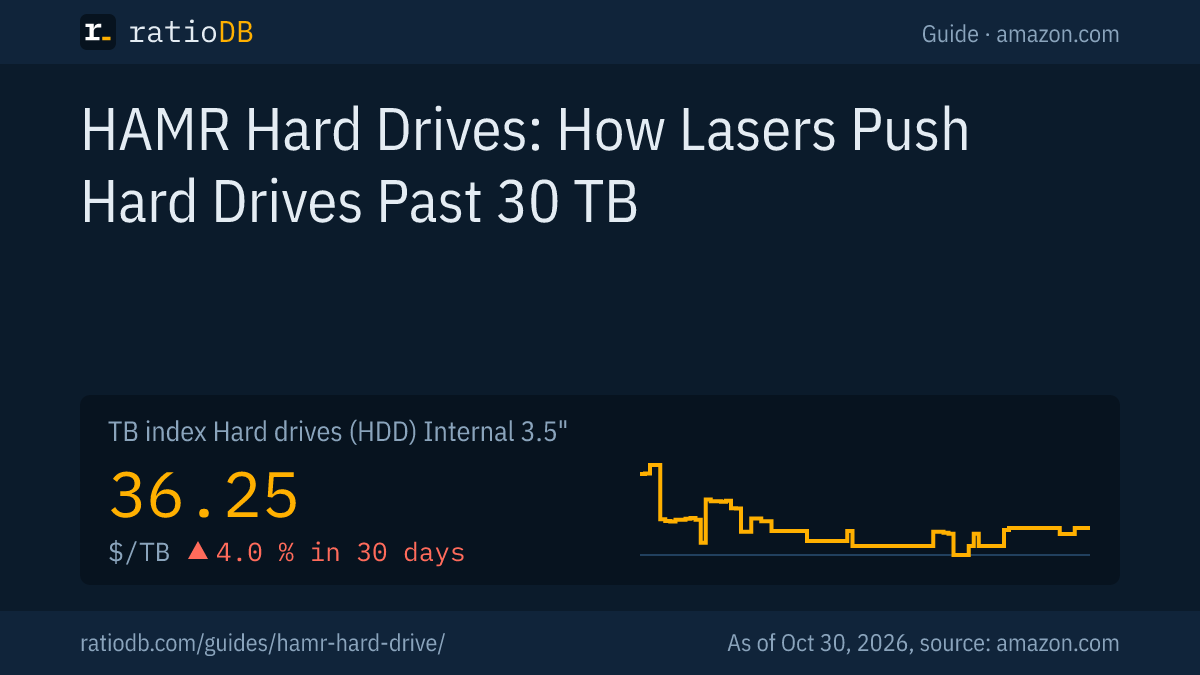
This guide explains how HAMR works, which models exist and when they make sense. On amazon.com, internal 3.5-inch hard drives cost $36.25 per TB according to the ratioDB TB index (as of Oct 30, 2026 at 3:17 PM UTC). ratioDB does not benchmark drives. We combine manufacturer data with live price per TB from our database.
What is a HAMR hard drive?
A HAMR hard drive is a hard drive whose write head carries a laser. The laser briefly heats the magnetic layer at the exact spot being written. Seagate calls its Mozaic 3+ platform the industry's first implementation of HAMR and reaches 3.6 TB per platter with it.
The problem HAMR solves: to fit more data on a platter, the magnetic grains have to shrink. Seagate's tech paper TP707 explains that small grains become thermally unstable unless the material becomes magnetically harder. A harder material, however, can no longer be written by a conventional head. HAMR heats the hard material for an instant, writes it while warm and lets it cool right away.
HAMR models such as the IronWolf Pro belong to Seagate's familiar 3.5-inch lines. What changes is inside: the write head and the platters. Seagate lists 10 platters for the 36 TB model, which works out to 3.6 TB per platter.
How does HAMR work?
HAMR uses a laser, an optical waveguide and a plasmonic near-field transducer (NFT) in the write head. The NFT focuses the light onto a tiny spot of iron-platinum media. According to Seagate, heating, writing and cooling together take less than 1 nanosecond.
Seagate describes the process in tech paper TP707:
- Laser: a laser is attached to a submount on the head, and a waveguide carries its light to the NFT.
- Near-field transducer: the NFT has a disk and a peg. The disk absorbs the light and converts it into a surface plasmon (an oscillation of electrons at the metal surface) that travels down the peg. The width of the peg sets the width of the hot spot on the media.
- Heat and write: the heat briefly lowers the coercivity, the resistance to being re-magnetized, and the head writes the bit.
- Cool down: the spot cools immediately and holds the bit.
The recording layer is high-anisotropy iron-platinum (FePt), a magnetically very hard material. Seagate redesigned the platter's overcoat to withstand heating to more than 400 °C. The drive also has to manage heat flow precisely: if heat spreads too slowly, Seagate notes it can erase adjacent data.
Which HAMR hard drives are available?
So far, HAMR drives you can buy come from Seagate: Exos M and IronWolf Pro at 28 and 30 TB have been available worldwide through resellers since July 2025. Seagate has been sampling Exos M drives up to 36 TB with select customers since January 2025. Western Digital and Toshiba have announced HAMR but have nothing on retail shelves yet.
HAMR drives and plans according to the manufacturers (read 10/26/2026)
| Maker | Model or plan | Capacity | Status per the maker |
|---|---|---|---|
| Seagate | Exos M | 28 and 30 TB | channel availability since 07/15/2025, MSRP $569.99 and $599.99 |
| Seagate | IronWolf Pro | 28 and 30 TB | channel availability since 07/15/2025, MSRP $569.99 and $599.99 |
| Seagate | Exos M | up to 36 TB | sampling with select customers since 01/21/2025 |
| Western Digital | HAMR drives | n/a | qualification with 2 hyperscale customers, ramp in 2027 |
| Toshiba | HAMR drives | 32 TB demonstrated | 28 to 30 TB test samples planned for 2025, mass production after validation |
The prices are launch MSRPs from Seagate's July 15, 2025 press release. The same release says Seagate had shipped more than 1 million Mozaic drives at that point. Exos M is the data center line, IronWolf Pro the NAS line. What else sets the Exos family apart is covered in Seagate Exos.
At our last price check, amazon.com had no new offer for a Seagate HAMR drive in the ratioDB database. The largest internal drives with an offer are in the price table below.
Is HAMR the same as CMR or SMR?
No. HAMR describes how a bit is written, while CMR and SMR describe how tracks are laid out on the platter. HAMR works with both: Toshiba reached 32 TB with HAMR plus SMR, and its planned 28 to 30 TB HAMR test samples use CMR.
CMR (conventional magnetic recording) places tracks side by side, while SMR (shingled magnetic recording) overlaps them like roof shingles. SMR adds capacity but writes more slowly when existing data is overwritten, and adding HAMR does not change that. Which layout suits your NAS or PC is covered in CMR vs SMR.
As a buyer, check the data sheet for CMR or SMR even when a drive uses HAMR. Toshiba's new M12 series shows what data center drives look like: its 30 to 34 TB SMR models are host-managed according to Toshiba, meaning the operating system or software controls writes into the overlapping tracks. Drives like that are not meant for regular PCs or NAS units.
What is the difference between HAMR, MAMR and ePMR?
HAMR heats the platter with a laser, MAMR (microwave-assisted magnetic recording) assists writing with microwaves, and ePMR (energy-assisted perpendicular magnetic recording) refines classic perpendicular recording. All 3 aim to put more terabytes on each platter.
Recording technologies of the 3 hard drive makers according to the manufacturers
| Technology | Maker | Status per the maker |
|---|---|---|
| HAMR | Seagate | in the channel up to 30 TB, samples up to 36 TB |
| HAMR | Western Digital | ramp in 2027, 100 TB targeted by 2029 |
| HAMR | Toshiba | 32 TB on 10 platters demonstrated, mass production after validation |
| MAMR and FC-MAMR | Toshiba | MAMR in mass production since 2021, M12 at 30 to 34 TB sampling since March 2026 |
| ePMR with UltraSMR | Western Digital | 40 TB in qualification, volume production planned for the second half of 2026 |
On May 14, 2024, Toshiba demonstrated both paths: 32 TB with HAMR on 10 platters and 31 TB with MAMR on 11 platters, both using SMR. Its partners are Resonac for media and TDK for heads. Until HAMR enters mass production, Toshiba says it will keep supplying high-capacity drives based on MAMR.
Western Digital's February 3, 2026 press release describes a common architecture for ePMR and HAMR. ePMR is set to scale to 60 TB using innovations from HAMR without increasing power consumption. These are the maker's targets, not shipping products.
How much do high-capacity hard drives cost per TB?
On amazon.com, internal 3.5-inch hard drives cost $36.25 per TB in the TB index (as of Oct 30, 2026 at 3:17 PM UTC). The largest internal drive with a new offer in the ratioDB database is 24 TB: WD Red Pro 24 TB at $1,899.99, or $79.17 per TB.
Cheapest new internal 3.5-inch drive per TB by capacity from 16 TB on amazon.com, as of Oct 30, 2026 at 3:17 PM UTC
| Capacity | Cheapest internal 3.5" drive per TB | Price | Price per TB |
|---|---|---|---|
| 16 TB | Synology Plus HAT3310 16 TB | $694.66 | $43.42 |
| 18 TB | Seagate Exos X18 18 TB | $712.00 | $39.56 |
| 24 TB | WD Red Pro 24 TB | $1,899.99 | $79.17 |
The cheapest drive per TB right now is HGST Ultrastar He6 6 TB at $23.08 per TB (6 TB). The cheapest drive at 24 TB or more, WD Red Pro 24 TB, costs $79.17 per TB, 243.0% more than that cheapest offer. If you are not short on drive bays, smaller sizes are cheaper per TB right now. The TB index moved +4.0% over 30 days.
Why hard drives have become more expensive since 2025, and how the switch to HAMR production plays into it, is covered in Hard drive prices. The hard drive price history shows the daily index.
What does HAMR promise for cost and power per TB?
In its January 21, 2025 press release, Seagate claims a 25% lower cost per TB and 60% lower power per TB for HAMR. According to the footnote, both figures compare an Exos X10 with 10 TB against a 30 TB Exos M, so they describe an upgrade from 10 to 30 TB.
That comparison matters. It pits an old 10 TB drive against a new 30 TB drive, so part of the gain comes simply from 1 drive taking over the capacity of 3 old ones. Against today's 24 TB drives without HAMR, the jump is smaller, and Seagate gives no figure for that comparison.
Seagate also claims 300% more capacity in the same data center footprint, again versus the Exos X10. IDC, quoted in Seagate's July 15, 2025 release, says enterprises want to reduce power consumption and square footage. IDC is also quoted in the January release saying that 89% of data stored in leading cloud service providers' data centers sits on hard drives.
In a home NAS the math is different. What counts there is purchase price per TB, noise and how long a RAID array takes to rebuild after a failure. How long rebuilds take with large drives is covered in Best NAS hard drive.
Are HAMR hard drives reliable?
Long-term field data for HAMR is still limited. Seagate reported more than 1 million Mozaic drives shipped by July 2025 and volume shipments to a leading cloud provider. ratioDB found no independent failure statistics for HAMR models during research.
In tech paper TP707, Seagate highlights the overcoat that survives more than 400 °C while keeping a reliable interface between media and head. Seagate also states that HAMR drives with reliability specifications were already in customers' hands for testing early on. These are manufacturer statements.
For comparison, Toshiba lists an MTTF of 2.5 million hours and an annualized failure rate (AFR) of 0.35% for its new MAMR-based M12 series, noting that MTTF is a statistical figure and not a guarantee of product life. What MTBF and AFR mean in practice and how long drives really last is covered in Hard drive lifespan.
Is a HAMR hard drive worth it at home?
A HAMR drive is worth it at home when you need a lot of capacity in very few bays, for example a NAS with 2 or 4 slots. Whether the big models cost more per TB than mid-size drives right now is shown in the price table above.
3 questions help:
- How many bays do you have? A 2-bay NAS with 2 × 30 TB in a mirror gives you 30 TB of usable space.
- What does 1 TB cost? Compare the price per TB of the big models with mid-size drives in the table above.
- How long can a rebuild take? The bigger the drive, the longer it takes to restore after a failure.
A desktop PC rarely needs 28 or 30 TB in 1 drive. For backups of large photo and video archives, an external 3.5-inch drive is often the simpler option, listed under external 3.5" hard drives. If you want HAMR in a NAS, the IronWolf Pro is the line Seagate markets for NAS systems.
When will 40 TB hard drives arrive?
According to the makers, 40 TB is getting close: Western Digital plans volume production of a 40 TB ePMR UltraSMR drive in the second half of 2026 and HAMR up to 100 TB by 2029. Seagate has shown more than 6 TB per platter in the lab and names a path to 10 TB per platter.
Everything in this section is a manufacturer plan or forecast:
- Seagate: more than 6 TB per disk in the lab, a pathway to 10 TB per platter (press release 01/21/2025).
- Western Digital: 40 TB ePMR in qualification, volume in the second half of 2026; HAMR ramp in 2027, scaling to 100 TB by 2029; ePMR to 60 TB (press release 02/03/2026).
- Toshiba: M12 SMR at 30 to 34 TB sampling since 03/31/2026, CMR samples up to 28 TB from Q3 2026; more capacity later through HAMR and 12 platters.
When such capacities show up on amazon.com depends on the makers. At Seagate, the largest models went to data centers first: up to 32 TB in volume to a leading cloud provider according to the January 21, 2025 release, then 28 and 30 TB to the channel from July 15, 2025. ratioDB adds new models to the list as soon as they are listed with a price.
How does ratioDB compare hard drives?
ratioDB checks amazon.com prices for all listed hard drives regularly and converts them to price per TB, with 1 TB equal to 1,000,000,000,000 bytes. The TB index is the median of the 10 cheapest new offers per drive type.
The tables in this guide only include offers sold under the manufacturer's name, labeled with the product line from the data sheet. We identify HAMR models by Seagate's lines: Exos M plus IronWolf Pro at 28 and 30 TB. Used and renewed offers appear with their condition in the list and never count toward the index. Technical details come from the linked sources, read on 10/26/2026. We do not run our own measurements. All rules are on the methodology page. The list is at internal 3.5" hard drives.
HAMR hard drive FAQ
What does HAMR stand for?
HAMR stands for heat-assisted magnetic recording. A laser in the write head briefly heats the platter where the bit is written. According to Seagate, heating, writing and cooling together take less than 1 nanosecond.
Which hard drives use HAMR?
So far the retail drives are Seagate Exos M and IronWolf Pro at 28 and 30 TB, available worldwide since July 2025 according to Seagate. Exos M up to 36 TB exists as samples. Western Digital plans HAMR from 2027.
What is Mozaic 3+?
Mozaic 3+ is Seagate's platform for HAMR drives. Seagate calls it the industry's first implementation of HAMR, at 3.6 TB per platter. Exos M and the 28 and 30 TB IronWolf Pro are built on it according to Seagate.
How many TB fit on one platter?
With HAMR, Seagate says it reaches 3.6 TB per platter, and the 36 TB model uses 10 platters. Seagate has shown more than 6 TB per disk in the lab and names 10 TB per platter as its long-term path.
Does the laser make the drive hot?
Only a tiny spot of the platter heats up, and only briefly. Seagate designed the overcoat for more than 400 °C. The process takes less than 1 nanosecond according to Seagate, and the spot cools right after.
Is HAMR better than CMR?
They are not alternatives. HAMR describes writing with heat, CMR describes the track layout. Toshiba plans HAMR test samples with CMR but has also shown HAMR with SMR. What matters for you is still whether a drive uses CMR or SMR.
How much does a large hard drive cost per TB right now?
On amazon.com the TB index for internal 3.5-inch drives is $36.25 per TB (as of Oct 30, 2026 at 3:17 PM UTC). The cheapest drive at 24 TB or more costs $79.17 per TB.
Sources
- Seagate: Exos M up to 36 TB on Mozaic 3+ (01/21/2025), 30 TB drives in the channel (07/15/2025), HAMR tech paper (TP707)
- Western Digital: ePMR and HAMR press release (02/03/2026)
- Toshiba: HAMR and MAMR beyond 30 TB (05/14/2024), M12 series at 30 to 34 TB (03/31/2026)
- ratioDB: amazon.com prices, Methodology