DDR6: Where the Standard Stands and When It Arrives
DDR6 is the planned successor to DDR5 memory. The standards body JEDEC states that DDR6 is in development in its JC-42 committee, and no final standard exists yet. According to industry reports, Samsung, SK hynix and Micron are working on it, and SK hynix places DDR6 in a 2029 to 2031 window.
This guide sums up what is officially known about DDR6, which timelines manufacturers and tech media mention, how LPDDR6 and CAMM2 fit in, and whether waiting for DDR6 is worth it. Every date comes with its source, because dates can shift until the standard is final. ratioDB does not test memory itself; we compare prices. Live DDR5 and DDR4 prices from amazon.com are further down (as of Oct 30, 2026 at 9:17 AM UTC).
What is DDR6?
DDR6 stands for Double Data Rate 6 and is the 6th generation of DDR memory for desktop PCs and servers. JEDEC is developing the standard in its JC-42 committee for solid state memories, alongside HBM5, the memory used on graphics and AI accelerators.
DDR generations replace each other every few years. The current standard, DDR5, is called JESD79-5 at JEDEC and was published in July 2020; the latest revision, JESD79-5D, came out in November 2025. What DDR5 changed compared with DDR4 is covered in the guide DDR5 vs DDR4.
One thing to keep apart: DDR6 for PCs and LPDDR6 for phones and laptops are 2 separate standards. LPDDR6 is already published, DDR6 is not.
Is there a DDR6 standard yet?
No. JEDEC's main memory page lists DDR6 as in development, and no published DDR6 standard appears there. According to a report by the Korean outlet TheElec, an early draft has existed since 2024, and the standard is not final yet.
The standards around DDR6 at a glance:
| Standard | Used for | Status per source |
|---|---|---|
| DDR5 (JESD79-5) | desktop PCs, laptops, servers | published July 2020, revision JESD79-5D in November 2025 (JEDEC) |
| DDR5 up to 8,800 MT/s (JESD79-5C) | faster DDR5 modules | published April 2024 (JEDEC) |
| LPDDR6 (JESD209-6) | phones, laptops, AI | published July 9, 2025 (JEDEC) |
| CAMM2 (JESD318) | module format for DDR5 and LPDDR5X | published December 5, 2023 (JEDEC) |
| DDR6 | desktop PCs and servers | in development in the JC-42 committee (JEDEC) |
With JESD79-5C, JEDEC expanded the DDR5 timing parameters from 6,800 to 8,800 MT/s (megatransfers per second). So DDR5 itself still has headroom. More on very fast DDR5 modules is in the guide CUDIMM.
When is DDR6 coming out?
There is no official date. At the SK AI Summit in Seoul in November 2025, SK hynix showed a roadmap that places DDR6 in a 2029 to 2031 window. TheElec reported in May 2026 that commercial use is expected around 2028.
The known timelines with their sources:
| Source | Claim | Published |
|---|---|---|
| SK hynix roadmap at the SK AI Summit (via TechSpot) | DDR6 in a 2029 to 2031 window | November 2025 |
| TheElec (via The FPS Review) | commercial use around 2028 | May 2026 |
| JEDEC | no date, standard in development | ongoing |
The claims differ, and none of them is a launch a manufacturer has announced. According to The FPS Review, Samsung, SK hynix and Micron are all working on DDR6. After a new standard is final, it usually takes extra time before matching processors and motherboards ship.
How fast will DDR6 be?
According to TheElec's report, DDR6 is expected to start at around 8,800 MT/s and reach up to 17,600 MT/s. That is a report about a draft; JEDEC has not published any data rates yet. For comparison, the DDR5 standard goes up to 8,800 MT/s with JESD79-5C.
How the numbers compare:
| Memory | Data rate | Source |
|---|---|---|
| DDR5 | up to 8,800 MT/s | JEDEC JESD79-5C |
| LPDDR6 | 10,667 to 14,400 MT/s | Tom's Hardware on the JEDEC standard |
| DDR6 (draft) | around 8,800 to 17,600 MT/s | TheElec via The FPS Review |
Higher data rates usually come with new timings. How speed and latency relate on DDR5 is explained in the guide DDR5 timings.
What is the difference between DDR6 and LPDDR6?
LPDDR6 (Low Power DDR6) is the power-saving memory for phones, laptops and AI devices, and it is soldered directly onto the board. JEDEC published the JESD209-6 standard on July 9, 2025. DDR6 for desktop PCs and servers with removable modules is still in development.
What JEDEC lists for LPDDR6:
- Layout: 2 sub-channels per die, each with 12 data lines and 4 command and address lines.
- Access: data moves in 32-byte blocks.
- Power saving: a lower VDD2 voltage, DVFSL (voltage and frequency scaling at low load) and a Dynamic Efficiency mode.
Tom's Hardware gives LPDDR6 data rates of 10,667 to 14,400 MT/s. For you as a PC buyer, that means you will see LPDDR6 first in new devices with soldered memory. For upgrading a laptop today, there is DDR5 SO-DIMM; see the guide laptop RAM.
What role does CAMM2 play for DDR6?
CAMM2 (Compression Attached Memory Module 2) is a flat module format that JEDEC published on December 5, 2023 as the JESD318 standard. It exists for DDR5 and LPDDR5X and targets fast laptops and desktop PCs. According to TheElec, CAMM2 is also being discussed as a module format for DDR6.
JEDEC describes CAMM2 as a shared connector design with different pinouts for DDR5 and LPDDR5X. According to JEDEC, DDR5 CAMM2 targets performance laptops and mainstream desktops. Whether DDR6 for PCs arrives as a classic DIMM, as CAMM2 or in both forms stays open until the standard is final.
Will DDR6 fit my DDR5 motherboard?
There is no official information yet, because the standard is not final. So far, every new DDR generation has needed its own slots and motherboards; DDR5 does not fit DDR4 slots either. For DDR6, you will very likely need a new motherboard and a matching processor.
If you build or upgrade a PC today, you buy DDR5 for a current platform. What to look for is covered in the guide buying DDR5 RAM, and how to turn on the memory profile in the guide how to enable XMP.
Is it worth waiting for DDR6?
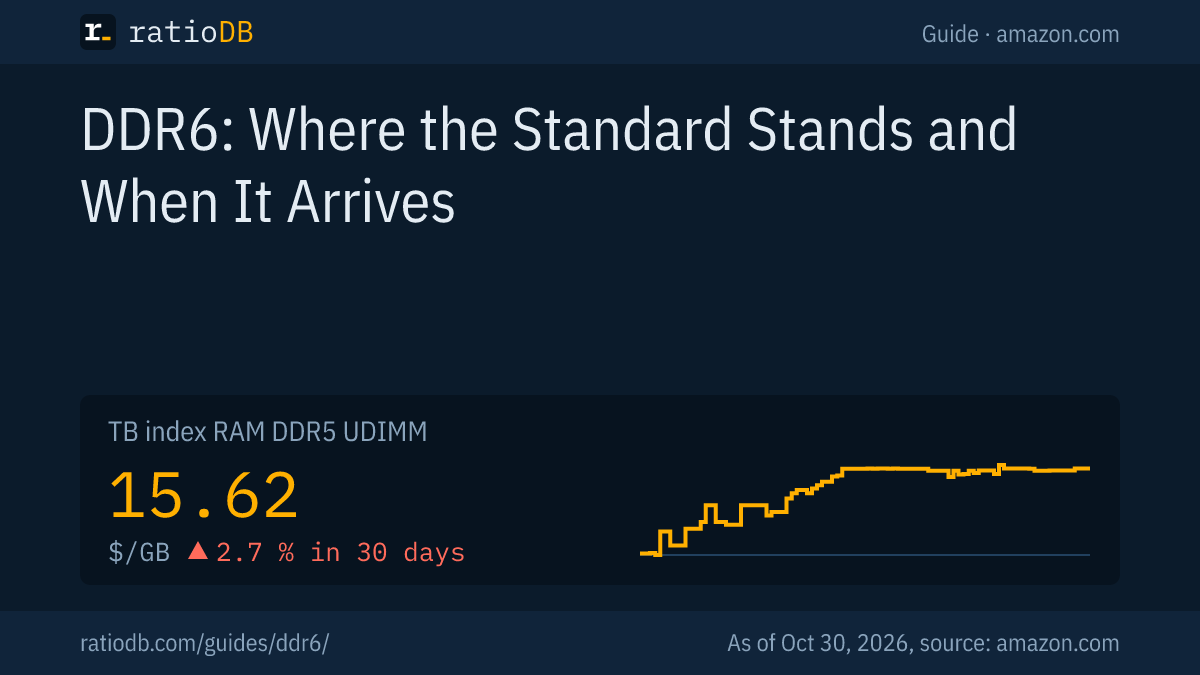
For a PC you need now, probably not: based on the timelines above, DDR6 arrives around 2028 at the earliest, and you will very likely need a new platform for it. DDR5 desktop RAM on amazon.com currently sits at an index of $15.62 per GB (as of Oct 30, 2026 at 9:17 AM UTC).
Prices are moving noticeably, though. The DDR5 desktop index changed by ▲ 12.7 % over 90 days, and the 90-day low was $13.61 per GB. So prices have gone up. If you have to buy soon anyway, a price alert helps you catch a dip. The guide RAM prices tracks how prices develop.
Memory index per GB on amazon.com, as of Oct 30, 2026 at 9:17 AM UTC
| Memory | Index per GB | 30 days | 90 days | 90-day low |
|---|---|---|---|---|
| DDR5 desktop | $15.62 | ▲ 2.6 % | ▲ 12.7 % | $13.61 |
| DDR5 SO-DIMM (laptop) | $16.37 | ▲ 3.5 % | ▲ 20.2 % | $13.70 |
| DDR4 desktop | $6.39 | ▲ 3.1 % | ▲ 9.1 % | $5.91 |
| DDR4 SO-DIMM (laptop) | $6.05 | ▲ 3.8 % | ▲ 4.0 % | $5.91 |
Cheapest DDR5 kits on amazon.com by size, as of Oct 30, 2026 at 9:17 AM UTC
| Capacity | Cheapest DDR5 kit | Modules | Speed per title | Price | Price per GB |
|---|---|---|---|---|---|
| 16 GB | A-Tech PC/Computer Upgrade 16 GB | 1 × 16 GB | 4,800 MT/s | $249.99 | $15.62 |
| 32 GB | Crucial Pro 2 × 16 GB | 2 × 16 GB | 6,000 MT/s | $459.99 | $14.37 |
| 64 GB | Crucial Pro 2 × 32 GB | 2 × 32 GB | 6,400 MT/s | $999.99 | $15.62 |
We read speed and size from the listing titles. For a typical gaming PC with 32 GB, the cheapest kit right now is Crucial Pro 2 × 16 GB (2 × 16 GB) for $459.99. All kits are listed under DDR5 desktop RAM, kits with 32 GB under DDR5 32 GB, laptop modules under DDR5 SO-DIMM and older modules under DDR4 RAM. How much you need is covered in the guide how much RAM do I need?.
How does ratioDB compare memory?
ratioDB pulls the amazon.com prices of all listed modules regularly and converts them to price per GB. A kit of 2 modules counts with its total capacity. The index is the median of the 10 cheapest new offers in a list, and the change compares it with the value 30 and 90 days earlier.
Speed and size come from the listing titles. Used offers are labeled and never count toward the index. ratioDB lists no DDR6 modules yet because none are for sale. ratioDB does not test memory itself. All rules are on the methodology page, all lists under RAM prices per GB.
DDR6 FAQ
Can I buy DDR6 yet?
No. JEDEC lists DDR6 as in development, and no final standard has been published. For PCs, DDR5 is what you can buy today; for phones and laptops with soldered memory, LPDDR6 already has a final standard.
When will DDR6 be released?
There is no official date. SK hynix places DDR6 in a 2029 to 2031 window on its roadmap from November 2025. TheElec reported in May 2026 that commercial use is expected around 2028.
How fast will DDR6 be?
According to TheElec, DDR6 is expected to start at around 8,800 MT/s and reach up to 17,600 MT/s. JEDEC has not published any figures yet. DDR5 goes up to 8,800 MT/s in the JESD79-5C standard.
Is LPDDR6 the same as DDR6?
No. LPDDR6 is the power-saving memory for phones, laptops and AI devices; JEDEC published it as JESD209-6 on July 9, 2025. DDR6 for desktop PCs and servers is a separate standard that is still in development.
Do I need a new motherboard for DDR6?
There is no official information yet. So far, every DDR generation has needed its own slots; DDR5 does not fit DDR4 motherboards, for example. Plan on a new motherboard and a matching processor.
Should I buy DDR5 now or wait for DDR6?
If you need a PC now, DDR5 is the current choice, because DDR6 arrives around 2028 at the earliest based on known timelines. DDR5 prices fluctuate; current values and the 90-day trend are in the table above.
Will DDR6 use CAMM2?
That is open. According to TheElec, CAMM2 is being discussed as a module format for DDR6. The CAMM2 standard JESD318 has existed since December 2023 for DDR5 and LPDDR5X.
Sources
- JEDEC: Main memory standards, with DDR6 in development
- JEDEC via Business Wire: JESD79-5C expands DDR5 to 8,800 MT/s, April 17, 2024
- JEDEC via Business Wire: LPDDR6 standard JESD209-6 released, July 9, 2025
- JEDEC: CAMM2 standard JESD318, December 5, 2023
- Tom's Hardware: JEDEC publishes first LPDDR6 standard, July 10, 2025
- The FPS Review: TheElec report on DDR6, May 5, 2026
- TweakTown: DDR6 development at Samsung, SK hynix and Micron
- Guru3D: DDR6 could reach 17,600 MT/s
- TechSpot: SK hynix expects DDR6 after 2029
- ratioDB: amazon.com prices, methodology