QLC vs TLC: Which SSD Flash Type Should You Buy?
TLC flash stores 3 bits per memory cell, QLC flash stores 4. QLC packs more capacity into each chip, but it writes more slowly once the fast cache is full and is often rated for less total writing. Samsung quotes 80 to 160 MB/s after the cache for its QLC 870 QVO, versus 530 MB/s for its TLC 870 EVO. For games, office work and media libraries QLC is usually fine; for heavy, sustained writing TLC is the safe pick.
This guide explains QLC vs TLC using manufacturers' own specs and shows what SSD lines with a documented cell type cost per TB on amazon.com right now (as of Oct 29, 2026 at 1:17 AM UTC). ratioDB does not benchmark SSDs. We only include lines whose data sheet states the cell type, because many brands leave it out or change it between batches.
What is the difference between QLC and TLC?
TLC (triple-level cell) stores 3 bits per cell and must distinguish 8 voltage levels. QLC (quad-level cell) stores 4 bits and needs 16 levels. That fits about a third more data into the same number of cells. The trade-off: lower write speed after the cache and usually lower TBW.
The number of levels is 2 to the power of the bit count: 2 to the power of 3 is 8, 2 to the power of 4 is 16. Samsung's own data sheets call the 870 EVO flash "3bit MLC" and the 870 QVO flash "4bit MLC", which means TLC and QLC.
| Cell type | Bits per cell | Voltage levels | Data vs SLC |
|---|---|---|---|
| SLC (single-level cell) | 1 | 2 | baseline |
| MLC (multi-level cell) | 2 | 4 | twice as much |
| TLC (triple-level cell) | 3 | 8 | 3 times as much |
| QLC (quad-level cell) | 4 | 16 | 4 times as much |
How many write cycles each cell type tolerates and what that means for lifespan is covered in our guide to SSD lifespan. This page focuses on the buying decision between QLC and TLC.
Is QLC slower than TLC?
For reads and short writes, barely: on Samsung's drives both cell types first write into a fast area called Intelligent TurboWrite. Once it is full, QLC drops sharply. Samsung quotes 80 MB/s for the 1 TB 870 QVO and 160 MB/s from 2 TB, versus 530 MB/s for the TLC 870 EVO from 1 TB.
The 2 Samsung SSDs make a rare like-for-like comparison: same form factor, same SATA interface, same MKX controller and the same peak figures of 560 MB/s read and 530 MB/s write. The difference is the flash.
Samsung 870 EVO (TLC) vs 870 QVO (QLC) per data sheet
| Feature | 870 EVO (TLC) | 870 QVO (QLC) |
|---|---|---|
| Cell type per Samsung | V-NAND 3bit MLC | V-NAND 4bit MLC |
| Capacities | 250 GB to 4 TB | 1 to 8 TB |
| Read and write | up to 560 and 530 MB/s | up to 560 and 530 MB/s |
| Write after cache is full | 300 MB/s (250 and 500 GB), 530 MB/s (1 to 4 TB) | 80 MB/s (1 TB), 160 MB/s (2 to 8 TB) |
| TBW at 1 TB | 600 TB | 360 TB |
| TBW at 4 TB | 2,400 TB | 1,440 TB |
| Warranty | 5 years | 3 years |
| MTBF | 1.5 million hours | 1.5 million hours |
Sources: 870 EVO data sheet, 870 QVO data sheet. Samsung measures peak figures with Intelligent TurboWrite active.
In everyday terms: installing a game or copying a few photos feels the same on QLC. Copy 200 GB of video in one go to a 1 TB QVO, though, and Samsung's figure drops to 80 MB/s, slower than many hard drives. The EVO stays at 530 MB/s from 1 TB up.
Can a QLC SSD be slower than a hard drive?
After the cache fills, small QLC drives can be. Samsung rates the 1 TB 870 QVO at 80 MB/s at that point. A NAS hard drive such as the 24 TB Seagate IronWolf Pro is rated up to 285 MB/s, an 8 TB WD Red Plus up to 215 MB/s. For random reads, every SSD stays far ahead.
| Drive | Sustained write per maker | Source |
|---|---|---|
| Samsung 870 QVO 1 TB (QLC) after cache | 80 MB/s | Samsung |
| Samsung 870 QVO 2 to 8 TB (QLC) after cache | 160 MB/s | Samsung |
| WD Red Plus 8 TB (WD80EFPX), hard drive | up to 215 MB/s | Western Digital |
| Seagate IronWolf Pro 24 TB, hard drive | up to 285 MB/s | Seagate |
| Samsung 870 EVO 1 to 4 TB (TLC) after cache | 530 MB/s | Samsung |
Values from the Samsung 870 QVO and 870 EVO, WD Red Plus and IronWolf Pro data sheets. Seagate specifies its hard drive figure at the outer diameter (OD) of the platters, Western Digital gives a maximum.
This only matters if you write very large amounts of data in one go. For launching programs, loading games and handling many small files, even a QLC SSD is far ahead of a hard drive because it has no heads to move.
What is an SLC cache?
An SLC cache is part of the flash that temporarily stores only 1 bit per cell, which makes it fast to write. New data lands there first and is later rewritten into TLC or QLC cells. Samsung calls this Intelligent TurboWrite, SanDisk calls it nCache 4.0.
Many makers do not disclose the cache size. StorageReview describes nCache 4.0 in the WD Blue SN5100 as a pseudo-SLC cache that data is written to before it moves to the main QLC flash (StorageReview). Tom's Hardware found a pseudo-SLC cache of about 400 GB on the 2 TB Crucial P310 (Tom's Hardware, 07/17/2024).
The cache costs space: Tom's Hardware points out that 400 GB of pSLC cache occupies 1,600 GB of regular flash on the P310, because each cell in the cache holds 1 bit instead of 4. Samsung's data sheet also shows a size effect: the 1 TB 870 QVO writes only half as fast after the cache as the 2 TB and larger models.
Do QLC SSDs wear out faster than TLC?
Usually, but not always. Samsung rates the QLC 870 QVO for 360 TB written per TB of capacity and the TLC 870 EVO for 600 TB. SanDisk, on the other hand, rates the 1 TB WD Blue SN5100 with QLC for 600 TBW, the same as Samsung's 1 TB TLC drives.
TBW (terabytes written) is the amount of data the maker allows you to write within the warranty; coverage ends at the stated time or the TBW, whichever comes first. Samsung says its endurance figures comply with JEDEC's JESD218 standard. JEDEC is a standards body for the microelectronics industry, and JESD218 sets operating conditions and endurance verification requirements for SSDs (JEDEC).
TBW per TB of capacity per data sheet
| SSD | Cell type | TBW by size | TBW per TB | Warranty |
|---|---|---|---|---|
| Samsung 870 QVO | QLC | 360 TB (1 TB) to 2,880 TB (8 TB) | 360 TB | 3 years |
| WD Blue SN5100 | QLC | 300 TB (500 GB) to 1,200 TB (4 TB) | 300 to 600 TB | 5 years |
| Samsung 870 EVO | TLC | 150 TB (250 GB) to 2,400 TB (4 TB) | 600 TB | 5 years |
| Samsung 990 EVO Plus | TLC | 600 TB (1 TB) to 2,400 TB (4 TB) | 600 TB | 5 years |
| Samsung 990 PRO | TLC | 600 TB (1 TB) and 1,200 TB (2 TB) | 600 TB | 5 years |
| Samsung 9100 PRO | TLC | 600 TB (1 TB) to 4,800 TB (8 TB) | 600 TB | 5 years |
Sources: Samsung data sheets for the 870 QVO, 870 EVO, 990 EVO Plus, 990 PRO, 9100 PRO, plus SanDisk's WD Blue SN5100 specs (data sheet 08/2025, also listed by StorageReview).
On the SN5100, TBW per TB falls as capacity grows: 600 TB at 1 TB, 450 TB at 2 TB and 300 TB at 4 TB. For most people, every value here lasts many years. Writing 50 GB a day adds up to about 18 TB a year, so 360 TBW would take roughly 20 years.
How much do QLC and TLC SSDs cost per TB right now?
The cheapest SSD with QLC per data sheet costs $167.99 per TB on amazon.com right now (WD Blue SN5100 1 TB), the cheapest with TLC $200.00 per TB (Samsung 990 PRO 2 TB).
SSD lines with cell type per data sheet, cheapest new offer on amazon.com, as of Oct 29, 2026 at 1:17 AM UTC
| Line | Cell type per data sheet | Interface | TBW per TB | Warranty | Cheapest offer | Price per TB |
|---|---|---|---|---|---|---|
| Samsung 870 QVO | QLC | SATA | 360 TB | 3 years | Samsung 870 QVO 8 TB: $1,459.99 | $182.50 |
| WD Blue SN5100 | QLC | PCIe 4.0 | 600 TB | 5 years | WD Blue SN5100 1 TB: $167.99 | $167.99 |
| Samsung 870 EVO | TLC | SATA | 600 TB | 5 years | Samsung 870 EVO 4 TB: $1,249.90 | $312.48 |
| Samsung 990 PRO | TLC | PCIe 4.0 | 600 TB | 5 years | Samsung 990 PRO 2 TB: $399.99 | $200.00 |
| Samsung 9100 PRO | TLC | PCIe 5.0 | 600 TB | 5 years | Samsung 9100 PRO 2 TB: $409.00 | $204.50 |
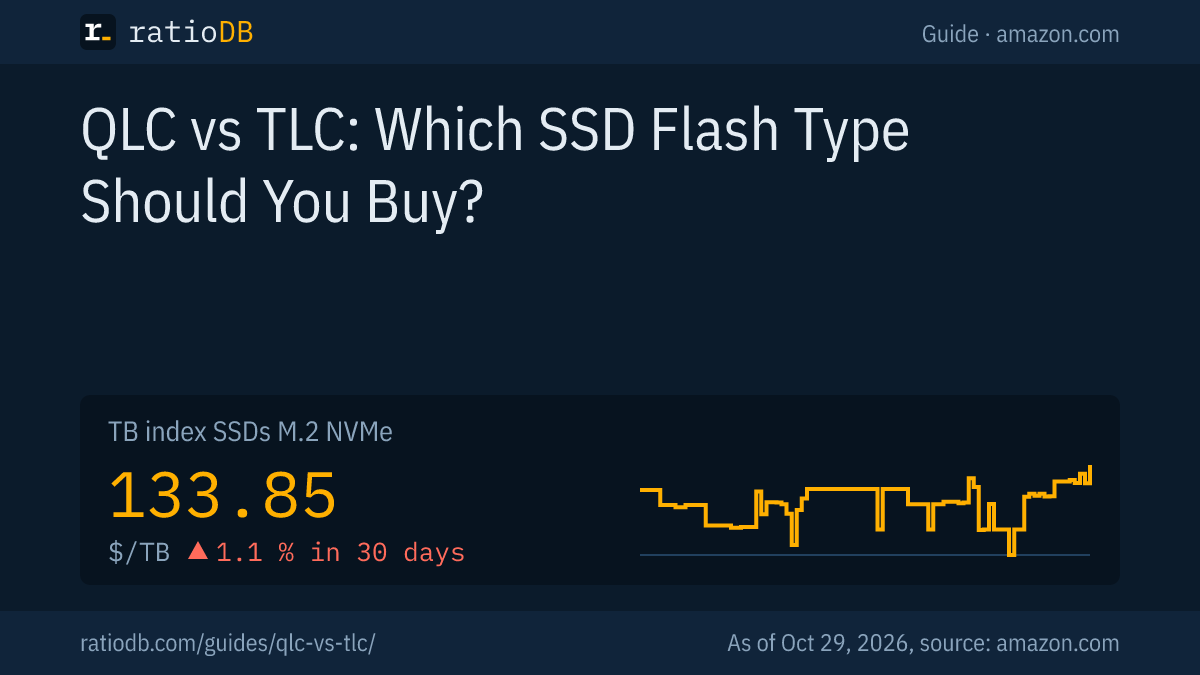
We only list lines whose data sheet names the cell type. A missing line had no new offer on amazon.com in our latest fetch. The cheapest offer may be any capacity, so per TB values mix sizes. For comparison, the TB index for all M.2 NVMe SSDs is $133.85 per TB, and for 2.5-inch SATA SSDs $122.93 per TB. Many budget SSDs do not state their cell type at all, so their data sheets cannot settle whether they use QLC or TLC.
The direct Samsung comparison: the 870 QVO costs $182.50 per TB right now (Samsung 870 QVO 8 TB), the 870 EVO $312.48 per TB (Samsung 870 EVO 4 TB). Here QLC is 41.6% cheaper per TB. Long-term SSD prices are on our SSD price history page, and the wider trend is in our guide to SSD prices.
Are there QLC NVMe SSDs?
Yes. The WD Blue SN5100 uses QLC according to SanDisk and reads at up to 7,100 MB/s over PCIe 4.0. The Crucial P310 also uses Micron QLC according to Tom's Hardware. On peak figures, these drives sit close to TLC models like the Samsung 990 EVO Plus.
| SSD | Cell type | Read per maker | Write per maker | TBW at 2 TB |
|---|---|---|---|---|
| WD Blue SN5100 2 TB | QLC per SanDisk | up to 7,100 MB/s | up to 6,700 MB/s | 900 TB |
| Crucial P310 2 TB | QLC per Tom's Hardware | n/a | n/a | 440 TB per Tom's Hardware |
| Samsung 990 EVO Plus 2 TB | TLC per Samsung | up to 7,250 MB/s | up to 6,300 MB/s | 1,200 TB |
| Samsung 990 PRO 2 TB | TLC per Samsung | up to 7,450 MB/s | up to 6,900 MB/s | 1,200 TB |
We have no data sheet stating the cell type for the Crucial P310, so its values come from Tom's Hardware's review and not from the maker. It is left out of the price table above for the same reason. Peak figures apply while the fast cache has room.
How can you tell if an SSD uses QLC or TLC?
The manufacturer's data sheet is the most reliable source. Samsung states the cell type explicitly, and so does SanDisk for the WD Blue SN5100. Many other brands only say "3D NAND" without a bit count. Warranty, TBW and post-cache write speed can give hints.
- Read the data sheet: Look for QLC, TLC, "3bit" or "4bit". If it only says "3D NAND", the cell type is unknown.
- Compare warranty and TBW: A 3-year warranty and low TBW per TB hint at QLC, as with the 870 QVO. It is not proof: the SN5100 has QLC and a 5-year warranty.
- Check reviews: Outlets such as Tom's Hardware and StorageReview often name the flash, as with QLC in the Crucial P310.
- Listing titles: Sellers sometimes put QLC or TLC in the title. That is a seller claim and may be wrong.
Among the Samsung lines covered here, "QVO" means QLC, "EVO" and "PRO" mean TLC, each according to the data sheet. Other brands follow no fixed naming scheme.
Who should buy QLC and who should buy TLC?
QLC suits large game libraries, media archives and secondary drives that are read a lot and rarely hit with huge writes. TLC is the better choice for a boot drive, video editing, virtual machines and anything that writes large amounts of data regularly.
| Use | Recommendation | Why |
|---|---|---|
| Game library | QLC or TLC | games are mostly read |
| Boot drive | TLC | updates and paging write constantly |
| Video editing, large copies | TLC | write speed stays high after the cache |
| Media archive, secondary drive | QLC | lots of space, few large writes |
| NAS cache, database | TLC | sustained writes need high TBW |
| Laptop with 1 slot | TLC | a single drive has to do everything |
Price decides too. If a TLC SSD costs barely more per TB than a QLC one, take TLC. If QLC is clearly cheaper and the drive is mostly storage, skip the premium. For pure bulk storage, hard drives remain much cheaper per TB, see our guide SSD vs HDD.
Is QLC good enough for gaming or a PS5?
Yes, QLC is usually fine for games. Once installed, games are mostly read, and for reads QLC and TLC are close on manufacturer specs. The QLC WD Blue SN5100 reads at up to 7,100 MB/s according to SanDisk, the TLC Samsung 990 EVO Plus at up to 7,250 MB/s.
QLC slows down when installing large games once the cache fills up. Which SSDs fit a PS5 and what Sony requires is covered in our guide to the best SSD for PS5, recommended lines in our best SSD guide, and whether NVMe or SATA is enough in our guide NVMe vs SATA.
How does ratioDB classify QLC and TLC?
ratioDB only labels an SSD line QLC or TLC if the manufacturer's data sheet states the cell type. Prices are fetched from amazon.com at regular intervals and converted to price per TB, with 1 TB equal to 10^12 bytes.
We do not take cell types from listing titles because they are unverified. The table shows the cheapest new single drive per line, in any capacity. We do not run our own measurements; all technical values come from the linked data sheets. All rules are on our methodology page, and every offer is listed under M.2 NVMe SSDs and 2.5-inch SATA SSDs.
QLC vs TLC FAQ
Is QLC or TLC better?
TLC writes faster after the cache fills and usually has higher TBW. QLC fits more capacity per chip. For a boot drive and heavy writing TLC is better, for games and archives QLC is usually enough.
How long does a QLC SSD last?
Samsung rates the 1 TB 870 QVO for 360 TBW, SanDisk the 1 TB WD Blue SN5100 for 600 TBW. At 50 GB a day, 360 TBW would last about 20 years on paper. The warranty ends after 3 or 5 years depending on the model.
Is QLC slower than TLC?
For reads, barely. For large writes after the cache is full, yes: Samsung quotes 80 to 160 MB/s for the 870 QVO after the cache and 530 MB/s for the 870 EVO from 1 TB.
Are there QLC NVMe SSDs?
Yes, for example the WD Blue SN5100, which uses QLC according to SanDisk and reads at up to 7,100 MB/s over PCIe 4.0. According to Tom's Hardware, the Crucial P310 uses QLC too.
Is the Samsung 870 QVO QLC?
Yes. Samsung's data sheet lists "Samsung 4bit MLC V-NAND", which is QLC. The 870 EVO uses "V-NAND 3bit MLC" according to Samsung, which is TLC.
Does the Samsung 990 EVO Plus use QLC or TLC?
Samsung's 990 EVO Plus brochure lists "Samsung V-NAND TLC". The 990 PRO and 9100 PRO use TLC too, according to Samsung.
What is an SLC cache?
Part of the flash temporarily works at 1 bit per cell and absorbs new data quickly. The SSD later rewrites it into TLC or QLC cells. Once the cache is full, write speed drops.
Sources
- Samsung: 870 QVO data sheet, 870 EVO data sheet, 990 EVO Plus brochure, 990 PRO data sheet, 9100 PRO data sheet
- SanDisk: WD Blue SN5100 data sheet (08/2025), specs also listed by StorageReview
- JEDEC JESD218: Solid-State Drive Requirements and Endurance Test Method
- Reviews: StorageReview on the WD Blue SN5100, Tom's Hardware on the Crucial P310 (07/17/2024)
- ratioDB: amazon.com prices, methodology