Seagate Exos vs IronWolf: Is an Enterprise Drive Right for Your NAS?
Seagate Exos is Seagate's enterprise hard drive line for data centers, and IronWolf is its NAS line. At large capacities, Exos and IronWolf Pro share the same data sheet basics: 7,200 rpm, CMR, 2.5 million hours MTBF and a 5-year warranty. IronWolf adds NAS extras such as bundled data recovery and published noise figures, while Exos is often cheaper per TB. The cheapest new Exos on amazon.com costs $39.56 per TB right now (Seagate Exos X18 18 TB, as of Oct 29, 2026 at 1:17 AM UTC).
This guide compares Exos with IronWolf and IronWolf Pro using Seagate's own data sheets, Backblaze's failure statistics and current amazon.com prices. ratioDB does not benchmark drives. For the brand duel between Western Digital and Seagate NAS drives, see our guide WD Red vs IronWolf.
What is the difference between Seagate Exos and IronWolf?
Exos is built for servers and data centers, IronWolf for NAS systems. Seagate lists dense RAID, cloud storage, backup and NAS systems with more than 16 bays as Exos use cases. IronWolf targets home and small business NAS with up to 8 bays, IronWolf Pro commercial NAS with unlimited bays.
| Feature | Exos (12 to 24 TB) | IronWolf Pro | IronWolf |
|---|---|---|---|
| Target use | cloud and enterprise data centers | commercial and enterprise NAS | home and small business NAS |
| Bays | NAS above 16 bays listed | unlimited | 1 to 8 |
| Spindle speed | 7,200 rpm | 7,200 rpm | 5,400 to 7,200 rpm |
| Workload per year | not listed in the large Exos data sheets | 550 TB | 180 TB |
| MTBF | 2.5 million hours | 2 to 2.5 million hours | 1 million hours |
| Interface | SATA or SAS | SATA | SATA |
| Data recovery | not listed | 3 years Rescue | 3 years Rescue |
| Noise in data sheet | not listed | listed | listed |
| Warranty | 5 years | 5 years | 3 years |
Sources: data sheets for Exos (12/2025), IronWolf Pro (11/2023) and IronWolf (04/2024). The smaller Exos 7E8 and 7E10 are rated for 550 TB per year in their data sheets.
Exos drives are designed for 24/7 duty: Seagate assumes 8,760 power-on hours per year. The large models are helium sealed and come with data center features such as Super Parity, self-encrypting (SED) versions and FastFormat, which switches the sector size between 512e and 4Kn.
Which Exos lines are there?
Older Exos data sheets carry names like Exos X18 and X22 for large helium drives and Exos 7E8 and 7E10 for sizes up to 10 TB, often grouped as Exos X and Exos E by retailers. Seagate's current data sheet simply calls the line Exos, with capacities up to 32 TB.
Exos lines according to Seagate data sheets
| Line | Sizes in data sheet | Cache | MTBF | AFR per Seagate | Warranty |
|---|---|---|---|---|---|
| Exos (current, part numbers ending in K) | 24 to 32 TB | 512 MB | 2.5 million hours | 0.35% | 5 years |
| Exos (current) | 12 to 24 TB | 512 MB | 2.5 million hours | 0.35% | 5 years |
| Exos X22 | 20 and 22 TB | 512 MB | 2.5 million hours | 0.35% | 5 years |
| Exos X18 | 10 to 18 TB | 256 MB | 2.5 million hours | 0.35% | 5 years |
| Exos 7E10 | 2 to 10 TB | 256 MB | 2 million hours | 0.44% | 5 years |
| Exos 7E8 | 1 to 8 TB | 128 to 256 MB | 2 million hours | 0.44% | 5 years |
Sources: data sheets for Exos X22 (09/2022), Exos X18 (06/2021), Exos 7E10 (04/2021), Exos 7E8 and the current Exos data sheet.
For the newest generation, Seagate quotes 3 TB per platter and its Mozaic technology, and says 90% of the components carry over from earlier generations. Older Exos X and Exos E models are still widely sold. Their part numbers start with ST and usually contain NM, such as ST16000NM000J for a 16 TB Exos X18.
AFR (annualized failure rate) is the expected failure rate per year of 24/7 use. The data sheet values match the standard conversion from MTBF exactly: 1 minus e to the power of (minus 8,760 divided by MTBF) gives 0.35% at 2.5 million hours and 0.44% at 2 million hours.
How much does a Seagate Exos cost per TB right now?
amazon.com currently lists 4 new Exos offers we can match to a data sheet. The cheapest is Seagate Exos X18 18 TB at $39.56 per TB, and the median across all of them is $43.76 per TB.
Cheapest new Exos drives on amazon.com, as of Oct 29, 2026 at 1:17 AM UTC
| Exos model | Series | Capacity | Price | Price per TB |
|---|---|---|---|---|
| Seagate Exos X18 18 TB | Exos X18 | 18 TB | $712.00 | $39.56 |
| Seagate Exos X10 10 TB | Exos X10 | 10 TB | $399.95 | $40.00 |
| Seagate Exos 7E8 8 TB | Exos 7E8 | 8 TB | $380.18 | $47.52 |
| Seagate Exos 7E8 4 TB | Exos 7E8 | 4 TB | $224.89 | $56.22 |
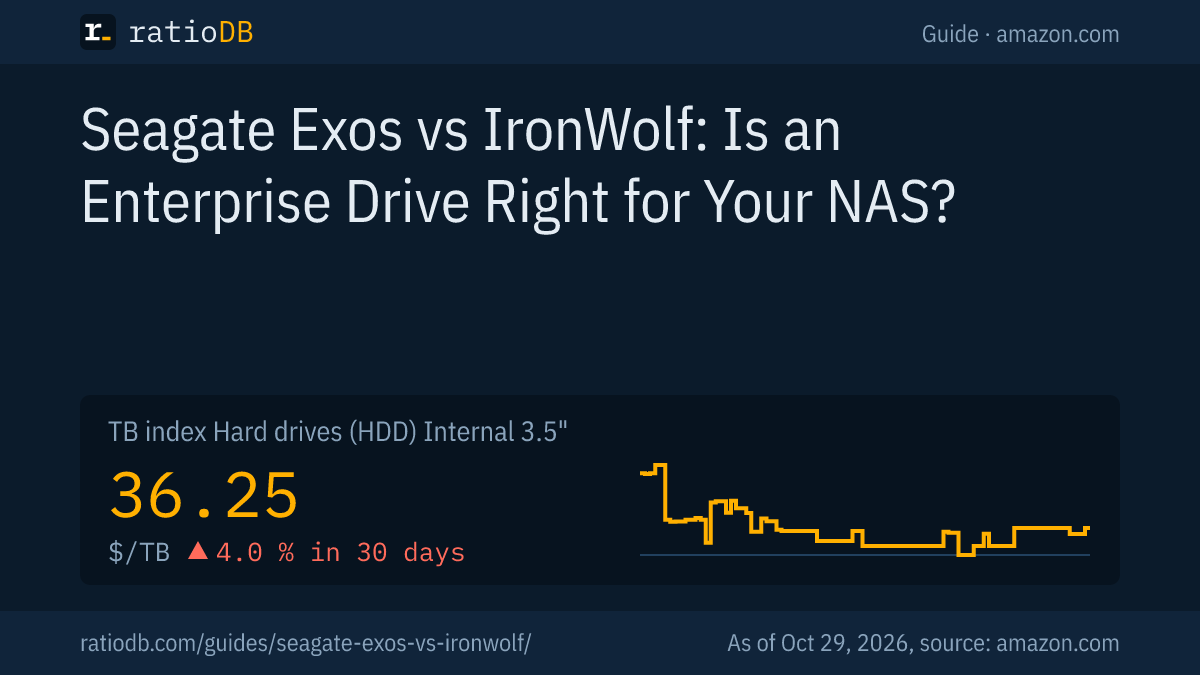
The table shows new Exos drives in our internal 3.5-inch category, sold under the Seagate name, whose part numbers match a data sheet, sorted by price per TB. Small Exos drives with 2 to 4 TB are usually much more expensive per TB than large ones. The TB index for all internal 3.5-inch drives is $36.25 per TB right now.
Is Seagate Exos cheaper than IronWolf Pro?
Right now, yes: the cheapest Exos costs $39.56 per TB on amazon.com, the cheapest NAS drive (Toshiba N300 Pro 12 TB) $44.17 per TB, a gap of 10.4%. Individual sizes can tell a different story.
No size currently has new offers from both Exos and IronWolf Pro on amazon.com. The cheapest IronWolf Pro costs $48.89 per TB (Seagate IronWolf Pro 14 TB). The cheapest regular IronWolf costs $52.67 per TB (Seagate IronWolf 6 TB). The price history chart on each product page shows whether today's price is a good one.
Exos vs IronWolf Pro: how close are they on paper?
At 24 TB, Exos and IronWolf Pro are almost identical on their data sheets: CMR, helium, 7,200 rpm, 512 MB cache, up to 285 MB/s, 6.3 W at idle and 2.5 million hours MTBF. IronWolf Pro adds noise figures and data recovery, Exos adds SAS, SED and FastFormat options.
| Feature | Exos 24 TB (ST24000NM002H) | IronWolf Pro 24 TB (ST24000NT002) |
|---|---|---|
| Recording | CMR, helium | CMR, helium |
| Spindle speed | 7,200 rpm | 7,200 rpm |
| Cache | 512 MB | 512 MB |
| Transfer rate per maker | up to 285 MB/s | up to 285 MB/s |
| MTBF | 2.5 million hours | 2.5 million hours |
| Idle power | 6.3 W | 6.3 W |
| Noise idle and seek | not listed | 20 and 26 dBA |
| Sector format | 512e, switchable to 4Kn | 512e |
| Data recovery | not listed | 3 years Rescue |
| Warranty | 5 years | 5 years |
Values from the Exos (12/2025) and IronWolf Pro (11/2023) data sheets. The hardware specs line up closely. The difference is in extras and audience: Seagate tunes IronWolf Pro for NAS systems and bundles data recovery, while Exos targets cloud and enterprise data centers according to its data sheet.
Exos vs regular IronWolf: when does the cheaper NAS drive make sense?
The regular IronWolf is rated for 1 to 8 bays, 180 TB per year, 1 million hours MTBF and 3 years of warranty, and its smaller models spin at 5,400 or 5,900 rpm. Exos always spins at 7,200 rpm and carries 5 years of warranty. For a quiet 2 to 4 bay NAS, a 5,400 rpm IronWolf is the calmer choice on paper.
The IronWolf ST8000VN002 (8 TB, 5,400 rpm) is rated at 25 dBA idle and 26 dBA seek with 4.0 W at idle, according to Seagate. Exos data sheets list no noise values at all. IronWolf only goes up to 16 TB, so for anything bigger the choice is between IronWolf Pro and Exos. The cheapest regular IronWolf on amazon.com costs $52.67 per TB right now (Seagate IronWolf 6 TB).
Is Seagate Exos too loud for a home NAS?
The Exos data sheets we checked list no acoustic values, while IronWolf Pro from 12 to 24 TB is rated at 20 dBA idle and 26 dBA seek. So you cannot compare Exos noise from manufacturer figures before you buy.
What we can say: both lines spin at 7,200 rpm and the large models are helium sealed. How loud a drive ends up depends on the NAS enclosure and where it sits as well. If the NAS lives in a bedroom or office, a drive with a published noise rating is the safer bet. In a basement or closet, it hardly matters.
How much power does an Exos use in a home NAS?
According to Seagate, a current 24 TB Exos (ST24000NM002H) idles at 6.3 W and the 28 to 32 TB models at 6.9 W. An 18 TB Exos X18 is rated at 5.3 W, a 22 TB Exos X22 at 5.74 W. That is on par with an IronWolf Pro of the same size.
| Model | Idle power per data sheet | Per year at 24/7 |
|---|---|---|
| Exos X18 18 TB (ST18000NM000J) | 5.3 W | about 46 kWh |
| Exos X22 22 TB (ST22000NM001E) | 5.74 W | about 50 kWh |
| Exos 24 TB (ST24000NM002H) | 6.3 W | about 55 kWh |
| Exos 32 TB (ST32000NM004K) | 6.9 W | about 60 kWh |
| IronWolf Pro 24 TB (ST24000NT002) | 6.3 W | about 55 kWh |
The yearly figures are calculated as idle power times 8,760 hours, without sleep. A NAS that spins drives down at night uses less. Multiply the kWh by your electricity rate to get the cost. Large drives cut power per TB: 4 drives of 24 TB give you 96 TB for about 220 kWh a year.
How reliable is Seagate Exos according to Backblaze?
Backblaze runs several Exos models at scale. In Q2 2026, the 24 TB Exos (ST24000NM002H) logged a 3.30% annualized failure rate across 9,631 drives, while the 12 and 14 TB Exos X18 models (ST12000NM000J, ST14000NM000J) had zero failures. Seagate's own rating is 0.35% per year.
Exos models in Backblaze Drive Stats, Q2 2026
| Model | Line per Seagate | Drives | Average age | AFR quarter | AFR lifetime |
|---|---|---|---|---|---|
| ST24000NM002H | Exos 24 TB | 9,631 | 12.2 months | 3.30% | 3.24% |
| ST16000NM000J | Exos X18 16 TB | 171 | 15.4 months | 2.57% | too few drives |
| ST14000NM000J | Exos X18 14 TB | 497 | 17.0 months | 0% | too few drives |
| ST12000NM000J | Exos X18 12 TB | 1,079 | 22.0 months | 0% | 1.10% |
| ST8000NM0055 | Exos 7E8 8 TB | 13,112 | 104.7 months | 3.44% | 1.98% |
Source: Backblaze Drive Stats for Q2 2026 (09/29/2026), model to line mapping from Seagate data sheets. Backblaze only includes models with more than 500 drives in its lifetime table.
3 things stand out. Most Exos models at Backblaze fail more often than the data sheet AFR suggests, and Backblaze's lifetime rate across all brands (1.41% per year) is also above the 0.35 to 0.44% in Exos data sheets. The new 24 TB Exos sits above 3% a year in its first year of service, while the smaller Exos X18 runs almost without failures. And the Exos 7E8, at nearly 9 years old on average, still fails at just under 2% a year over its lifetime. For more on reading these numbers, see our guide how long do hard drives last.
Should you buy a used or refurbished Exos?
Used and refurbished Exos drives are often the cheapest per TB. amazon.com currently has 3 such offers, from $31.75 per TB (Seagate Exos 7E8 8 TB). The manufacturer warranty often no longer applies, and you do not know how long the drive has been running.
Check a used Exos with a SMART tool after it arrives: power-on hours, reallocated sectors and pending sectors should match the price you paid. What to watch for with used enterprise drives, including past cases of used drives sold as new, is covered in our guide to refurbished hard drives. ratioDB never counts used offers in the index or in the tables above.
Exos or IronWolf: which should you buy?
Buy an Exos if it is cheaper per TB than an IronWolf Pro of the same size, you get the SATA version and noise is not a concern. Buy IronWolf Pro if you want bundled data recovery or published noise figures, and a regular IronWolf for a quiet small NAS up to 16 TB.
- Interface: Only buy SATA Exos unless your NAS or server has a SAS controller. SAS drives need a SAS controller.
- Price per TB: Compare with the IronWolf Pro of the same size. If the Exos is not noticeably cheaper, IronWolf Pro gives you more extras for the money.
- Location: In a basement noise does not matter, in a living room it might.
- Seller and warranty: Buy new from a seller that passes on the full manufacturer warranty, and ask before ordering if in doubt.
Seagate itself lists NAS systems with more than 16 bays as an Exos use case. For a typical home NAS with 2 to 6 bays, both lines work technically.
How does ratioDB compare Exos and IronWolf?
ratioDB fetches amazon.com prices for every listed hard drive at regular intervals and converts them to price per TB, with 1 TB equal to 10^12 bytes. Whether a drive counts as Exos or IronWolf depends on its part number in Seagate's data sheets, not on the listing title.
Offers without a matching part number are left out of the tables. Used and refurbished offers appear in the list with their condition, and we mention them separately in the text. We do not measure noise or power ourselves; all values come from the linked data sheets. All rules are on our methodology page, and every offer is listed under internal 3.5-inch hard drives. Long-term prices are on our hard drive price history page.
Seagate Exos vs IronWolf FAQ
Is Seagate Exos better than IronWolf?
On paper, large Exos models match IronWolf Pro on MTBF, speed and warranty, and beat the regular IronWolf on warranty (5 vs 3 years) and MTBF. IronWolf has NAS extras like data recovery and published noise ratings. Exos is often cheaper per TB.
Can I use Seagate Exos in a NAS?
Yes, if your NAS supports the interface. SATA Exos drives work in any NAS with SATA bays. Seagate lists NAS systems with more than 16 bays as an Exos use case, but the drives also work in small units.
Is Seagate Exos loud?
Seagate does not publish noise figures in its Exos data sheets. Both Exos and IronWolf Pro spin at 7,200 rpm. For a NAS in a living space, an IronWolf Pro (20 dBA idle per data sheet) or a 5,400 rpm IronWolf is the better documented choice.
What is the difference between Exos X and Exos E?
Exos X refers to large helium models such as Exos X18 and X22 with 2.5 million hours MTBF. Exos E refers to smaller models up to 10 TB such as Exos 7E8 and 7E10 with 2 million hours MTBF. Seagate's current data sheet calls the whole line Exos.
How long is the Seagate Exos warranty?
Seagate lists a 5-year limited warranty for all Exos lines. Used, refurbished or bulk-sourced drives may have a shorter warranty or none, so check with the seller before you buy.
What is the failure rate of Seagate Exos?
Seagate rates large Exos models at 0.35% per year and the Exos 7E8 and 7E10 at 0.44%. In Backblaze's Q2 2026 data, Exos models ranged from 0% to 3.44% per year.
Sources
- Seagate: Exos data sheet (12/2025), Exos X22 data sheet (09/2022), Exos X18 data sheet (06/2021), Exos 7E10 data sheet (04/2021), Exos 7E8 data sheet, IronWolf Pro data sheet (11/2023), IronWolf data sheet (04/2024)
- Backblaze Drive Stats for Q2 2026 (09/29/2026)
- ratioDB: amazon.com prices, methodology