Largest Hard Drive in 2026: From 32TB in Stores to 44TB
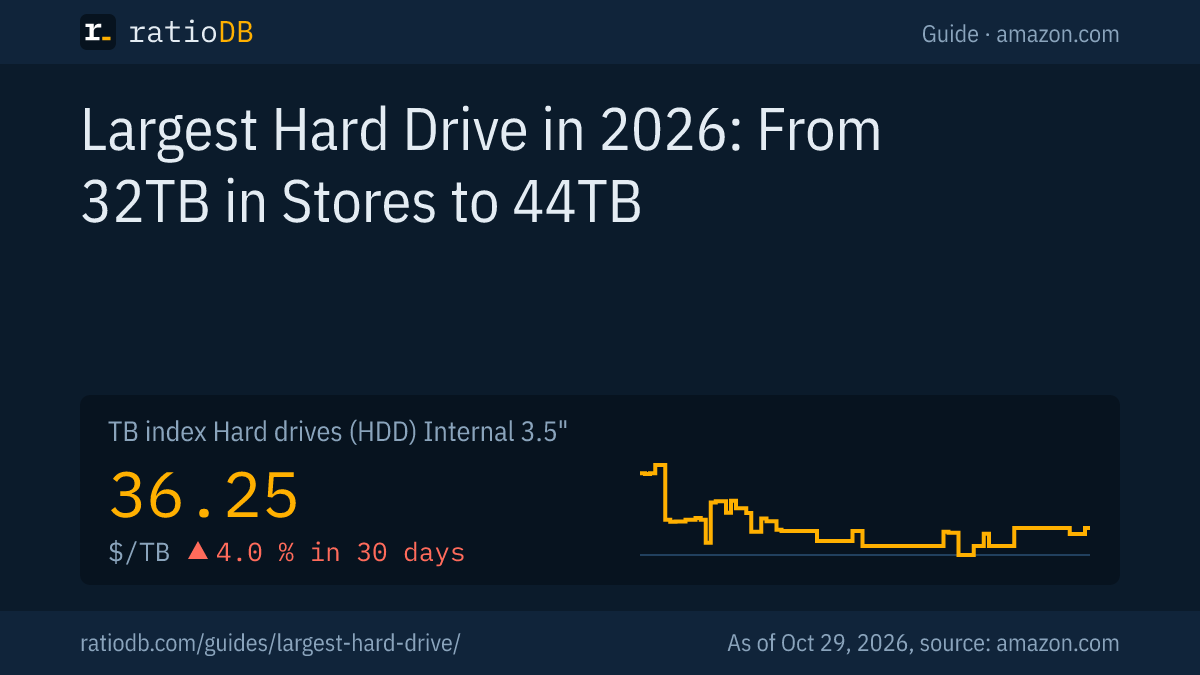
The largest hard drive in 2026 holds 44TB according to Seagate, which has been shipping drives built on its HAMR platform Mozaic 4+ in volume to 2 large cloud providers since March 2026. For retail, Seagate began shipping 32TB IronWolf Pro, Exos and SkyHawk AI drives in January 2026. On Amazon.com, the largest new internal 3.5-inch drive in the ratioDB database right now is 24TB (as of Oct 29, 2026 at 1:17 AM UTC). For home users, that means 32TB is the top of the manufacturer lineups for retail, and Amazon.com listings often stop lower.
This guide covers which hard drives are the largest, which of them you can buy, what they cost per TB, what a 24TB drive costs and what to watch for with very large drives. Manufacturer specs come from the linked press releases and product pages, prices live from the ratioDB database. ratioDB does not run its own hardware tests.
What is the largest hard drive in the world?
The largest hard drive in the world holds 44TB according to Seagate. On March 3, 2026, Seagate announced that drives on its Mozaic 4+ platform with up to 44TB are qualified and shipping in volume to 2 leading hyperscale cloud providers. Broader availability is planned as production scales.
Mozaic 4+ uses HAMR (heat-assisted magnetic recording). Seagate calls it the industry's only HAMR platform deployed at scale and puts today's density at 4TB or more per disk (Seagate, Mar 3, 2026). The customers are hyperscalers, the operators of giant data centers. The 44TB drives are not sold in stores yet.
For perspective: the first hard drive ever, the IBM 350 in the 1956 RAMAC system, stored about 5MB according to IBM, was the size of 2 refrigerators and weighed more than a ton (IBM). 44TB is 8.8 million times as much.
What is the largest hard drive you can buy?
The largest hard drives for retail hold 32TB according to the manufacturers. Seagate has been shipping 32TB IronWolf Pro, Exos and SkyHawk AI drives to channel and retail partners worldwide since January 12, 2026, each with a 5-year limited warranty. Western Digital's WD Red Pro NAS line goes up to 26TB.
| Line | Largest capacity per maker | Use per maker | Recording |
|---|---|---|---|
| Seagate IronWolf Pro | 32TB | NAS, 550TB per year | CMR |
| Seagate Exos | 32TB | data center, up to 3TB per disk | not stated separately |
| Seagate SkyHawk AI | 32TB | video surveillance | CMR |
| WD Red Pro | 26TB | NAS, 550TB per year | CMR |
Table sources: Seagate, Jan 12, 2026, Seagate IronWolf Pro, WD Red Pro. Seagate frames its 32TB drives around its CMR technology and explicitly lists the IronWolf Pro and SkyHawk AI as CMR. CMR (conventional magnetic recording) writes tracks side by side, SMR (shingled magnetic recording) overlaps them. What that means in practice is explained in CMR vs SMR.
Seagate lists a 550TB per year workload rating for the 32TB IronWolf Pro, and Western Digital does the same for the WD Red Pro. The Exos and IronWolf lines are compared in Seagate Exos vs IronWolf, and the NAS lines in WD Red vs IronWolf.
What are the largest hard drives on Amazon.com right now?
The largest new internal 3.5-inch hard drive on Amazon.com is 24TB right now according to ratioDB: WD Red Pro 24 TB at $1,899.99. External drives also top out at 24TB. In total, 3 new drives with 20TB or more are in the database.
Cheapest new 3.5-inch hard drive per capacity from 16TB up on Amazon.com, internal and external, as of Oct 29, 2026 at 1:17 AM UTC
| Capacity | Cheapest internal 3.5" drive (per TB) | Cheapest external 3.5" drive (per TB) |
|---|---|---|
| 16 TB | Synology Plus HAT3310 16 TB: $694.66 ($43.42) | no offer |
| 18 TB | Seagate Exos X18 18 TB: $712.00 ($39.56) | no offer |
| 20 TB | no offer | WD Elements 20 TB: $829.99 ($41.50) |
| 24 TB | WD Red Pro 24 TB: $1,899.99 ($79.17) | SanDisk Professional G-Drive Enterprise-Class 24 TB: $1,379.99 ($57.50) |
A missing capacity had no new offer under a hard drive maker's name (internal) or from a known brand (external) at our last check. The price per TB is in brackets.
The largest external drive in the database right now is SanDisk Professional G-Drive Enterprise-Class 24 TB with 24TB at $1,379.99, or $57.50 per TB. External 3.5-inch drives cost $42.64 per TB according to the TB index right now, internal ones $36.25 per TB. To pick an external drive, see Best external hard drive. Every offer is listed under internal 3.5" hard drives.
Is a bigger hard drive cheaper per TB?
No, the largest hard drive is usually not the cheapest per TB. On Amazon.com, the cheapest internal 3.5-inch size per TB from 4TB up is 6 TB right now, at $23.08. The largest internal drive costs 243.0% more per TB.
The cheapest internal drive per TB from 4TB up is HGST Ultrastar He6 6 TB at $23.08 per TB right now. The largest, WD Red Pro 24 TB, comes in at $79.17 per TB. That is 118.4% above the TB index for internal 3.5-inch drives of $36.25. The top models mostly belong to NAS or enterprise lines such as WD Red Pro or Seagate IronWolf Pro, which the makers back with a 5-year limited warranty.
When the largest drive still makes sense:
- Few bays: A 2-bay NAS holds 64TB with 2 × 32TB, double the 32TB of 2 × 16TB.
- Space in the case: 1 big drive takes 1 bay, 2 smaller drives take 2.
- Growing data: If you collect video archives or large backups, a bigger drive pushes back the next purchase.
If you just want a lot of storage for little money and have enough bays, the sweet spot size (lowest price per TB) is the better buy. Price trends are covered in Hard drive prices, and the long-term US chart is on our hard drive price history page.
Which large hard drive fits which use?
For a NAS, IronWolf Pro and WD Red Pro go up to 32TB and 26TB, for video surveillance the SkyHawk AI reaches 32TB, and for data centers there is the Exos. For 1 big backup drive at your desk, an external 3.5-inch drive is often the simplest option, up to 24TB on Amazon.com right now.
| Use | Line at the largest capacity | Maker spec |
|---|---|---|
| Multi-user NAS | Seagate IronWolf Pro 32TB | 550TB per year, CMR, 5-year warranty |
| NAS and RAID | WD Red Pro 26TB | 550TB per year, CMR, 5-year warranty |
| AI video surveillance | Seagate SkyHawk AI 32TB | more than 10,000 hours of video |
| Data center | Seagate Exos 32TB | up to 3TB per disk |
| Desk backup | external 3.5" drive | case, power adapter and cable included |
Sources: Seagate, Jan 12, 2026, WD Red Pro. Seagate also says the 32TB SkyHawk AI handles 3 times the workload of standard video drives. Drives for recorders and cameras are covered in Surveillance hard drive.
NAS lines are the usual pick for a home NAS, because the makers design them for 24/7 multi-drive use. Seagate aims the Exos at cloud and enterprise data centers. For a single backup drive at your desk, you do not need a NAS line, and capacity and price per TB matter most.
How much does a 24TB hard drive cost?
A 24TB internal hard drive costs from $1,899.99 on Amazon.com right now, or $79.17 per TB. External 24TB drives start at $1,379.99 ($57.50 per TB). Western Digital lists the 24TB WD Red Pro at up to 287 MB/s.
The cheapest new internal 24TB drive right now is WD Red Pro 24 TB at $1,899.99. The cheapest external one is SanDisk Professional G-Drive Enterprise-Class 24 TB at $1,379.99. The external drive is $520.00 cheaper than the internal one, even with the case and power adapter included.
At those 287 MB/s from Western Digital (Western Digital), reading a full 24TB drive once takes about 23 hours on paper. That number matters for backups and NAS systems: the bigger the drive, the longer a full backup or restore takes.
How do hard drives get so big?
Hard drives grow by storing more data per disk and fitting more disks per drive. Seagate lists up to 3TB per disk for the 32TB Exos and more than 4TB per disk for its HAMR platform Mozaic 4+. Western Digital adds UltraSMR with overlapping tracks.
A 3.5-inch hard drive only has so much room for disks, so most of the extra capacity comes from density. Seagate cites up to 3TB per disk for the 32TB Exos (Seagate, Jan 12, 2026). With Mozaic 4+, Seagate says it is at more than 4TB per disk today, heading toward 10TB per disk (Seagate, Mar 3, 2026).
| Technology | How it works | Example per maker |
|---|---|---|
| High-density CMR | tracks side by side, written more densely | Seagate IronWolf Pro 32TB |
| UltraSMR (Western Digital) | tracks overlap like roof shingles | WD 40TB drive in qualification |
| HAMR | a laser heats the disk while writing | Seagate Mozaic 4+ up to 44TB |
On February 3, 2026, Western Digital presented a 40TB UltraSMR drive that is in qualification with 2 hyperscale customers, with volume production planned for the second half of 2026 (Western Digital, Feb 3, 2026). HAMR itself is a big enough topic for its own guide.
How big will hard drives get?
Seagate and Western Digital plan hard drives with up to 100TB. Seagate wants to move its HAMR platform from more than 4TB to 10TB per disk. Western Digital targets 100TB with HAMR by 2029 and sees a path to 60TB for its ePMR technology. These are manufacturer forecasts.
The plans at a glance, all manufacturer claims and forecasts:
| Maker | Target | Timeline per maker |
|---|---|---|
| Seagate | up to 100TB at 10TB per disk | no year given |
| Western Digital (ePMR) | 40TB in volume, path to 60TB | 40TB from second half of 2026 |
| Western Digital (HAMR) | 100TB | by 2029, ramp from 2027 |
Sources: Seagate, Mar 3, 2026, Western Digital, Feb 3, 2026. Seagate shipped its 44TB drives to hyperscalers first. The retail IronWolf Pro tops out at 32TB according to its product page in October 2026.
What should I watch for with very large hard drives?
With very large hard drives, watch the GPT partition style, the capacity limit of enclosures and docks, long copy times and a second backup. Microsoft says the old MBR partition style only addresses about 2.2TB in Windows, so anything larger needs GPT.
The key points:
- Use GPT: Microsoft explains that drives over 2TB must be initialized with GPT, and booting from such a drive requires UEFI firmware (Microsoft Learn).
- Enclosures and docks: Not every accessory supports big drives. Inateck lists 2 × 10TB for its SA02002 dock (Inateck), ICY BOX up to 30TB for the Spade Base 388 (ICY BOX).
- Time: At about 287 MB/s, reading 24TB end to end takes almost a full day on paper. A full backup or a RAID rebuild takes correspondingly long.
- More data per failure: 1 big drive puts a lot of data in 1 place. A second copy is a must, as 3-2-1 backup rule explains.
- Displayed size: Seagate counts 1TB as 1 trillion bytes, so Windows shows a 32TB drive as about 29.1TB. TB vs TiB explains why.
More advice for NAS builds with big drives is in Best NAS hard drive.
Are there SSDs bigger than hard drives?
Yes, the largest SSDs hold more than the largest hard drives. Solidigm offers the D5-P5336 with up to 122.88TB, almost 3 times the 44TB of the biggest hard drive. These SSDs are built for data centers and cost far more per TB than hard drives.
Solidigm lists the D5-P5336 with up to 122.88TB in the E3.S, E1.L and U.2 form factors (Solidigm), which are server form factors. For home users, the hard drive remains the cheapest way to lots of storage: on Amazon.com, M.2 NVMe SSDs cost $133.85 per TB according to the TB index right now, internal 3.5-inch hard drives $36.25, so the SSD costs about 3.7 times as much per TB. More in SSD vs HDD.
How does ratioDB compare large hard drives?
ratioDB pulls Amazon.com prices for every listed hard drive at regular intervals and converts them into price per TB, with 1TB equal to 1,000,000,000,000 bytes. The TB index is the median of the 10 cheapest new offers per form factor.
The large-capacity table shows the cheapest new single drive per size, internal drives only under a hard drive maker's name, external drives only from known brands. Used and refurbished drives appear in the list with their condition but never count toward the index. All rules are on our methodology page. The full lists are under hard drives, internal 3.5" drives and external 3.5" drives.
Largest hard drive FAQ
What is the biggest hard drive in the world?
The biggest hard drive holds 44TB according to Seagate. Seagate has been shipping drives on its HAMR platform Mozaic 4+ in volume to 2 large cloud providers since March 2026. They are not available in stores yet.
What is the largest hard drive you can buy?
According to the manufacturers, 32TB is the top for retail: Seagate has been shipping 32TB IronWolf Pro, Exos and SkyHawk AI drives to retailers since January 2026. On Amazon.com, the largest new internal drive in our database right now is 24TB.
Is there a 100TB hard drive?
Not yet. Seagate and Western Digital plan hard drives with up to 100TB, and Western Digital names 2029 as its target. These are manufacturer forecasts.
Is the largest hard drive the cheapest per TB?
Usually not. On Amazon.com, 6 TB is the cheapest internal 3.5-inch size per TB right now. The largest models mostly belong to NAS or enterprise lines and often cost more per TB.
How much is a 24TB hard drive?
A 24TB internal hard drive costs from $1,899.99 on Amazon.com right now ($79.17 per TB, as of Oct 29, 2026 at 1:17 AM UTC). External 24TB drives start at $1,379.99.
What is the largest SSD?
Solidigm offers the D5-P5336 with up to 122.88TB in server form factors such as U.2 and E3.S. Per TB, SSDs cost far more than hard drives.
Sources
- Seagate: Mozaic 4+ with up to 44TB (Mar 3, 2026), 32TB in retail (Jan 12, 2026), IronWolf Pro
- Western Digital: Innovation Day 2026 (Feb 3, 2026), WD Red Pro
- Solidigm: D5-P5336, IBM: RAMAC
- Microsoft Learn: Windows support for hard disks larger than 2 TB
- Accessories: ICY BOX Spade Base 388, Inateck SA02002
- ratioDB: Amazon.com prices, hard drive price history, methodology