LTO tape: generations, cost per TB and when a drive pays off
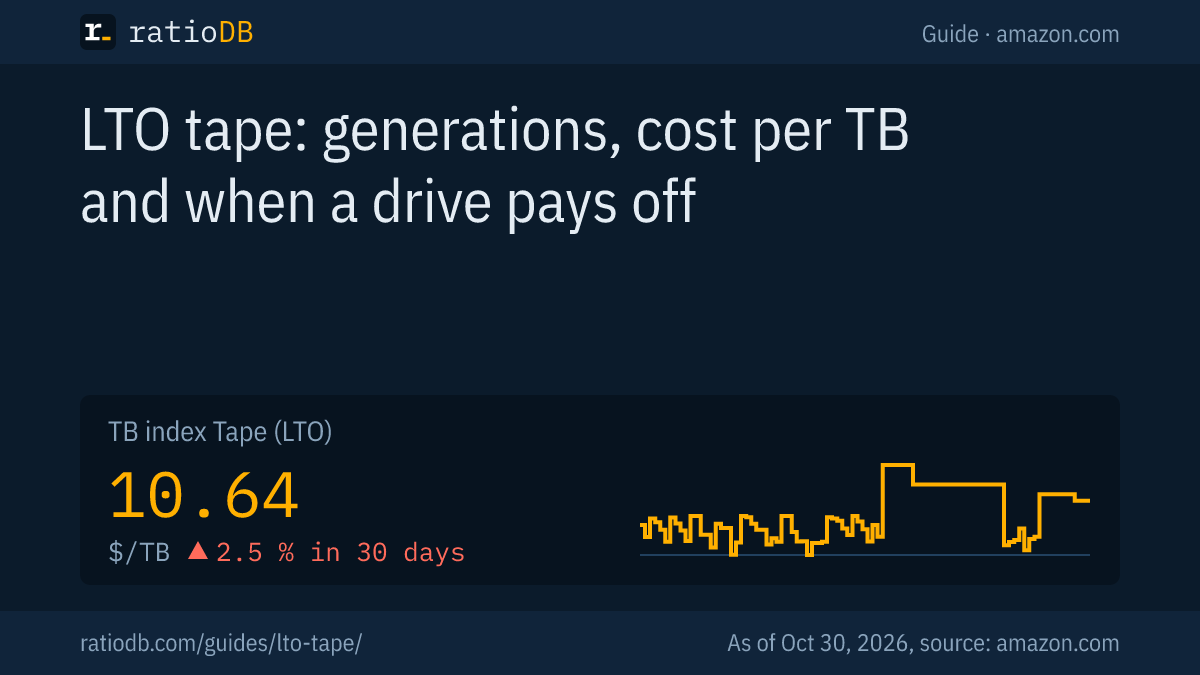
LTO (Linear Tape-Open) is an open magnetic tape standard developed by HPE, IBM and Quantum in the LTO Program. According to Fujifilm's data sheet, an LTO-9 cartridge holds 18 TB native and an LTO-10 cartridge 30 or 40 TB. On amazon.com, the cheapest new LTO-9 cartridge currently costs $5.56 per native TB, the cheapest hard drive $23.08 (as of Oct 30, 2026 at 1:17 AM UTC).
This guide explains the LTO generations, what a tape drive can and cannot read, and uses real amazon.com prices to show at what data volume tape beats hard drives. ratioDB does not test drives. We combine LTO Program and manufacturer specs with live price per TB.
What is LTO tape?
LTO tape is a magnetic tape cartridge for backup and archiving that is read and written only in an LTO tape drive. After writing, the cartridge sits on a shelf without power. The LTO Program states that tape "remains the lowest cost storage media on a $/GB basis."
An LTO drive moves the tape past a read/write head. Files sit in sequence along the tape, so finding a single file takes longer than on a hard drive. For large backups and archives this matters little, because data is written in big batches and rarely read.
Key features according to the LTO Program:
- Offline: A cartridge on a shelf has no network connection. The LTO Program calls this a "true physical air gap" and positions it as protection against ransomware.
- Encryption: Generation 4 and later drives encrypt with 256-bit AES in GCM mode. Hardware encryption "typically" affects less than 1% of drive performance.
- LTFS: The Linear Tape File System lets you access tape like a disk with folders, starting with LTO-5, on Linux, macOS and Windows.
- WORM: Write-once cartridges have existed since LTO-3, and LTO-9 continues to support WORM and encryption.
- Power: Citing research by Solutions North, the LTO Program says tape "consumes 96% less energy than HDD when used for data archives."
Sources: LTO Program, technology, LTO Program, FAQ, LTO Program, history, LTO Program, LTO-9.
Which LTO generations exist and how much fits on a tape?
LTO-5 through LTO-10 are on the market. LTO-9 holds 18 TB native and 45 TB compressed, LTO-10 30 TB or 40 TB native. Compressed figures assume 2.5:1 compression, which only highly compressible data reaches.
Native means what fits on the tape without compression. Photos, videos and ZIP archives are already compressed, so for them only the native figure counts. ratioDB therefore always calculates price per TB from native capacity.
LTO generations with capacity per Fujifilm data sheet and the cheapest new offer on amazon.com, as of Oct 30, 2026 at 1:17 AM UTC
| Generation | Native | Compressed (2.5:1) | Cheapest new offer | Price per TB native |
|---|---|---|---|---|
| LTO-5 | 1.5 TB | 3 TB | HP HEWLETT PACKARD LTO5 Ultrium 10 × 1.5 TB: $198.50 (10-pack) | $13.23 |
| LTO-6 | 2.5 TB | 6.25 TB | Fujifilm LTO Ultrium 6 5 × 2.5 TB: $130.50 (5-pack) | $10.44 |
| LTO-7 | 6 TB | 15 TB | IBM LTO7 Ultrium7 6 TB: $58.96 | $9.83 |
| LTO-8 | 12 TB | 30 TB | HP Q2078A LTO Ultrium 8 10 × 12 TB: $814.99 (10-pack) | $6.79 |
| LTO-9 | 18 TB | 45 TB | HP HPE LTO-9 18 TB: $99.99 | $5.56 |
| LTO-10 | 30 TB | 75 TB | no offer | n/a |
Capacity source: Fujifilm, LTO Ultrium Data Cartridge Specifications. Fujifilm lists maximum native transfer rates of 140 MB/s for LTO-5, 160 MB/s for LTO-6, 300 MB/s for LTO-7, 360 MB/s for LTO-8 and 400 MB/s for LTO-9, depending on the drive interface.
The LTO Program introduced LTO-10 in 2025. On November 12, 2025, HPE, IBM and Quantum also announced a 40 TB cartridge with an Aramid base film that works in the same LTO-10 drive as the 30 TB cartridge, with shipments expected in the first quarter of 2026 (LTO Program, November 12, 2025). At our last update, amazon.com had no new LTO-10 cartridge offer. The LTO roadmap extends to generation 14 with 913 TB compressed per cartridge. That is a roadmap with no product yet.
Which tapes can my LTO drive read?
An LTO-9 drive reads and writes only LTO-9 and LTO-8 media, and an LTO-10 drive only LTO-10. Through LTO-7, drives read 2 older generations and wrote 1 older generation. If you have old tapes, you need a matching drive to read them.
The rules according to the LTO Program:
| Drive | Reads | Writes |
|---|---|---|
| LTO-7 | LTO-5, LTO-6, LTO-7 | LTO-6, LTO-7 |
| LTO-8 | LTO-7, LTO-7 Type M, LTO-8 | LTO-7, LTO-7 Type M, LTO-8 |
| LTO-9 | LTO-8, LTO-9 | LTO-8, LTO-9 |
| LTO-10 | LTO-10 | LTO-10 |
Sources: LTO Program, compatibility, LTO Program, FAQ.
This matters for an archive that spans many years. If you start with LTO-9 in 2026, an LTO-10 drive will not read those tapes. Plan to copy the archive to new tapes when you change drive generations, or keep a working older drive.
What do you need besides tapes for LTO?
Besides cartridges, LTO needs a tape drive, usually a SAS connection in your PC or server and software that writes to tape or supports LTFS. The drive is the biggest cost. ratioDB does not track drive prices because they vary widely by seller, form factor and interface.
The parts at a glance:
- Drive: internal for a 5.25" bay or external in its own enclosure. The generation decides which tapes it reads.
- Connection: HPE lists a 12 Gb/s SAS interface for its LTO-9 drives (HPE QuickSpecs LTO). Regular desktop PCs have no SAS port, so you need an add-in card called an HBA (host bus adapter).
- Software: backup programs with tape support, or LTFS to copy files as you would to a disk.
- Cartridges: at least 2 sets so that 1 copy can live off-site.
- Cleaning cartridge: drives need cleaning from time to time.
New LTO-9 cartridges need a calibration on their very first load, and only then. According to the LTO Program it averages about 20 minutes, most finish within 30 minutes, some take up to 2 hours, and it cannot be disabled. LTO-10 cartridges do not need it. Quantum cites a typical 35 to 52 minutes for LTO-9 (Quantum, LTO-9 FAQ).
How much does LTO tape cost per TB compared to a hard drive?
On amazon.com, LTO tape currently costs far less per TB than the cheapest hard drive: HP HPE LTO-9 18 TB costs $5.56 per native TB, HGST Ultrastar He6 6 TB $23.08 per TB. That is a factor of 4.2. As of Oct 30, 2026 at 1:17 AM UTC.
The cheapest new tape per native TB is HP HPE LTO-9 18 TB (LTO-9) at $5.56. The TB index for internal 3.5" hard drives is $36.25. Older generations such as LTO-5 and LTO-6 are cheap per cartridge but usually cost more per TB and need a matching older drive.
Cartridge price per TB is only half the math. Any PC reads a hard drive, while tape needs the drive. With small data sets the drive eats up the cartridge savings. With large data sets tape earns them back.
At what data volume does an LTO drive pay off?
At current amazon.com prices, every TB on LTO tape saves $17.53 compared to the cheapest hard drive. A $4,000 drive pays for itself at roughly 229 TB of data. The math covers media and drive only.
The formula: drive price divided by savings per TB. Savings are the price per TB of the cheapest hard drive minus the price per TB of tape. Since ratioDB does not track drive prices, the table uses 3 example prices. Plug in the price your dealer quotes for a drive.
Data volume at which tape beats hard drives, example drive prices, cartridges and hard drives at amazon.com prices as of Oct 30, 2026 at 1:17 AM UTC
| Drive costs | Tape pays off from |
|---|---|
| $2,000 | 115 TB |
| $4,000 | 229 TB |
| $6,000 | 343 TB |
A concrete example with 100 TB: you need 6 cartridges of HP HPE LTO-9 18 TB for a total of $599.94. With hard drives it would be 6 units of Seagate Exos X18 18 TB (18 TB each) for $4,272.00. The cartridges cost $3,672.06 less, and the drive price has to come out of that.
For most home users with 2 to 20 TB of data, LTO does not pay off, and external hard drives are the cheaper backup. What a backup following the 3-2-1 rule costs is calculated in the guide 3-2-1 backup rule. Tape gets interesting for photographers, video producers, businesses and data hoarders with archives in the range of the table above.
How long does LTO tape last?
HPE states that LTO drives used with WORM media "can archive large amounts of data for periods of up to 30 years." That requires proper storage: room temperature, original case, upright and away from strong magnetic fields.
Storage advice from the LTO Program:
- Temperature and humidity: within the range printed on the cartridge sleeve, usually room temperature.
- Original case: keep cartridges in their boxes so no dust reaches the tape.
- Upright: "Vertical storage positioning is recommended for tape cartridges."
- Magnetic fields: X-rays do not affect magnetic media according to the LTO Program, but magnetic luggage inspection devices may.
- Rewinding: yearly rewinding is good practice but not required if cartridges are stored properly.
The 30 years are a manufacturer figure. For an archive spanning decades, the drive is often the limit: an LTO-10 drive does not read LTO-9 tapes. To keep an archive readable, copy it to new tapes when you change drive generations. For small archives that should stay readable without a tape drive, there is M-DISC (see the guide M-DISC).
What does an LTO tape backup look like in practice?
An LTO tape backup usually runs with 2 sets: 1 set of cartridges stays at the workplace for quick restores, the second set is kept off-site. New data is added regularly, and finished projects move to their own cartridges, where they stay unchanged.
A typical workflow for a video studio or a photographer with a large archive:
- Working data on a hard drive or NAS: current projects live on fast drives, and LTO tape is the archive behind them.
- Finish a project: completed projects are written to 2 cartridges with LTFS or backup software.
- Verify: most programs read the data back after writing. Verification takes time but belongs in the routine.
- Label and record: label the cartridge and keep a list of which project sits on which tape.
- Move off-site: the second cartridge goes to another location, such as a partner's office or a safe deposit box.
- Free up space: only once both copies are verified do you delete the project from the hard drive.
With LTFS you see a cartridge's contents like a folder and copy files by drag and drop. That is convenient but slower than backup software that writes large amounts of data in 1 continuous stream. Anyone backing up whole servers regularly usually uses backup software with tape support.
In this setup, tape fits the 3-2-1 rule well: it is a different medium than the hard drive, and the off-site cartridge is the copy in another location.
LTO tape or hard drive: which fits whom?
Hard drives fit small and medium data sets, backups with fast access and anyone who does not want to buy extra hardware. LTO tape fits large archives, businesses with retention requirements and anyone who wants copies offline and off-site.
| Feature | LTO tape | Hard drive |
|---|---|---|
| Media price per TB | low | medium |
| Extra hardware | drive required | none, USB or SATA |
| Access to a single file | slow (winding) | fast |
| Offline storage | built for it | possible |
| Protection from accidental deletion | WORM cartridges | software only |
| Readable in 20 years | matching drive needed | port and electronics must work |
Hard drives running around the clock, for example in a NAS, have their own rules, covered in the guide best NAS hard drive. Current hard drive prices are in the guide hard drive prices and on the hard drive price history chart. All internal drives are listed under internal 3.5" hard drives.
What should I look for when buying LTO tapes?
When buying LTO tapes, check your drive's generation, choose new cartridges for archives, compare native capacity and look at price per TB. Used tapes are fine for trying things out, but you do not know their history.
The key points:
- Generation: buy only generations your drive writes, so with LTO-9 only LTO-8 and LTO-9.
- Native capacity: always compare native capacity. "45 TB" on an LTO-9 box is compressed, native is 18 TB.
- Packs: 5-packs and 10-packs often cost less per cartridge. ratioDB divides the price by total capacity.
- WORM or rewritable: WORM only for data that must never change.
- Barcode labels: tape libraries with robots need labels. For a single drive, writing on the label is enough.
All cartridges are listed under Tape (LTO), LTO-9 under LTO-9 and LTO-8 under LTO-8.
How does ratioDB compare LTO tapes?
ratioDB regularly collects amazon.com prices for all listed LTO cartridges and converts them to price per native TB, with 1 TB equal to 1,000,000,000,000 bytes. Packs are divided by total capacity. New and used cartridges are never mixed in a calculation.
Capacities come from the Fujifilm data sheet and LTO Program announcements, as of October 24, 2026. We do not track drives, so the math above uses example prices. We do not run our own measurements. All rules are on the methodology page.
LTO tape FAQ
How much does an LTO-9 tape cost?
The cheapest new LTO-9 cartridge on amazon.com currently costs $99.99, which is $5.56 per native TB (as of Oct 30, 2026 at 1:17 AM UTC). An LTO-9 cartridge holds 18 TB native and 45 TB compressed according to Fujifilm.
Can an LTO-9 drive read LTO-7 tapes?
No. According to the LTO Program, an LTO-9 drive reads and writes only LTO-8 and LTO-9. For LTO-7 you need an LTO-7 or LTO-8 drive. An LTO-10 drive reads only LTO-10.
Is LTO worth it for home use?
For most home users no, because the drive costs more than the cartridge savings. With a $4,000 drive, tape only pays off from about 229 TB at current prices. Below that, external hard drives are cheaper.
How much really fits on an LTO tape?
The native capacity, so 18 TB for LTO-9. The compressed figure of 45 TB assumes 2.5:1 compression. Photos, videos and ZIP archives hardly compress any further.
How long does LTO tape last?
HPE cites up to 30 years for archiving with WORM media. That assumes proper storage: room temperature, original case, upright. A matching drive often limits readability more than the tape itself.
What is LTFS?
LTFS stands for Linear Tape File System. Starting with LTO-5, it splits the tape into an index partition and a data partition, so the cartridge shows up on Linux, macOS and Windows like a drive with folders.
Does a new LTO-9 tape need initialization?
Yes. Every new LTO-9 cartridge is calibrated once on its first load. According to the LTO Program this averages about 20 minutes and can take up to 2 hours. LTO-10 cartridges do not need it.
Sources
- LTO Program: technology, FAQ, compatibility, 40 TB LTO-10 cartridge (November 12, 2025), LTO-9, history
- Fujifilm: LTO Ultrium Data Cartridge Specifications
- HPE: QuickSpecs LTO Ultrium Tape Drives
- Quantum: LTO-9 Media Calibration FAQ
- ratioDB: amazon.com prices, methodology