DDR5 vs DDR4: What is the difference and which is worth it in 2026?
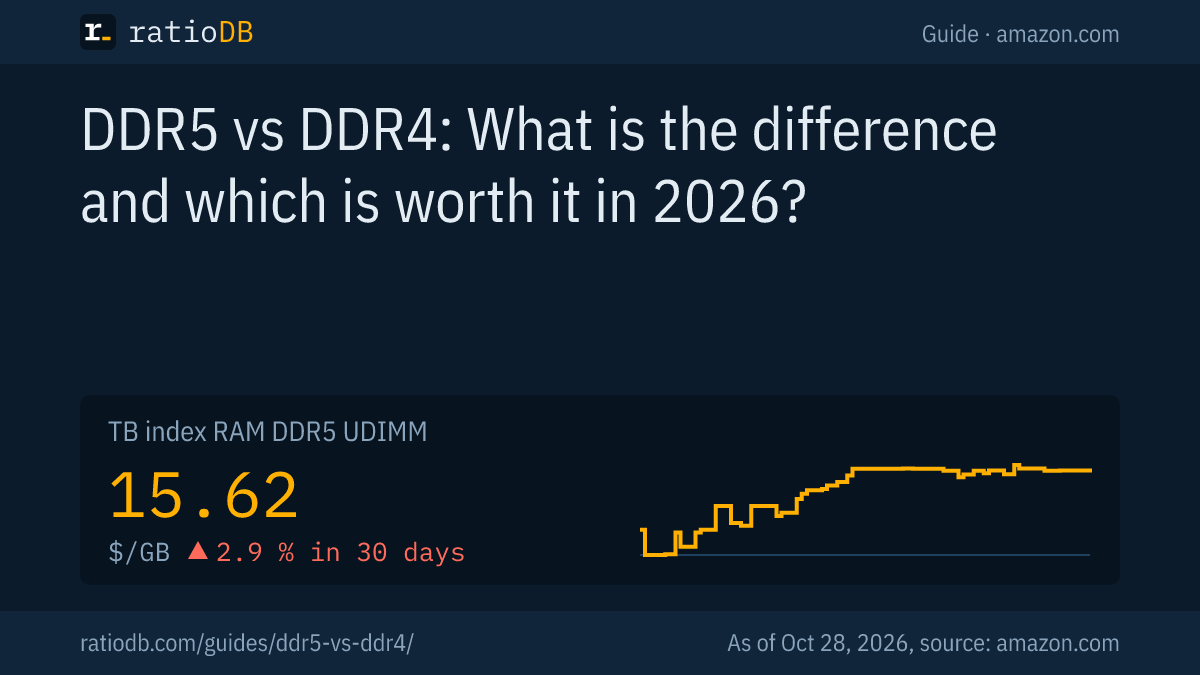
DDR5 is the newer memory standard: according to Kingston it starts at 4,800 MT/s, where DDR4 tops out at 3,200 MT/s, and it runs at 1.1 instead of 1.2 volts. Your motherboard decides which one you need, because DDR5 does not fit DDR4 slots. On amazon.com, DDR5 desktop RAM currently costs $15.62 per GB, DDR4 $6.51 per GB (as of Oct 28, 2026 at 1:17 AM UTC).
This guide explains the technical differences, shows which processors need which memory, sums up performance measurements and compares the current prices of both RAM types with real numbers from the ratioDB database.
What is the difference between DDR5 and DDR4?
DDR5 is faster, more efficient and built differently from DDR4: with 2 subchannels per module, its own voltage regulator on the module and error correction inside the chip. JEDEC, the body behind memory standards, published DDR5 on July 14, 2020.
| Feature | DDR5 | DDR4 |
|---|---|---|
| Speed according to Kingston | from 4,800 MT/s | up to 3,200 MT/s |
| Voltage | 1.1 volts | 1.2 volts |
| Fits the other slot | no | no |
At 1.1 volts, DDR5 uses about 20% less power than equivalent DDR4 components at 1.2 volts, according to Kingston. Kingston also lists 3 things that are new with DDR5: each module is split into 2 independent 32-bit subchannels (still 64-bit data width in total), a voltage regulator (PMIC, power management integrated circuit) sits on the module, and on-die ECC corrects bit errors inside the memory chip.
Sources: JEDEC, July 14, 2020, Kingston.
MT/s means megatransfers per second, millions of data transfers per second. JEDEC describes the subchannels as "two 40-bit fully independent sub-channels", with the error correction bits of ECC modules counted in. With the JESD79-5A update in October 2021, JEDEC defined the core timings for up to 6,400 MT/s (JEDEC, Oct 26, 2021).
Important: on-die ECC protects data inside the memory chip. It is not the same as ECC RAM for servers, which detects errors on the way to the processor.
Do DDR5 and DDR4 fit the same slot?
No. The notch in the contact strip sits in a different place on DDR5 than on DDR4. That way, a module cannot be pushed into the wrong slot by mistake.
Kingston says the notch in the center acts like a key and keeps modules out of incompatible sockets (Kingston). So the choice between DDR5 and DDR4 is made when you choose the motherboard.
Which processor needs DDR5, which needs DDR4?
AMD processors for socket AM5 use DDR5, those for AM4 use DDR4. Intel 12th to 14th gen processors support both, depending on the motherboard. Intel lists the Core Ultra 200S for socket LGA1851 with DDR5 only.
| Platform | Example processor | Memory per manufacturer |
|---|---|---|
| AMD AM5 | Ryzen 7 9800X3D | DDR5, up to DDR5-5600 with 2 modules |
| AMD AM4 | Ryzen 7 5800X3D | DDR4, up to DDR4-3200 |
| Intel LGA1700 (12th to 14th gen) | Core i7-14700K | up to DDR5-5600 or DDR4-3200 |
| Intel LGA1851 (Core Ultra 200S) | Core Ultra 9 285K | up to DDR5-6400 |
Sources: AMD Ryzen 7 9800X3D, AMD Ryzen 7 5800X3D, Intel Core i7-14700K, Intel Core Ultra 9 285K.
With Intel 12th to 14th gen, the motherboard decides: a board usually has either DDR4 or DDR5 slots. Check your motherboard manual or the manufacturer's list of tested modules before you buy RAM.
To find out what is in your PC: on Windows, Task Manager shows the speed and often the type under Performance and Memory. More in the guide Why RAM prices are so high.
How much faster is DDR5 in games and apps?
That depends heavily on the processor, graphics card and app. In recent tests with a very fast graphics card, DDR4 delivered 9.5 to 14% fewer frames per second on average according to Tom's Hardware, and DDR5 was 20% faster on average according to TechSpot. With a slower graphics card, Tom's Hardware measured only a 2% difference in games, but 46% in a compression app.
The key measurements at a glance:
| Test | System | Result |
|---|---|---|
| Tom's Hardware, July 28, 2026 | Intel 12th to 14th gen, RTX 5090, 1080p, DDR5-7200 vs DDR4-3200 | DDR4 9.5 to 14% slower on average in 15 games, 25.3% in the worst case |
| TechSpot, Dec 5, 2025 | Core i5-12400F, RTX 5090, DDR5-6000 vs DDR4-3600 | DDR5 20% faster on average in 12 games, Cyberpunk 2077: 88 instead of 66 frames per second |
| Tom's Hardware, updated Nov 20, 2025 | Core i9-12900K, RTX 2080 Ti | Games: DDR5-6400 only 2% ahead of DDR4-3200, compression: DDR5-4800 46% faster than DDR4-4000 |
Sources: Tom's Hardware, July 28, 2026, TechSpot, Dec 5, 2025, Tom's Hardware.
The RTX 5090 tests run at low resolution so the graphics card does not hold things back. That shows the largest possible difference. With a slower graphics card or at higher resolution, the gap in games is smaller, as the older test with the RTX 2080 Ti shows. In apps that work the memory hard, such as packing and unpacking large archives, DDR5 can be clearly ahead.
What do CL and MT/s mean for RAM?
MT/s states how many million data transfers the memory manages per second, CL (CAS latency) states how many clock cycles it needs to respond. Only both together give the true latency in nanoseconds. That is why DDR5 with a higher CL is not automatically slower.
Crucial explains that CAS latency and clock cycle time together determine true latency, the actual time it takes memory to respond (Crucial). The formula is: CL times 2,000 divided by the speed in MT/s gives the latency in nanoseconds (Evetech). Our calculation for typical kits:
| Kit | Calculation | True latency |
|---|---|---|
| DDR4-3200 CL16 | 16 × 2,000 / 3,200 | 10.0 ns |
| DDR4-3600 CL18 | 18 × 2,000 / 3,600 | 10.0 ns |
| DDR5-4800 CL40 | 40 × 2,000 / 4,800 | 16.7 ns |
| DDR5-6000 CL36 | 36 × 2,000 / 6,000 | 12.0 ns |
| DDR5-6000 CL30 | 30 × 2,000 / 6,000 | 10.0 ns |
| DDR5-6400 CL32 | 32 × 2,000 / 6,400 | 10.0 ns |
So a DDR5-6000 CL30 kit responds just as fast as DDR4-3200 CL16, while moving almost twice as much data per second. Slow DDR5 kits at 4,800 MT/s and CL40, on the other hand, have a higher latency. When buying, look at both values.
The labels follow a fixed pattern: DDR5-4800 means 4,800 MT/s. Often there is also a label like "PC5-38400", the same speed expressed as bandwidth in MB/s (4,800 times 8 bytes), starting with "PC4" for DDR4. Retailers often write "MHz" instead of MT/s, usually meaning the same number.
What do DDR5 and DDR4 cost per GB right now?
On amazon.com, DDR5 desktop RAM currently costs $15.62 per GB, 140.0% more than DDR4 at $6.51 per GB. Over the last 90 days, DDR5 changed by +11.6% and DDR4 by +8.1%.
Index per GB on amazon.com, new offers, as of Oct 28, 2026 at 1:17 AM UTC
| RAM type | Index per GB | 30 days | 90 days |
|---|---|---|---|
| DDR5 desktop | $15.62 | ▲ 2.9 % | ▲ 11.6 % |
| DDR5 laptop | $16.52 | ▲ 5.1 % | ▲ 24.4 % |
| DDR4 desktop | $6.51 | ▲ 3.7 % | ▲ 8.1 % |
| DDR4 laptop | $6.05 | ▲ 3.9 % | ▲ 3.5 % |
The index is the median of the 10 cheapest new offers per RAM type, converted to 1 GB. For kits with several modules, the total capacity counts. An example with 32 GB: the cheapest new DDR5 desktop kit, Crucial Pro 2 × 16 GB, costs $459.99, the cheapest DDR4 kit, Timetec 2 × 16 GB, costs $193.99.
Which kits are cheapest per GB right now?
The table shows the 3 cheapest new kits per RAM type on amazon.com, sorted by price per GB. That shows which kits set the price level right now.
Cheapest new kits per RAM type on amazon.com, as of Oct 28, 2026 at 1:17 AM UTC
| RAM type | Kit | Capacity | Price per GB | Price |
|---|---|---|---|---|
| DDR5 desktop | Crucial Pro 2 × 16 GB | 2 × 16 GB | $14.37 | $459.99 |
| DDR5 desktop | Lexar Thor RGB 2 × 16 GB | 2 × 16 GB | $15.00 | $479.99 |
| DDR5 desktop | Klevv FIT 2 × 16 GB | 2 × 16 GB | $15.53 | $496.99 |
| DDR5 laptop | Gigastone 2 × 32 GB | 2 × 32 GB | $13.27 | $848.99 |
| DDR5 laptop | Corsair Vengeance 2 × 16 GB | 2 × 16 GB | $15.00 | $479.99 |
| DDR5 laptop | Acer SD200 Single 16 GB | 16 GB | $15.62 | $249.99 |
| DDR4 desktop | Timetec 4 × 16 GB | 4 × 16 GB | $5.94 | $379.99 |
| DDR4 desktop | Timetec 2 × 16 GB | 2 × 16 GB | $6.06 | $193.99 |
| DDR4 desktop | Acclamator 2 × 16 GB | 2 × 16 GB | $6.25 | $199.99 |
| DDR4 laptop | A-Tech 16 GB | 16 GB | $5.54 | $88.64 |
| DDR4 laptop | Puskill 2 × 16 GB | 2 × 16 GB | $5.62 | $179.97 |
| DDR4 laptop | Gigastone 2 × 16 GB | 2 × 16 GB | $5.88 | $188.09 |
The lowest price per GB often belongs to large kits. Still, only buy as much as your system needs and your motherboard supports. There are also used or refurbished offers: the cheapest right now is Crucial 16 GB (DDR4 laptop, used) at $5.94 per GB. Used kits are labeled in the lists and do not count toward the index.
What does each capacity cost with DDR5 and DDR4?
The table shows the cheapest new kit per total capacity and RAM type on amazon.com. That way you see at a glance what 16, 32 or 64 GB currently cost with DDR5 or DDR4.
Cheapest new kit per capacity on amazon.com, as of Oct 28, 2026 at 1:17 AM UTC
| Total capacity | DDR5 desktop | DDR5 laptop | DDR4 desktop | DDR4 laptop |
|---|---|---|---|---|
| 16 GB | $249.99 | $249.99 | $103.99 | $88.64 |
| 32 GB | $459.99 | $479.99 | $193.99 | $179.97 |
| 64 GB | $1,069.99 | $848.99 | $379.99 | no offer |
"no offer" means ratioDB currently lists no new offer for that combination. Desktop RAM is called UDIMM, laptop RAM SO-DIMM. The two form factors do not fit each other.
Is DDR4 still worth it?
For an existing PC with a DDR4 motherboard, yes: adding more RAM there is the cheapest option, because switching to DDR5 means a new motherboard and often a new processor. For a new PC, DDR5 is the choice, because the large manufacturers are winding DDR4 down.
TrendForce reported in July 2025: Samsung stopped taking DDR4 orders in June 2025, Micron announced the end of DDR4 with final shipments in Q1 2026, and SK hynix planned to complete shipments by April 2026 (TrendForce, July 9, 2025). In September 2025, TrendForce reported, citing press reports, that Samsung and SK hynix would make DDR4 for longer, Samsung into 2026 (TrendForce, Sep 2, 2025).
On amazon.com, DDR4 desktop RAM changed by +3.7% over the last 30 days and by +8.1% over 90 days. If you plan to upgrade, keep an eye on prices. ratioDB shows the history of every RAM type under DDR4 desktop and DDR5 desktop.
What about laptop RAM?
The same applies to laptops: the device decides the type. Laptop RAM is called SO-DIMM and currently costs $16.52 per GB with DDR5 and $6.05 per GB with DDR4 on amazon.com.
Many thin laptops have soldered memory. Then it cannot be upgraded at all. Check the manual or the manufacturer's website to see whether your laptop has slots before you buy. Current prices are under DDR5 laptop and DDR4 laptop.
What is CUDIMM?
CUDIMM is a DDR5 desktop module with its own clock chip on the module, the client clock driver. It regenerates the clock signal from the processor to keep higher speeds stable. Intel's 800-series chipset platform is the first to support CUDIMM.
Kingston describes the chip like this: it buffers and redrives the clock signal from the processor, improving signal integrity to the module (Kingston via BusinessWire, Oct 24, 2024). For the Core Ultra 200S, Intel lists "Up to DDR5-6400 MT/s 1DPC CUDIMM" (up to DDR5-6400 with 1 module per channel) (Intel). For most PCs, regular DDR5 modules (UDIMM) are enough.
Which DDR5 speed should I buy?
Buy the speed your processor officially supports according to the manufacturer, or a faster kit with an overclocking profile. AMD lists DDR5-5600 with 2 modules for the Ryzen 7 9800X3D, Intel up to DDR5-6400 for the Core Ultra 9 285K.
Faster kits only run at their rated speed with the profile enabled in the BIOS (XMP on Intel, EXPO on AMD), otherwise at standard speed. Whether the profile runs stable depends on the processor and motherboard. 2 modules usually run faster than 4, more on that in the guide Why RAM prices are so high.
How does ratioDB compare DDR5 and DDR4?
ratioDB fetches the amazon.com prices of all listed RAM kits every 2 hours and converts them into price per GB. DDR5 and DDR4, desktop and laptop are in separate lists with their own index.
Every offer is listed with condition, price, capacity and timestamp. For kits with several modules, the total capacity counts. Used and refurbished kits are labeled and never count toward the index. All rules are on the methodology page. The overview of all RAM types is under RAM.
DDR5 vs DDR4 FAQ
Can I put DDR5 into a DDR4 motherboard?
No. According to Kingston, the notch sits in a different place so DDR5 does not fit DDR4 slots and vice versa. For DDR5 you need a motherboard with DDR5 slots.
Is DDR5 noticeably faster in games?
With a very fast graphics card at low resolution, yes: Tom's Hardware measured 9.5 to 14% fewer frames per second on average with DDR4, TechSpot 20% more on average with DDR5. With a slower graphics card, Tom's Hardware measured only 2%.
Which memory works with AMD AM5?
DDR5. AMD lists DDR5-5600 with 2 modules for the Ryzen 7 9800X3D on socket AM5. Processors for socket AM4 use DDR4.
Do Intel processors support DDR4 and DDR5?
12th to 14th gen do, according to Intel the Core i7-14700K for example supports up to DDR5-5600 or DDR4-3200. The motherboard decides which memory fits. Intel lists the Core Ultra 200S with DDR5 only.
Is DDR5 more expensive than DDR4?
Yes, on amazon.com currently by 140.0% per GB: DDR5 desktop RAM costs $15.62 per GB, DDR4 $6.51 (as of Oct 28, 2026 at 1:17 AM UTC). ratioDB tracks the history daily.
Is it worth upgrading from DDR4 to DDR5?
Only together with a new motherboard and often a new processor. If you only need more RAM, adding it to your existing DDR4 system is usually cheaper.
Sources
- JEDEC: DDR5 standard (July 14, 2020), JESD79-5A update (Oct 26, 2021)
- Kingston: DDR5 overview, Crucial: memory timings, Evetech: CAS latency, Kingston CUDIMM (BusinessWire, Oct 24, 2024)
- AMD: Ryzen 7 9800X3D, Ryzen 7 5800X3D
- Intel: Core i7-14700K, Core Ultra 9 285K, Core Ultra 200S brief
- Tests: Tom's Hardware (July 28, 2026), TechSpot (Dec 5, 2025), Tom's Hardware (updated Nov 20, 2025)
- DDR4 phase-out: TrendForce (July 9, 2025), TrendForce (Sep 2, 2025)
- ratioDB: daily amazon.com prices, methodology