SSD prices 2026: Why are SSD prices going up and what comes next?
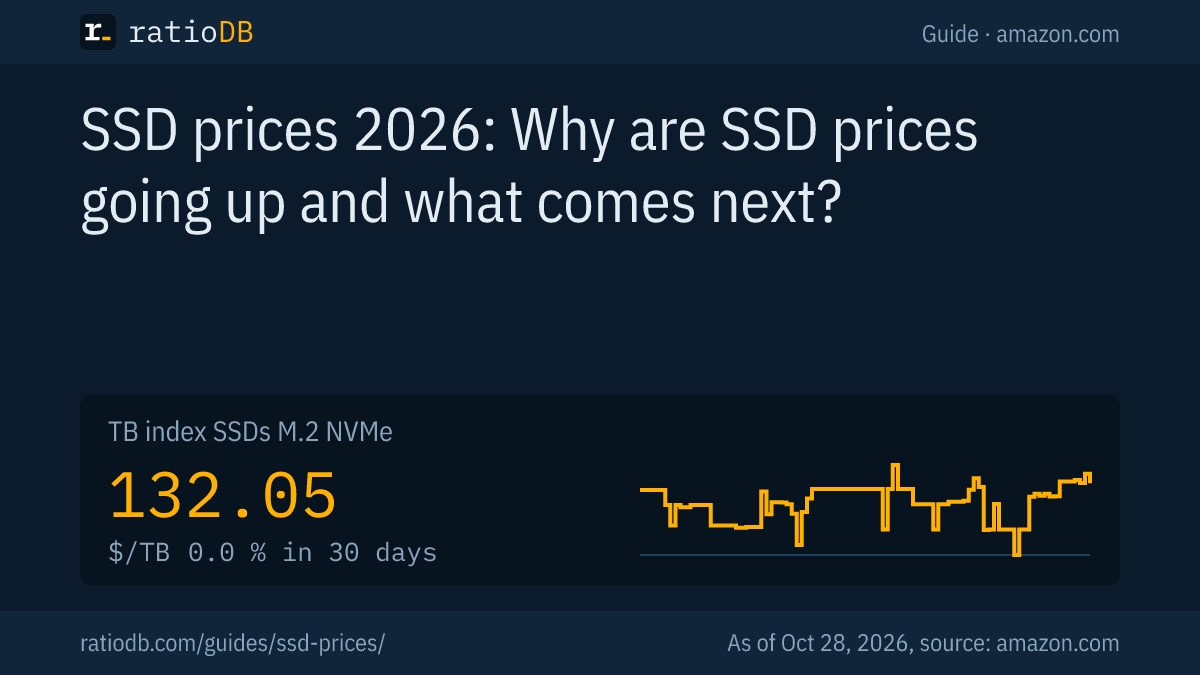
SSD prices have risen sharply since late 2025 because AI data centers buy huge amounts of flash memory and manufacturers steer their capacity there. On amazon.com, an M.2 NVMe SSD currently costs $132.05 per TB according to the ratioDB TB index, a change of 0.0% over 90 days (as of Oct 28, 2026 at 1:17 AM UTC). This guide shows real prices per TB from our daily history, explains the reasons with market research figures and covers what manufacturers expect for 2027.
All prices in this article come live from the ratioDB database and are recalculated with every update. Forecasts by manufacturers and analysts are labeled as forecasts and linked to their source.
SSD price history: live chart →
How much have SSD prices gone up?
The TB index for all SSDs on amazon.com stands at $118.71 per TB, a change of +0.3% over 30 days and +2.2% over 90 days. M.2 NVMe SSDs are at $132.05 per TB, 0.0% over 30 days. Compared with fall 2025, many SSDs cost more than twice as much.
The index is the median of the 10 cheapest new offers per day. The percentages only compare offers that had a price on both days, so new bait offers don't distort the trend.
SSD prices per TB on amazon.com, new offers, as of Oct 28, 2026 at 1:17 AM UTC
| SSD type | TB index | 30 days | 90 days |
|---|---|---|---|
| M.2 NVMe SSD | $132.05 | 0.0 % | 0.0 % |
| 2.5" SATA SSD | $122.93 | ▲ 0.7 % | ▼ 3.7 % |
| M.2 SATA SSD | $242.11 | ▼ 1.7 % | ▼ 0.4 % |
| External SSD | $125.50 | 0.0 % | ▲ 9.4 % |
Our history starts on Jul 30, 2026, when the TB index for SSDs stood at $110.49 per TB. The big jump came before that, in winter 2025 and spring 2026. Several outlets measured it with their own samples:
- A ComputerBase sample in Germany, reported by PC Games Hardware, found SSDs 126% more expensive in mid August 2026 than in mid September 2025. A 1 TB Kingston NV3 went from 50 to 145 euros, a 4 TB Samsung 990 EVO Plus from 240 to 572 euros (Aug 16, 2026).
- IBM cites camelcamelcamel data showing the 4 TB Samsung 9100 Pro rising from $350 in October 2025 to $1,300 in July 2026 (IBM).
- According to a 3DCenter index, M.2 SSDs in Germany cost about twice as much in June 2026 as a year earlier (Notebookcheck, Jun 15, 2026).
The figures differ because every source measures different products and periods. The direction is the same everywhere.
How have SSD prices developed since 2025?
After production cuts from late 2024, flash memory prices rose slowly in 2025. From Q4 2025, a hard drive shortage and demand from AI data centers added to it. TrendForce expected the biggest jump for Q2 2026, with contract prices up 70 to 75%.
The key milestones, each with its source. Contract prices are the prices in supply agreements between chipmakers and large customers, and they determine what SSDs cost at retail later.
| Date | Event | Source |
|---|---|---|
| Q2 2025 | Client SSD contract prices +3 to 8%, TrendForce cites the production cuts from late 2024 | TrendForce |
| Q3 2025 | Forecast for flash memory +5 to 10% on average | TrendForce |
| September 2025 | Lead times for large data center hard drives rise from a few weeks to over 52 weeks | TrendForce via I-Connect007 |
| Q4 2025 | SanDisk raises prices by 10%, Micron pauses quotes | TrendForce |
| Q1 2026 | Forecast raised to +55 to 60%, data center SSDs +53 to 58%, a record | TrendForce |
| Q2 2026 | Forecast for flash memory +70 to 75% | TrendForce via TechNews |
| Q3 2026 | Forecast +10 to 15%, the increase slows down | TrendForce via Chinatimes |
| Q4 2026 | Forecast +15 to 20%, data center SSDs pick up again | TrendForce |
Since Jul 30, 2026, ratioDB has recorded amazon.com prices daily. The chart at the top of the M.2 NVMe SSD page shows the history day by day.
Why are SSD prices going up?
SSDs got more expensive because AI data centers buy huge amounts of flash memory, because a shortage of large hard drives pushes cloud providers to SSDs and because manufacturers shift capacity to DRAM. Less is left for consumer SSDs.
AI data centers are buying flash memory
AI servers store huge amounts of data on fast SSDs. TrendForce expects data center SSD demand, measured in bits, to grow more than 80% in 2026 (TrendForce, Sep 30, 2026). According to TrendForce, manufacturers shift flash memory that would otherwise go into consumer SSDs toward data center SSDs. Cheap QLC SSDs (4 bits per memory cell) are especially scarce as a result (TrendForce, Jan 5, 2026).
SanDisk shows the shift in its own numbers: the data center share of its business rose from 12% to 38% within a year, while consumer revenue fell 32% in the last quarter (GuruFocus on SanDisk results, Aug 5, 2026).
The hard drive shortage drives demand
Cloud providers usually store rarely used data on large hard drives. According to TrendForce, lead times for those drives rose to over 52 weeks in 2025. Many providers switch to QLC SSDs instead, which according to TrendForce use about 30% less power (TrendForce via I-Connect007, Sep 16, 2025). That is exactly the type of flash used in budget consumer SSDs.
Manufacturers are shifting capacity to DRAM
DRAM is even scarcer than flash memory. According to TrendForce, manufacturers have converted some production lines from flash to DRAM (TrendForce, Feb 2, 2026) and prioritize capital spending for DRAM and HBM (high bandwidth memory) (TrendForce, Aug 18, 2026). How much RAM has risen is covered in the guide Why RAM prices are so high.
Contract prices exploded
TrendForce measured and forecast the jumps in flash memory contract prices as follows:
| Quarter | Flash contract price vs previous quarter | Source |
|---|---|---|
| Q1 2026 | +55 to 60% (forecast from Feb 2, 2026) | TrendForce |
| Q2 2026 | +70 to 75% (forecast) | TrendForce via TechNews |
| Q3 2026 | +10 to 15% (forecast) | TrendForce via Chinatimes |
| Q4 2026 | +15 to 20% (forecast) | TrendForce |
For comparison: in January 2026, TrendForce still expected +33 to 38% for Q1, and 4 weeks later +55 to 60%. Forecasts in this market have recently been far too low.
Who makes the flash memory in SSDs?
The market is split among 5 large manufacturers: Samsung, SK hynix with Solidigm, Kioxia, Micron and SanDisk. In Q1 2026, Samsung held 31.6% of revenue, SK hynix with Solidigm 17.6%, and Kioxia, Micron and SanDisk 13.9% each.
According to TrendForce, revenue of the top 5 rose to $38.9 billion in Q1 2026, up 83.7% from the previous quarter (TrendForce via I-Connect007, May 25, 2026). In Q2 it was $68.87 billion, another 77% more. Samsung reached 29.3% and Kioxia 13.6% (TrendForce, Aug 18, 2026).
Revenue grows mostly through prices. Kioxia reported an average selling price about 70% higher than in the previous quarter for April to June 2026, with barely more volume sold (TrendForce, Jul 31, 2026). At SanDisk, about 2 thirds of revenue growth came from higher prices (source above).
When will SSD prices go down?
TrendForce expects relief in the second half of 2027 at the earliest, when new fabs deliver. Manufacturers are more cautious: SanDisk expects supply to stay allocated beyond 2027, Kioxia and Micron expect ongoing shortages. All of these are forecasts and may change.
What the key voices say, each as a forecast:
- TrendForce: flash supply should loosen in the second half of 2027 as new capacity comes online, with weak consumer demand adding pressure on prices (TrendForce, Jul 31, 2026).
- SanDisk: the flash market should exceed $300 billion in 2026 and approach $500 billion in 2027, with supply staying on allocation beyond 2027 (GuruFocus, Aug 5, 2026).
- Kioxia: demand should keep outpacing supply in 2027 (TrendForce, Jul 31, 2026, source above).
- Micron: industry flash bit growth of low 20s percent in 2026 and mid 20s percent per year in 2027 and 2028, with supply constraints persisting (Guru3D, Oct 1, 2026).
There are short-term dips. For Q3 2026, TrendForce expected only +10 to 15%, because consumers are buying less and PC makers still hold inventory from the first half. According to TrendForce, PC makers are even putting smaller SSDs into new devices (TrendForce, Sep 30, 2026). The daily price history is the most reliable way to see when buying makes sense.
Are large SSDs cheaper per TB than small ones?
Not across the board right now: on amazon.com, the cheapest 4 TB NVMe SSD costs $167.44 per TB, the cheapest 1 TB model $139.99 per TB. The cheapest size per TB is often in the middle, the table shows the current picture by capacity.
Cheapest new NVMe SSD by capacity on amazon.com, as of Oct 28, 2026 at 1:17 AM UTC
| Capacity | Cheapest NVMe SSD | Price | Price per TB |
|---|---|---|---|
| 500 GB | Fikwot 2280,Read 500 GB | $85.49 | $170.98 |
| 1 TB | Timetec High Read Speed 1 TB | $139.99 | $139.99 |
| 2 TB | KingSpec NX Series 2 TB | $246.99 | $123.50 |
| 4 TB | Crucial P3 Plus 4 TB | $669.77 | $167.44 |
| 8 TB | WD Black SN850X 8 TB | $1,946.99 | $243.37 |
PC Games Hardware observed in 2026 that the order of price per TB has partly flipped in Germany: large SSDs there are cheaper per TB than 1 TB models (PC Games Hardware, Sep 14, 2026). It used to be the other way around. So always compare the price per TB before settling on a size. Very large 8 TB SSDs often remain the most expensive per TB.
Is an SSD with DRAM cache still worth it?
For most users, an SSD without its own DRAM cache is enough today. According to PC Games Hardware, the premium for DRAM rose from about 20 euros to 30 to 120 euros. NVMe SSDs without DRAM use a small part of the PC's system memory instead.
Many SSDs have their own DRAM chip that stores the mapping of the data. Budget NVMe SSDs skip it and use HMB (host memory buffer, a buffer in the PC's system memory). The method came with the NVMe 1.2 standard. Kioxia claims "equivalent performance" to an SSD with DRAM (Kioxia). Innodisk is more cautious and speaks of performance "closer to DRAM-equipped designs" (Innodisk, Apr 13, 2026).
For games, office work and your system, an SSD without DRAM is usually sufficient. Check the datasheet to see whether an SSD has DRAM and weigh the premium against the price per TB.
Is NVMe or SATA cheaper right now?
It depends on the capacity. Per TB, the TB index for M.2 NVMe SSDs on amazon.com currently stands at $132.05, the values for 2.5-inch SATA and M.2 SATA SSDs are in the table above. Because NVMe SSDs are much faster, a small premium is usually worth it.
SATA SSDs are limited by their interface to about 560 MB/s, while PCIe 4.0 NVMe SSDs reach more than 7,000 MB/s. In devices with an M.2 slot for NVMe, NVMe is the default choice. SATA SSDs mainly make sense for older PCs and laptops without a matching slot. The full comparison is in the guide NVMe vs SATA.
What are TLC and QLC and what do they mean for the price?
TLC flash stores 3 bits per cell, QLC flash 4 bits. QLC fits more data on a chip but handles fewer write cycles: Kingston lists 3,000 to 5,000 program/erase cycles for TLC and about 1,000 for QLC. QLC in particular is scarce in 2026 because data centers buy it in large volumes.
Every flash cell handles only a limited number of erase and write cycles. The more bits per cell, the more data fits on a chip and the fewer cycles the cell endures (Kingston, Apr 2026). The datasheets show it: the 1 TB Samsung 870 EVO with TLC is rated for 600 TB written, the 1 TB 870 QVO with QLC for 360 TB (Samsung 870 EVO, Samsung 870 QVO).
QLC used to be the budget choice for lots of storage. According to TrendForce, this type of flash is now especially scarce because cloud providers buy large QLC SSDs instead of hard drives. That has shrunk the price advantage of QLC. For most users, both types still last many years, more in the guide SSD lifespan.
Which SSD is worth buying at high prices?
At high prices, what counts most is the price per TB relative to warranty and TBW. A PCIe 4.0 SSD is enough for almost everyone, an SSD without DRAM works for games and office, and budget brands are worth it if warranty and manufacturer specs check out.
How to save without cutting the wrong corners:
- PCIe 4.0 instead of 5.0: PCIe 5.0 SSDs mainly pay off if you regularly copy very large amounts of data. For games and your system, PCIe 4.0 is usually more than enough.
- No DRAM is often fine: as described above, the DRAM premium has grown. For games and office work, an SSD with HMB does the job.
- Check warranty and TBW: budget SSDs often have a shorter warranty or a lower TBW rating. Weigh the price against the warranty years.
- Don't buy too small: a 2 TB SSD often costs less per TB than a 1 TB model, see the table above.
- Hard drive for large data: per TB, an SSD on amazon.com currently costs 3.4 times as much as a hard drive ($118.71 vs $35.00 TB index). Photos, videos and backups are cheaper on a hard drive.
According to TrendForce, PC makers are cutting costs too and putting smaller SSDs into new devices (TrendForce, Sep 30, 2026). If you buy a new PC or laptop, check whether the SSD can easily be replaced or added to later.
Should I buy an SSD now or wait?
If you need an SSD now, buy now and watch for the 90-day low. Waiting for much lower prices is a bet against the forecasts of TrendForce and the manufacturers, who expect relief in the second half of 2027 at the earliest.
How to proceed:
- Check what you need: 1 TB is enough for many as a system drive, 2 TB for lots of games. Large amounts of data are cheaper per TB on a hard drive.
- Check the form factor: M.2 NVMe, M.2 SATA or 2.5-inch SATA. Your motherboard or laptop manual lists it.
- Compare price per TB: a 2 TB SSD can be cheaper per TB than a 1 TB model. ratioDB sorts all offers by it.
- Watch for the 90-day low: offers with the "90-day low" badge cost as little as they have in 90 days.
- Save instead of guessing: add candidates to your watchlist. On your next visit, ratioDB shows how the price has changed since you saved it.
Is a used or refurbished SSD worth it?
A used SSD can be worth it if its price per TB is well below the index for new SSDs and you can check its wear. NVMe SSDs report wear in the Percentage Used value (life used in percent), where 100 means the rated endurance has been reached.
According to Microsoft, Percentage Used is a vendor estimate. A value of 100 means the rated endurance has been consumed, not necessarily that the SSD will fail (Microsoft Learn). Tools such as CrystalDiskInfo show the value. For a used SSD, ask the seller for a screenshot or check it right after purchase.
For offers sold under Amazon Renewed on amazon.com, Amazon offers a replacement or refund within 90 days of receipt (Amazon Renewed). ratioDB shows used and refurbished offers with their condition and never counts them toward the TB index. How to buy used drives safely is covered in the guide Refurbished hard drives.
What is a good price per TB for an SSD?
A good price is at or below the TB index of the SSD type. For M.2 NVMe SSDs that is currently $132.05 per TB on amazon.com, for all SSDs combined $118.71 per TB. The 90-day low of the overall index was $109.99 per TB.
The TB index is an honest yardstick because it is built from the 10 cheapest new offers. If an offer is clearly above it, there are almost always cheaper alternatives with the same capacity. Refurbished and used SSDs are shown separately and never count toward the index.
Also look at durability when comparing: budget SSDs often have a lower TBW rating (the maximum amount of data written according to the manufacturer). What that means for lifespan is explained in the guide SSD lifespan.
Are hard drives and RAM more expensive too?
Yes, all storage types are affected. On amazon.com, the TB index for hard drives changed by +0.6% over 90 days and the index for RAM by +5.9%. In the ComputerBase sample in Germany, hard drives were even 129% more expensive in August 2026 than in September 2025.
Hard drives suffer from the same shortage that pushes cloud providers toward SSDs. RAM is hit even harder by AI demand. Current prices by group are on the pages Hard drive prices per TB and RAM prices per GB. Whether a hard drive makes more sense for your data is covered in the guide SSD vs HDD.
How does ratioDB measure SSD prices?
ratioDB fetches the amazon.com prices of all 279 listed SSD offers every 2 hours and converts them into price per TB. The TB index is the median of the 10 cheapest new offers, and changes only compare offers with a price on both days.
Every offer is listed with its condition (new, refurbished, used), price, capacity and timestamp. Multipacks are divided by their total capacity. Shipping costs are not included. All rules are on the methodology page. The full list of all SSDs is under SSD prices per TB.
SSD prices FAQ
Why are SSDs so expensive in 2026?
AI data centers buy huge amounts of flash memory, the shortage of large hard drives pushes cloud providers to SSDs, and manufacturers shift capacity to DRAM. For Q1 and Q2 2026, TrendForce expected flash contract prices to rise by more than 50% in each quarter.
When will SSDs get cheaper again?
TrendForce expects relief in the second half of 2027 at the earliest. SanDisk expects supply to stay allocated beyond 2027, Micron expects ongoing constraints through 2028. These are forecasts that may change.
Are SSD prices still going up?
On amazon.com, the TB index for SSDs changed by +0.6% over the last 7 days and +0.3% over 30 days (as of Oct 28, 2026 at 1:17 AM UTC). TrendForce expects another 15 to 20% in flash contract prices for Q4 2026.
How much does a 1 TB SSD cost right now?
The cheapest new 1 TB NVMe SSD on amazon.com is currently Timetec High Read Speed 1 TB at $139.99 (as of Oct 28, 2026 at 1:17 AM UTC). The full list shows all models sorted by price per TB.
Are large SSDs cheaper per TB?
Often, but not always. The cheapest size per TB on amazon.com right now is shown in the table above. PC Games Hardware observed in 2026 that large SSDs are sometimes cheaper per TB than 1 TB models.
Are QLC SSDs still cheaper than TLC SSDs?
Usually, but the gap has narrowed. According to TrendForce, QLC is especially scarce because cloud providers buy large QLC SSDs instead of hard drives. QLC also handles fewer writes, Kingston lists about 1,000 cycles versus 3,000 to 5,000 for TLC.
How much more does an SSD cost per TB than a hard drive?
On amazon.com, the TB index for SSDs currently stands at $118.71 per TB and for hard drives at $35.00 per TB. Per TB, an SSD costs 3.4 times as much (as of Oct 28, 2026 at 1:17 AM UTC).
Is AI making SSDs more expensive?
Yes, to a large extent. TrendForce expects data center SSD demand to grow more than 80% in 2026. SanDisk raised the data center share of its business from 12% to 38% in a year.
Sources
- TrendForce: Q2 2025 (Mar 26, 2025), Q3 2025 (Jul 9, 2025), Q4 2025 (Sep 25, 2025), Q1 2026 first forecast (Jan 5, 2026), Q1 2026 raised (Feb 2, 2026), Market shares Q2 2026 (Aug 18, 2026), Q4 2026 (Sep 30, 2026), Kioxia and 2027 outlook (Jul 31, 2026)
- TrendForce in other media: I-Connect007, hard drive shortage (Sep 16, 2025), TechNews, Q2 2026 (Mar 31, 2026), I-Connect007, market shares Q1 2026 (May 25, 2026), Chinatimes, Q3 2026 (Jul 3, 2026)
- Manufacturers: GuruFocus on SanDisk (Aug 5, 2026), Guru3D on Micron (Oct 1, 2026), Kioxia: HMB, Innodisk: HMB (Apr 13, 2026)
- PC Games Hardware (German): Storage prices August 2026 (Aug 16, 2026), SSD prices per TB (Sep 14, 2026)
- IBM: NVMe vs SATA, Notebookcheck with 3DCenter index (Jun 15, 2026)
- Kingston: SLC, MLC, TLC and QLC (Apr 2026), Samsung: 870 EVO, 870 QVO
- Microsoft Learn: NVMe health log, Amazon Renewed
- ratioDB: daily amazon.com prices, methodology