SSD lifespan: How long does an SSD really last?
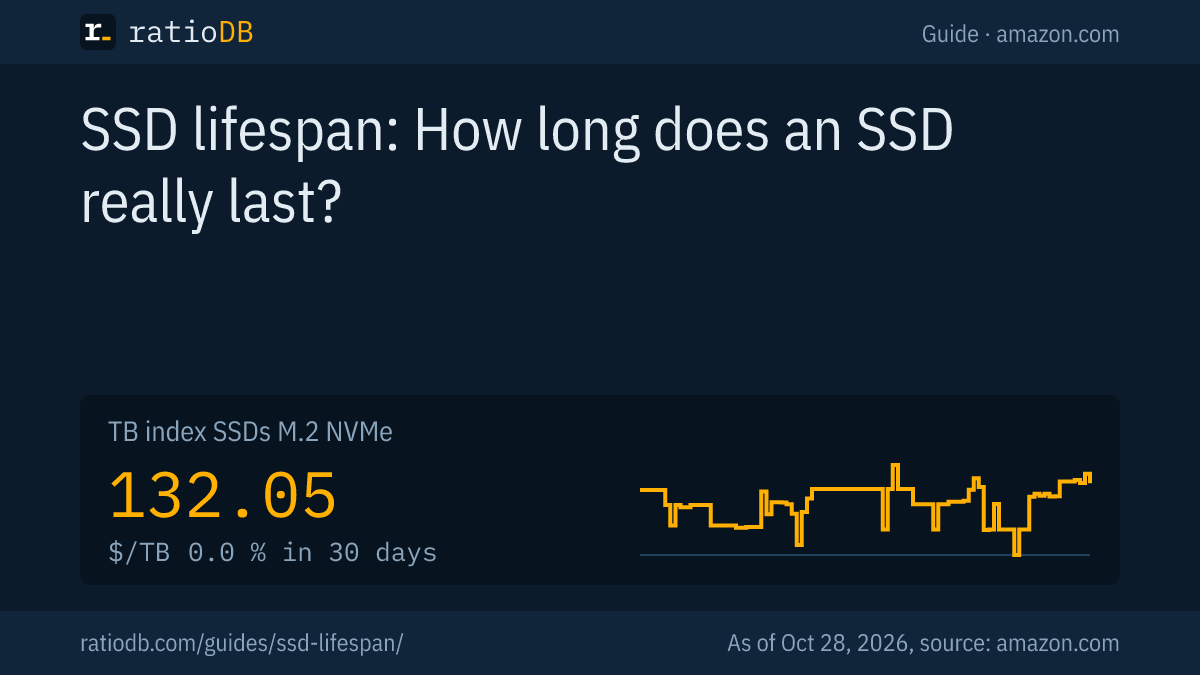
According to SanDisk, an SSD lasts about 5 to 10 years with normal use. Few users ever reach the write volume the manufacturer specifies: a 1 TB Samsung 990 PRO is rated for 600 TB, which at 20 GB per day works out to more than 80 years. The 3 to 5 year warranty usually ends long before that. This guide explains TBW and DWPD, compares popular models and works out which SSD on amazon.com currently offers the most write endurance per dollar.
The endurance ratings in this guide come from the manufacturers' datasheets and are linked. All prices come live from the ratioDB database and are recalculated with every update.
How long does an SSD last?
According to SanDisk, most SSDs last about 5 to 10 years with normal use. The German magazine PC-WELT names 5 to 7 years as the typical manufacturer figure, more than 10 years with light use, and about 3 to 5 years under heavy load and poor conditions.
The lifespan of an SSD depends mainly on how much you write to it. Flash memory only tolerates a limited number of write cycles per cell. For the manufacturers' endurance rating, only the amount of data written counts. SanDisk does the math: an SSD rated for 600 TBW lasts about 82 years at 20 GB per day (SanDisk). PC-WELT puts the manufacturer figures into context (PC-WELT, 2025-12-23).
In practice, people usually stop using an SSD for other reasons: it becomes too small, the device gets replaced, or it fails because of an electronics defect. That is why you need a backup regardless of the write volume.
What does TBW mean for SSDs?
TBW (terabytes written) is the amount of data a manufacturer rates an SSD for before the warranty ends. The 1 TB Samsung 990 PRO is rated for 600 TB, the 1 TB Kingston NV3 for 320 TB. The warranty ends when the TBW is reached or the warranty period is over, whichever comes first.
TBW ratings of popular SSDs according to their datasheets:
| SSD | Interface | TBW by capacity | Warranty |
|---|---|---|---|
| Samsung 990 PRO | M.2 NVMe | 1 TB: 600, 2 TB: 1,200, 4 TB: 2,400 | 5 years |
| WD_BLACK SN850X | M.2 NVMe | 1 TB: 600, 2 TB: 1,200, 4 TB: 2,400, 8 TB: 4,800 | 5 years |
| Kingston NV3 | M.2 NVMe | 500 GB: 160, 1 TB: 320, 2 TB: 640, 4 TB: 1,280 | 5 years |
| Samsung 870 EVO | 2.5-inch SATA | 250 GB: 150, 500 GB: 300, 1 TB: 600, 2 TB: 1,200, 4 TB: 2,400 | 5 years |
| Samsung 870 QVO | 2.5-inch SATA | 1 TB: 360, 2 TB: 720, 4 TB: 1,440, 8 TB: 2,880 | 3 years |
| Crucial MX500 | 2.5-inch SATA | 250 GB: 100, 500 GB: 180, 1 TB: 360, 2 TB: 700, 4 TB: 1,000 | 5 years |
| Crucial BX500 | 2.5-inch SATA | 240 GB: 80, 480 GB: 120, 1 TB: 360, 2 TB: 720, 4 TB: 1,000 | 3 years |
Sources: Samsung 990 PRO and 990 PRO 4 TB, WD_BLACK SN850X (07/2025), Kingston NV3, Samsung 870 EVO, Samsung 870 QVO, Crucial MX500, Crucial BX500.
Important: TBW limits the warranty. It does not tell you when an SSD will actually fail. Many SSDs write far more before they fail, as the endurance test further down shows. Samsung states that its endurance ratings follow the JEDEC standard JESD218.
What does DWPD mean?
DWPD (drive writes per day) tells you how many times per day you may fill the entire SSD during the warranty period. The formula is TBW divided by capacity in TB, warranty years and 365. A 1 TB Samsung 990 PRO works out to about 0.33 DWPD.
Kioxia and Kingston explain the conversion between TBW and DWPD as TBW = DWPD × capacity × years × 365 (Kioxia, 03/2021, Kingston, 11/2024). Our own calculation for 2 examples:
- Samsung 990 PRO 1 TB: 600 TBW divided by (1 TB × 5 years × 365) gives about 0.33 DWPD. You could rewrite a third of the SSD, about 330 GB, every day for 5 years.
- Samsung 870 QVO 1 TB: 360 TBW divided by (1 TB × 3 years × 365) also gives about 0.33 DWPD, but over only 3 years.
DWPD is mainly used for data center SSDs. For consumers, TBW and warranty are all you need to look at.
How much do I really write to my SSD?
According to SanDisk, home users write 20 to 40 GB per day on average. At that rate, an SSD rated for 600 TBW reaches its limit only after 41 to 82 years, one rated for 320 TBW after 22 to 44 years. The 3 to 5 year warranty ends long before that.
Our calculation of how long different TBW ratings last at a given daily write volume:
| Writes per day | 320 TBW (e.g. Kingston NV3 1 TB) | 600 TBW (e.g. Samsung 990 PRO 1 TB) | 1,200 TBW (e.g. Samsung 990 PRO 2 TB) |
|---|---|---|---|
| 20 GB | about 44 years | about 82 years | about 164 years |
| 40 GB | about 22 years | about 41 years | about 82 years |
| 100 GB | about 9 years | about 16 years | about 33 years |
| 300 GB | about 3 years | about 5 years | about 11 years |
The SMART values of your SSD show how much you actually write, more on that below. Heavy writers include video editing with large projects, frequent game installs, virtual machines and large downloads. For office work and browsing, TBW is practically never an issue.
Which SSD offers the most write endurance per dollar?
The cheapest per TB written on amazon.com right now is WD Black SN850X 2 TB at $0.31 per TB of TBW. ratioDB divides the current price by the TBW from the datasheet. This shows which SSD gives you the most endurance for your money.
The table contains every model from the TBW list above that is currently offered new on amazon.com, cheapest endurance first. DWPD is our own calculation from TBW, capacity and warranty.
Price per TB written on amazon.com, new offers, as of Oct 28, 2026 at 1:17 AM UTC
| SSD | TBW | Warranty | DWPD | Price | Price per TB written |
|---|---|---|---|---|---|
| WD Black SN850X 2 TB | 1,200 TB | 5 years | 0.33 | $369.00 | $0.31 |
| WD Black SN850X 4 TB | 2,400 TB | 5 years | 0.33 | $764.99 | $0.32 |
| Samsung 990 PRO 2 TB | 1,200 TB | 5 years | 0.33 | $399.99 | $0.33 |
| WD Black SN850X 1 TB | 600 TB | 5 years | 0.33 | $243.00 | $0.41 |
| WD Black SN850X 8 TB | 4,800 TB | 5 years | 0.33 | $1,946.99 | $0.41 |
| Crucial BX500 2 TB | 720 TB | 3 years | 0.33 | $296.97 | $0.41 |
| Kingston NV3 1 TB | 320 TB | 5 years | 0.18 | $156.25 | $0.49 |
| Samsung 870 QVO 8 TB | 2,880 TB | 3 years | 0.33 | $1,459.99 | $0.51 |
| Samsung 870 EVO 4 TB | 2,400 TB | 5 years | 0.33 | $1,249.90 | $0.52 |
| Crucial BX500 1 TB | 360 TB | 3 years | 0.33 | $194.99 | $0.54 |
| Samsung 870 EVO 500 GB | 300 TB | 5 years | 0.33 | $206.15 | $0.69 |
| Crucial BX500 240 GB | 80 TB | 3 years | 0.30 | $67.99 | $0.85 |
Large SSDs usually do well here because TBW grows with capacity. Cheap models with a low TBW are often more expensive per TB written, even though they look cheap per TB of storage. For office use and gaming this is secondary. If you write a lot, look closely at this column.
Which flash memory lasts the longest?
The fewer bits a memory cell stores, the more write cycles it tolerates. Kingston gives about 100,000 cycles for SLC, 10,000 for MLC, 3,000 to 5,000 for TLC and about 1,000 for QLC. According to Samsung, the 870 EVO uses TLC and the 870 QVO uses QLC.
| Memory type | Bits per cell | Write cycles according to Kingston |
|---|---|---|
| SLC | 1 | about 100,000 |
| MLC | 2 | about 10,000 |
| TLC | 3 | 3,000 to 5,000 |
| QLC | 4 | about 1,000 |
Source: Kingston, 04/2026.
At the same capacity, this shows in the TBW: the 1 TB Samsung 870 EVO with TLC (3 bits per cell according to Samsung) is rated for 600 TB, the 1 TB 870 QVO with QLC (4 bits per cell) for 360 TB, and with only 3 instead of 5 years of warranty. For most home users, both still last many years. QLC is a good choice for large data drives that are rarely rewritten.
What happens when an SSD wears out?
When an SSD has used up its reserves, it usually switches to a read-only mode. You can no longer save new data, but you can still read your existing data for a while. That is the big difference from a sudden defect.
Solidigm writes that once all spare blocks are used up, the SSD goes into read-only mode and users can still retrieve their old data for some time (Solidigm). Crucial describes the same behavior when SMART attribute 180 for unused reserve blocks drops to 0 (Crucial).
Worn-out flash is only one possible cause, though. SSDs can also fail because of electronics or firmware faults. A regular backup protects you in both cases.
How do I check the lifespan of my SSD?
Read the SMART values. NVMe SSDs report in the Percentage Used value how much of their rated endurance has been used. On SATA SSDs, the values have different names depending on the manufacturer, such as Wear Leveling Count at Samsung or Percentage Lifetime Used at Crucial.
The most important values:
| Value | SSD type | Meaning |
|---|---|---|
| Percentage Used | NVMe | used endurance in percent, 100 = rated endurance reached, may rise above 100 |
| Available Spare | NVMe | remaining reserve in percent |
| Data Units Written | NVMe | amount of data written |
| 177 Wear Leveling Count | SATA (Samsung) | remaining write cycles in percent |
| 241 Total LBAs Written | SATA (Samsung) | sectors written, 512 bytes each |
| 202 Percentage Lifetime Used | SATA (Crucial) | used lifetime in percent |
Sources: Microsoft Learn: NVMe health log, Kingston: SMART attributes, Samsung: SMART attributes (04/2016), Crucial.
How to read the values:
- Windows: CrystalDiskInfo shows the health status and warns with "Caution" once the remaining life is 10 % or less (CrystalDiskInfo).
- Manufacturer software: Samsung offers Magician, Crucial offers Storage Executive.
- Linux and macOS: The command smartctl -a /dev/nvme0n1 from the smartmontools package shows all values of an NVMe SSD, including Percentage Used (Netdata).
According to Microsoft, a Percentage Used of 100 indicates that the estimated endurance has been consumed. It does not have to mean a failure, and the value may rise above 100.
How long does an SSD keep data without power?
According to JEDEC, a consumer SSD must keep its data for at least 1 year at 30 °C while powered off, measured at the end of its rated endurance. For data center SSDs, the requirement is 3 months at 40 °C. A worn SSD is therefore not a good archive for the shelf.
The requirements come from a JEDEC presentation on the JESD218 standard (JEDEC). It also lists the conditions consumer SSDs are tested under: 40 °C in operation, 8 hours a day. According to JEDEC, TBW is the amount of data after which an SSD still meets all requirements, including keeping data without power. Retention testing therefore follows the write test.
For a backup that sits unused for a long time, a hard drive is often the better choice. You can read the comparison in the guide SSD vs HDD. Whatever the medium: connect archive drives regularly and check the data.
How reliable are SSDs?
In Backblaze's statistics, SSDs rarely fail: across 3,144 SSDs used as boot drives in servers, the annualized failure rate from Q4 2018 to Q2 2023 was 0.90 %. On average, fewer than 1 in 100 SSDs failed per year.
Backblaze publishes the failures of its drives regularly. At the end of 2022, the lifetime failure rate was 0.89 %. For 2022, Backblaze reported per-model figures such as 0.73 % for a Seagate ZA250CM10003 and 1.04 % for a Crucial CT250MX500SSD1 (Backblaze, 2023-03-09). Backblaze has not published newer SSD-only reports since 2023 (Backblaze, 2023-09-26).
The figures come from data centers and do not transfer 1 to 1 to use at home. The direction is still clear: SSDs are very reliable in everyday use.
How much can an SSD take in an endurance test?
Far more than the manufacturers specify. In the well-known endurance test by The Tech Report, 6 consumer SSDs wrote data from 2013 onward for about 18 months until they failed. The first gave up after about 700 TB, the last, a 256 GB Samsung 840 Pro, after about 2.4 PB, or 2,400 TB.
Results of the test, which ended in March 2015:
| SSD | Capacity | Written until failure |
|---|---|---|
| Intel 335 | 240 GB | about 700 TB |
| Corsair Neutron GTX | 240 GB | about 1.2 PB |
| Kingston HyperX 3K | 240 GB | about 2.1 PB (with data compression, about 1.5 PB actually written) |
| Samsung 840 Pro | 256 GB | about 2.4 PB |
Sources: reports on the test at ITC.ua (2015-03-13), Gigazine (2015-03-16) and StorageNewsletter.
The SSDs of that time are not directly comparable with today's, as flash memory and controllers have changed since. The test still shows that the rated TBW is a cautious limit. A 256 GB Samsung 840 Pro wrote 4 times as much as a 1 TB 990 PRO is rated for today, at a quarter of the capacity.
How do I extend the lifespan of my SSD?
The biggest lever is write volume, because that is exactly what TBW counts. If you write a lot, choose a larger SSD with a higher TBW or move large, constantly rewritten data to a 2nd drive. For office work, browsing and gaming, you don't need to do anything beyond that.
Practical tips:
- Choose a larger capacity: For all models in the table above, TBW grows with capacity. The 2 TB Samsung 990 PRO is rated for twice as many TB as the 1 TB version.
- TLC instead of QLC for heavy writes: At the same capacity, the 870 EVO with TLC has a higher TBW than the 870 QVO with QLC.
- Spread heavy writes: Temporary video editing files, virtual machines or large downloads can go to a 2nd SSD or a hard drive.
- Keep an eye on SMART values: A look at CrystalDiskInfo or the manufacturer software 1 or 2 times a year shows how fast the wear grows.
- Backup: No tip protects your data as reliably as a 2nd copy on another drive.
How does ratioDB calculate the price per TB written?
ratioDB divides the current amazon.com price of an SSD by the TBW from the manufacturer's datasheet. The TBW ratings come only from datasheets and manufacturer pages, matched by part number. Right now, 12 models with a TBW rating and a new offer are in the table.
ratioDB fetches prices every 2 hours. An offer only appears in the TBW table if it is new and its part number matches a model from our TBW list. All pricing rules are on the methodology page. You can find the full lists under M.2 NVMe SSD and 2.5-inch SATA SSD.
SSD lifespan FAQ
How long does an SSD last on average?
According to SanDisk, about 5 to 10 years with normal use. Home users rarely reach the write volume the manufacturer specifies: at 20 to 40 GB per day, an SSD rated for 600 TBW lasts 41 to 82 years on paper. The warranty is usually 3 to 5 years.
What happens when the TBW is reached?
The manufacturer's warranty ends, but the SSD usually keeps working. In The Tech Report's endurance test, SSDs wrote many times their rating. Once the reserves are fully used up, many SSDs switch to a read-only mode in which you can still rescue your data.
Which SSD lasts the longest?
According to the datasheets, large SSDs offer the highest TBW, such as the 8 TB WD_BLACK SN850X with 4,800 TBW. Among the 1 TB models in this guide, the Samsung 990 PRO, the WD_BLACK SN850X and the Samsung 870 EVO lead with 600 TBW each and a 5 year warranty.
Can an SSD last 20 years?
In terms of write volume, often yes: at 20 GB per day, an SSD rated for 320 TBW lasts about 44 years on paper. Nobody can say for sure whether the electronics will last that long, and the warranty ends after 3 to 5 years. Important data should therefore always also be on a 2nd drive.
Do SSDs fail if you don't use them?
An SSD slowly loses data without power. According to JEDEC, a consumer SSD at the end of its rated endurance must keep its data for at least 1 year at 30 °C while powered off. Connect rarely used SSDs regularly.
How can I tell that my SSD is about to fail?
From the Percentage Used value on NVMe SSDs or values such as Wear Leveling Count on SATA SSDs. CrystalDiskInfo warns with "Caution" when the remaining life is 10 % or less. Other warning signs are read errors and an SSD that suddenly can no longer be written to.
Sources
- Datasheets: Samsung 990 PRO, Samsung 990 PRO 4 TB, Samsung 870 EVO, Samsung 870 QVO, WD_BLACK SN850X (07/2025), Kingston NV3, Crucial MX500, Crucial BX500
- TBW and DWPD: Kioxia (03/2021), Kingston (11/2024), Kingston: SLC to QLC (04/2026)
- Lifespan: SanDisk, PC-WELT (2025-12-23), Solidigm: read-only mode, Crucial: SMART data
- SMART: Microsoft Learn, Kingston, Samsung (04/2016), CrystalDiskInfo, Netdata: smartctl
- JEDEC: JESD218
- Backblaze: SSD 2022 (2023-03-09), SSD mid-2023 (2023-09-26)
- The Tech Report endurance test: ITC.ua (2015-03-13), StorageNewsletter, Gigazine (2015-03-16)
- ratioDB: daily amazon.com prices, methodology