Xbox Series X storage: expansion card, SSD or hard drive?
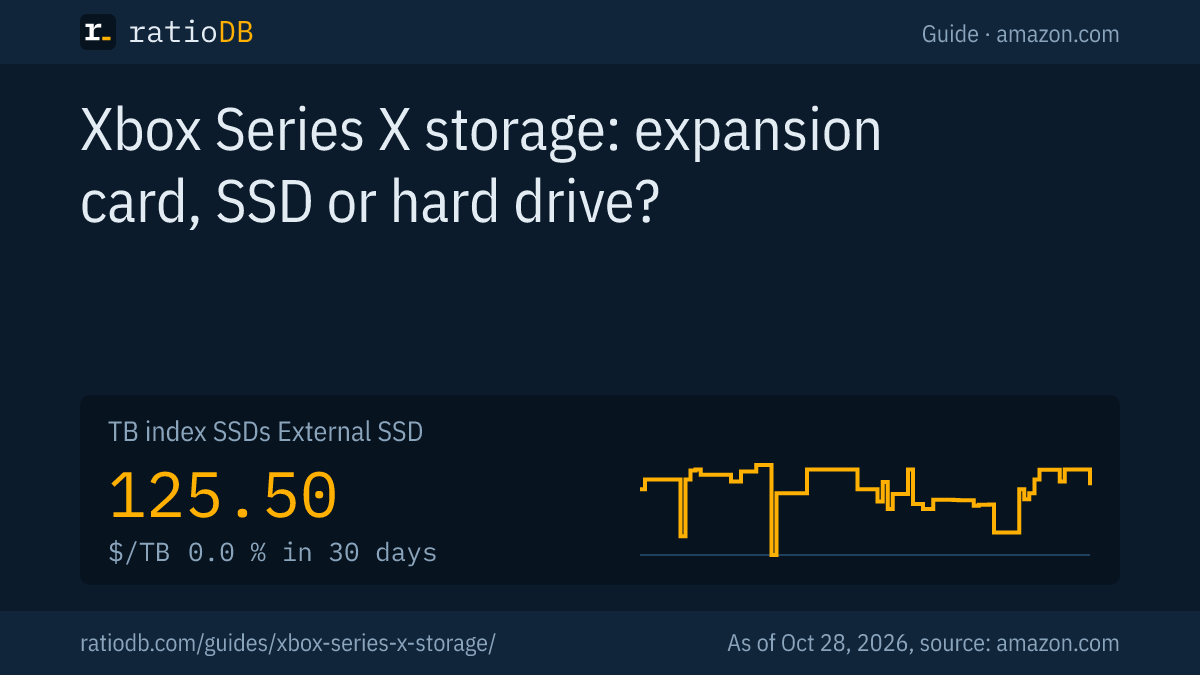
You can expand Xbox Series X storage in 2 ways: with a Storage Expansion Card from Seagate or SanDisk, which according to Microsoft runs every game, or with an external USB SSD or hard drive, which only stores games optimized for Xbox Series X and S. Per TB, a portable hard drive on amazon.com is currently the cheapest option at $47.50 (as of Oct 28, 2026 at 1:17 AM UTC).
Which option fits depends on whether you want to play current generation games straight from the extra storage or whether a place to park your library is enough. This guide explains what Microsoft says about each option and uses live prices from the ratioDB database to show what a TB costs on each path. We checked all manufacturer statements in the linked sources on October 24, 2026.
How do I expand storage on the Xbox Series X?
The Xbox Series X takes a Storage Expansion Card in its expansion slot or external drives over USB. Only the card runs games optimized for Xbox Series X and S. USB drives play Xbox One, Xbox 360 and original Xbox games directly.
Microsoft compared the options on Xbox Wire, the official Xbox blog, in 2020 (Xbox Wire, September 24, 2020):
| What you want | Expansion card | USB SSD or USB hard drive |
|---|---|---|
| Play games optimized for Xbox Series X and S | yes | no, storage only |
| Play Xbox One games | yes | yes |
| Play Xbox 360 and original Xbox games | yes | yes |
| Move games between drives | yes | yes |
| Connection | expansion slot | USB 3.1 |
According to Microsoft, the card performs exactly like the internal SSD. The Microsoft Store listing says the 1TB cards match internal storage "exactly" (Microsoft Store). A USB drive is an archive instead: current generation games wait there until you move them back to the internal SSD or the card.
Storage options with current amazon.com prices, new offers from known brands, as of Oct 28, 2026 at 1:17 AM UTC
| Storage option | Plays Series X and S optimized games | Index per TB | Example from the list |
|---|---|---|---|
| Expansion card | yes | no index (too few offers) | Seagate Storage Expansion 2 TB: $424.98 ($212.49 per TB) |
| External SSD (USB) | no, storage only | $125.50 | TeamGroup T-Force M200 2 TB: $249.99 ($125.00 per TB) |
| External 2.5" HDD | no, storage only | $47.50 | WD My Passport 5 TB: $218.00 ($43.60 per TB) |
| External 3.5" HDD | no, storage only | $42.62 | Seagate Expansion 8 TB: $279.99 ($35.00 per TB) |
The index is the median of the 10 cheapest new offers per drive type. There are too few cards on offer to build an index for them.
How much storage does the Xbox Series X have?
According to Microsoft, the Xbox Series X ships with a 1TB custom NVMe SSD. An IGN review unit, cited by Windows Central on September 28, 2020, showed 802 GB of that available for games. The rest is reserved for the system.
1TB sounds like plenty, but it fills up quickly with large games. SanDisk assumes an average game size of 36 GB for its expansion card (SanDisk). At that average, 802 GB holds about 22 games. Big titles often need far more than the average, so expect fewer.
Microsoft rates the internal SSD at 2.4 GB/s of raw I/O throughput. The expansion card matches that performance according to Microsoft. SanDisk names the Xbox Velocity Architecture, the console's storage technology, as the basis of its card's speed.
What does the Storage Expansion Card do?
The Storage Expansion Card is an SSD in card format for the expansion slot of the Xbox Series X and S. It runs every game directly, performs like the internal SSD according to Microsoft and supports Quick Resume, which lets you jump back into several suspended games.
The cards available according to their makers:
| Card | Sizes | Warranty per manufacturer | Source |
|---|---|---|---|
| Seagate Storage Expansion Card | 512GB, 1TB, 2TB | not verified | Xbox Wire 2020 and 2021 |
| SanDisk Optimus GX C50 | 512GB, 1TB, 2TB | 5 years | SanDisk |
Seagate launched the 1TB card with the console in 2020. Xbox Wire announced the 512GB and 2TB versions in October 2021 (Xbox Wire, October 21, 2021). SanDisk says you can play AAA games (big titles from major studios) directly off its Optimus GX C50, that it integrates with Quick Resume and that it uses the Xbox Velocity Architecture. With 2TB, SanDisk says there is room for up to 50 more games, based on 36 GB per game.
According to Microsoft, Quick Resume always keeps its data on the internal SSD. That is why it works no matter whether a game runs from the card or from an external drive.
Which games run from an external USB SSD or hard drive?
According to Microsoft, an external USB SSD or hard drive plays Xbox One games plus backward compatible Xbox 360 and original Xbox games directly. Games optimized for Xbox Series X and S can only be stored there and must be moved before you play.
Microsoft writes on Xbox Wire that the USB 3.1 storage you use today is plug and play compatible with Xbox Series X and S. Its 2020 comparison marks "plays games optimized for Xbox Series X and S" with a clear no for USB drives.
What that means day to day:
- Older games: Xbox One titles and backward compatible games can live on the USB drive permanently and run from there.
- New games: current generation titles sit on the USB drive and move to the internal SSD or the card before you play.
- Library instead of downloads: copying a game back from the USB drive saves a new download, which matters on a slow internet connection.
That suggests a simple split: internal SSD and card for the games you play now, a large USB drive as the archive.
External SSD or external hard drive for Xbox?
For a pure game archive on the Xbox Series X, an external hard drive is enough and costs far less per TB. On amazon.com, an external SSD costs $125.50 per TB according to the TB index, a portable hard drive $47.50. That makes the SSD about 2.6 times as expensive per TB.
An SSD has no moving parts and is smaller and lighter. That counts if you carry the drive around, to a friend's place for example. If it sits behind the console for good, a hard drive gets you several times the space for the same money.
An example at 2TB: the cheapest 2TB external SSD, TeamGroup T-Force M200 2 TB, costs $249.99. The cheapest 2TB portable hard drive, WD Elements 2 TB, costs $127.00. Drives labeled for gaming consoles such as WD D10 Game 8 TB currently cost $390.00, which is $48.75 per TB. An Xbox logo is not required: Microsoft only names USB 3.1 as the condition.
If you want a fixed archive with lots of space, look at a large 3.5-inch drive with a power adapter. The cheapest right now is Seagate Expansion 8 TB at $35.00 per TB (8 TB). Which form factor and size are cheapest per TB is covered in the guide Best external hard drive.
How much does Xbox Series X storage expansion cost per TB?
The cheapest Storage Expansion Card on amazon.com right now is Seagate Storage Expansion 2 TB at $424.98, which is $212.49 per TB. An external SSD costs $125.50 per TB according to the TB index, a portable hard drive $47.50 per TB (as of Oct 28, 2026 at 1:17 AM UTC).
Per TB, the card therefore costs about 1.7 times as much as a typical external SSD. Compared with a portable hard drive, it is about 4.5 times as much. You pay the premium for one thing: launching current generation games straight from the extra storage.
For context, the launch prices Microsoft announced:
| Card | Launch price | Per TB | Source |
|---|---|---|---|
| Seagate 1TB (2020) | $219.99 | $219.99 | Xbox Wire, September 24, 2020 |
| Seagate 512GB (2021) | $139.99 | about $273 | Xbox Wire, October 21, 2021 |
| Seagate 2TB (2021) | $399.99 | about $200 | Xbox Wire, October 21, 2021 |
Even at launch, the 2TB card was the best value per TB. Prices move constantly, so compare the live figures above. ratioDB lists the cards under External SSD whenever amazon.com carries them, every price with a timestamp.
How many games fit on each storage size?
Using SanDisk's average of 36 GB per game, 1TB holds about 27 games, 2TB about 55 and 4TB about 111. Large games take far more space, so the real number depends on your library.
| Storage size | Games at 36 GB, calculated | Fitting option |
|---|---|---|
| 512GB | about 14 | smallest card |
| 1TB | about 27 | card or small external SSD |
| 2TB | about 55 | largest card, external SSD or hard drive |
| 4TB | about 111 | external hard drive as archive |
| 8TB | about 222 | large external hard drive as archive |
| 16TB | about 444 | 3.5-inch drive with power adapter |
The numbers are rounded calculations with 1TB = 1,000 GB. SanDisk notes that actual user capacity may be less depending on the operating environment, and that the number of games varies with file size, formatting and other factors. It is safer to plan with the sizes of your own games.
When choosing a size, look at the price per TB: small drives often cost more per TB than large ones, as the live ratioDB tables show. 2TB external SSDs sorted by price per TB are on the 2TB external SSD page.
How big can an external hard drive for Xbox be?
Since the system update of February 19, 2025, the Xbox also works with external drives larger than 16TB. According to Thurrott, the console automatically splits such drives into several partitions of at most 16TB each. This applies to Xbox Series X and S and to Xbox One.
Thurrott links the Xbox system update notes as its source (Thurrott, February 19, 2025). For most players the practical question is how many games they want to keep. At SanDisk's 36 GB average, 4TB holds about 110 games and 8TB about 220.
Make sure the connection is USB 3.1, the requirement Microsoft names. Large 3.5-inch drives usually need their own power adapter, portable 2.5-inch drives run off the USB cable. More sizes are listed under External 2.5" HDD and External 3.5" HDD.
Which combination saves the most money?
The cheapest setup combines both: the internal SSD, plus a card if needed, holds the games you are playing now, and a large external hard drive stores the rest. That way you pay the high price per TB only for storage that really needs to be fast.
3 typical cases:
- You play a few games at a time: the internal SSD is enough, plus an external hard drive with 2 to 5TB as an archive. This is the cheapest path.
- You switch between many new games: a 1TB or 2TB card saves the moving around. Per TB, the 2TB card was cheaper at launch.
- You play lots of older Xbox One games: they run straight from the USB drive. An external hard drive does the job, an SSD is handier for travel.
The PS5 follows different rules, covered in the guide Best SSD for PS5. Which external SSD is worth it in general is in the guide Best external SSD. Long-term SSD prices are on the SSD price history page.
Does the same apply to the Xbox Series S?
Yes. The Storage Expansion Cards are made for Xbox Series X and S, and SanDisk lists both consoles for the Optimus GX C50. Microsoft's rules for USB drives apply to both models in the same way.
Microsoft talks about Xbox Series X and S throughout its Xbox Wire storage primer. The card fits both consoles, and so does a USB 3.1 drive.
What should I look for when buying Xbox storage?
Look at the purpose, the price per TB and the warranty. Current generation games need an official expansion card, an archive works with any USB 3.1 drive. Compare sizes per TB, because larger drives often cost less per TB.
The key points:
- Purpose: current generation games only play from the card or the internal SSD, storage and older games also work over USB.
- Official card: the expansion slot only takes cards built for it, such as those from Seagate and SanDisk.
- USB 3.1: the requirement Microsoft names for external drives.
- Price per TB: divide the price by the capacity. ratioDB sorts every offer that way.
- Warranty: SanDisk states 5 years for the Optimus GX C50. Check the warranty of every offer.
- Condition: ratioDB labels used and refurbished offers. More in the guide Refurbished hard drives.
How does ratioDB compare Xbox storage?
ratioDB fetches the amazon.com prices of all listed external SSDs and hard drives regularly and converts them into price per TB, with 1 TB = 10^12 bytes. The TB index is the median of the 10 cheapest new offers per drive type.
Storage Expansion Cards appear in the external SSD list whenever amazon.com carries them. Used and refurbished offers are labeled and never count toward the index. ratioDB does not test drives itself; the console facts come from Microsoft, Seagate and SanDisk. All rules are on the methodology page, all lists under SSD prices per TB and hard drive prices per TB.
Xbox Series X storage FAQ
Can I play Xbox Series X games from an external SSD?
No. According to Microsoft, games optimized for Xbox Series X and S only run from the internal SSD or a Storage Expansion Card. You can store them on an external USB SSD and move them before you play.
Which expansion cards are there for the Xbox Series X?
The Seagate Storage Expansion Card in 512GB, 1TB and 2TB and the SanDisk Optimus GX C50 in 512GB, 1TB and 2TB. Both go into the expansion slot. For the Seagate cards, Microsoft states the same performance as the internal SSD.
How much storage does the Xbox Series X have?
It has a 1TB internal SSD. According to an IGN review unit, 802 GB of that is available for games, the rest belongs to the system.
Is an external hard drive good enough for Xbox?
As an archive, yes. Xbox One, Xbox 360 and original Xbox games run directly from a USB 3.1 hard drive according to Microsoft. Current generation games are stored there and moved to play.
What is the maximum external storage size for Xbox?
Since the update of February 19, 2025, drives above 16TB work too. According to Thurrott, the Xbox splits them into partitions of at most 16TB.
What does Xbox storage cost per TB right now?
On amazon.com, an external SSD costs $125.50 per TB according to the TB index and a portable hard drive $47.50 per TB (as of Oct 28, 2026 at 1:17 AM UTC). Expansion cards cost much more per TB, the table above shows the current figures.
Sources
- Microsoft: Xbox Wire, storage options for Xbox Series X and S (September 24, 2020), Xbox Wire, new Seagate cards (October 21, 2021), Microsoft Store, Xbox Series X
- SanDisk Optimus GX C50 Storage Expansion Card
- Windows Central: 802 GB usable storage (September 28, 2020), Thurrott: drives above 16TB (February 19, 2025)
- ratioDB: amazon.com prices, methodology