Cloud Storage vs External Hard Drive: What Does 1 TB Really Cost?
An external hard drive is a one-time purchase, cloud storage is a monthly bill. The cheapest 2 TB external hard drive on amazon.com costs $127.00 right now (WD Elements 2 TB), while iCloud+ with 2 TB costs $9.99 a month according to Apple. After 13 months of cloud fees you have paid for the drive (as of Oct 30, 2026 at 7:17 PM UTC). CISA, the US cybersecurity agency, recommends backing up to an external drive or a properly vetted cloud service, and using both covers the 3-2-1 rule.
This guide calculates cost per TB over 1, 3 and 5 years using live prices from the ratioDB database and the providers' own price lists. It shows when the cloud wins, when the drive wins and how to combine them. ratioDB does not test drives or cloud services. We compare prices, manufacturer data and government guidance.
Is cloud storage or an external hard drive cheaper?
Per TB, an external hard drive is far cheaper than cloud storage over several years. You pay for a drive once, while a cloud plan bills you every month. At 2 TB, the cheapest external drive on amazon.com pays for itself against iCloud+ after 13 months.
The math has 3 parts:
- Drive price: a one-time cost, live from the ratioDB database for amazon.com.
- Cloud price: monthly or yearly, from each provider's pricing page, read on 10/26/2026.
- Service life: we assume 5 years for the drive, then a replacement. That is a ratioDB calculation assumption, not a lifespan promise.
The drive's advantage grows with the amount of data. For small amounts, the cloud is cheap: 200 GB of iCloud+ costs $2.99 a month according to Apple, 100 GB of Google One Basic $1.99 a month according to Google, and every Google account includes 15 GB for free. For a few hundred photos and documents you do not need a drive of your own.
How much does 1 TB per year cost in the cloud vs on a drive?
On an external hard drive, 1 TB costs from $7.00 per year when spread over 5 years (as of Oct 30, 2026 at 7:17 PM UTC), while the cloud costs many times more. iCloud+ 2 TB costs $119.88 a year according to Apple, about $60 per TB. Backblaze B2 charges $6.95 per TB per month.
Cost per year and per TB per year: external hard drives on amazon.com (price divided by 5 years) and cloud plans per provider, as of Oct 30, 2026 at 7:17 PM UTC
| Storage | Cost per year | Cost per TB per year |
|---|---|---|
| External hard drive 2 TB over 5 years: WD Elements 2 TB | $25.40 | $12.70 |
| External hard drive 4 TB over 5 years: Seagate Expansion 4 TB | $35.00 | $8.75 |
| External hard drive 5 TB over 5 years: LaCie Rugged 5 TB | $41.58 | $8.32 |
| External hard drive 8 TB over 5 years: Seagate Expansion 8 TB | $56.00 | $7.00 |
| iCloud+ 2 TB | $119.88 | $59.94 |
| Google AI Plus (2 TB) | $119.88 | $59.94 |
| Google AI Pro (5 TB) | $239.88 | $47.98 |
| Microsoft 365 Personal (1 TB) | $99.99 | $99.99 |
| Backblaze B2 (pay as you go, 1 TB) | $83.40 | $83.40 |
How to read the table: for drives, the purchase price is divided by 5 years. For cloud plans, it is the provider's yearly price, or 12 times the monthly price.
The cloud prices come from these sources, read on 10/26/2026:
- iCloud+: per Apple Support, $0.99 for 50 GB, $2.99 for 200 GB, $9.99 for 2 TB, $29.99 for 6 TB and $59.99 for 12 TB a month in the US.
- Google One: per Google, Basic with 100 GB at $1.99, Google AI Plus with 2 TB at $9.99 and Google AI Pro with 5 TB at $19.99 a month.
- Microsoft 365: per Microsoft, Basic with 100 GB at $19.99 a year, Personal with 1 TB at $99.99 a year, Family with 2 TB shared at $129.99 a year.
- Backblaze: B2 cloud storage at $6.95 per TB per month pay as you go, and Personal Backup with unlimited data at $99 a year, covering computers and connected external drives.
Note the bundles: Google's 2 TB and 5 TB plans are named after Google's AI features, and Microsoft 365 Personal includes Word, Excel, PowerPoint, Outlook and OneNote desktop apps according to Microsoft. If you use those anyway, the storage comes almost as a bonus, which makes them hard to compare on storage alone.
What does 2 TB cost over 1, 3 and 5 years?
2 TB on the cheapest external hard drive costs $127.00 on amazon.com right now, once. iCloud+ with 2 TB costs $119.88 in year 1 and $599.40 over 5 years according to Apple. Even 2 drives, one at home and one offsite, stay cheaper over 5 years.
Total cost for 2 TB after 1, 3 and 5 years: drives on amazon.com, cloud per provider, as of Oct 30, 2026 at 7:17 PM UTC
| Storage for 2 TB | After 1 year | After 3 years | After 5 years |
|---|---|---|---|
| External hard drive 2 TB: WD Elements 2 TB | $127.00 | $127.00 | $127.00 |
| 2 external hard drives 2 TB (one at home, one offsite) | $254.00 | $254.00 | $254.00 |
| iCloud+ 2 TB | $119.88 | $359.64 | $599.40 |
| Google AI Plus (2 TB) | $119.88 | $359.64 | $599.40 |
This is the heart of the question. With the cloud you pay for storage, a data center and access from anywhere. With a drive you pay only for the storage and handle copies and storage location yourself. For a fair comparison, add the time you spend running regular backups to the drive.
The gap widens with more data. A 5 TB external hard drive starts at $207.90 on amazon.com right now (LaCie Rugged 5 TB). Google AI Pro (5 TB) costs $19.99 a month, so after 11 months you have paid the price of the drive. Matching models are listed under external 2.5" hard drives and 2TB external hard drive.
How long does an external hard drive last?
An external hard drive has no fixed lifespan. Backblaze, a cloud provider that publishes its own failure statistics, reports an annualized failure rate of 1.36% for 2025 across 344,196 data center drives. Always plan for a failure and keep a second copy.
The Backblaze figure comes from data center drives running 24/7, so it does not translate 1 to 1 to an external drive you plug in now and then. It does show the scale: out of 100 drives, a little more than 1 fails per year on average. In 2024 the rate was 1.55% according to Backblaze. External drives also face bumps, drops and travel.
In our math you replace the drive after 5 years. Even then, 10 years of drive storage costs 2 purchase prices, while the cloud costs 120 monthly fees. When to replace a drive and how to spot a coming failure is covered in Hard drive lifespan.
How safe is your data in the cloud and on a drive?
Both have their own risks. A drive that stays plugged in can be hit by ransomware, which CISA says can delete or corrupt backups on a connected drive. For the cloud, CISA recommends a carefully vetted service, and Germany's BSI suggests checking a provider's reputation with a simple web search.
The key recommendations from CISA and the German Federal Office for Information Security (BSI):
- Pick a backup target: CISA advises backing up to an external hard drive or a properly vetted cloud service.
- Disconnect the drive: CISA warns that a connected drive could be used by ransomware to access the drive and delete or corrupt your backups. Plug it in only to back up.
- Store a copy elsewhere: the BSI advises keeping a physical backup medium in a different place than the computer, as protection against burglary or fire.
- Encrypt: CISA recommends encrypting removable media such as external hard drives. Keep recovery keys and passwords safe, since losing them can lead to permanent data loss according to CISA.
- Back up first: CISA says to start encryption only after backing up your data.
The BSI also cites its Cybersecurity Monitor 2025: only one fifth of internet users back up regularly.
How long does it take to upload 1 TB to the cloud?
Uploading 1 TB at 40 Mbit/s takes about 56 hours in theory, more than 2 days nonstop. At 10 Mbit/s it is over 9 days. For the first big backup, an external drive on a USB port is often many times faster.
Theoretical time for 1 TB (8 trillion bits) without protocol overhead
| Upload speed | Time for 1 TB | Time for 2 TB |
|---|---|---|
| 10 Mbit/s | about 222 hours (9.3 days) | about 18.5 days |
| 40 Mbit/s | about 56 hours (2.3 days) | about 4.6 days |
| 100 Mbit/s | about 22 hours | about 44 hours |
| 1,000 Mbit/s | about 2.2 hours | about 4.4 hours |
These values are plain arithmetic: 1 TB is 1,000,000,000,000 bytes or 8 trillion bits, divided by the upload rate. Real uploads take longer, because protocols, Wi-Fi and other devices on the network use bandwidth. Your plan's upload rate is listed in your internet contract.
After the first backup, only new and changed files are added. For phone photos the cloud is convenient from then on, while a multi-terabyte video archive stays easier on a drive. How fast an external drive is depends on the USB port, see USB speeds.
When is the cloud better than a hard drive?
The cloud is better when you have little data, want access on several devices or need an offsite copy without any effort. For phone photos, documents and files you share, a 50 to 200 GB plan is often the most convenient and cheapest option.
Typical cases for the cloud:
- Small amounts of data: 200 GB of iCloud+ costs $2.99 a month according to Apple, so a drive barely pays off.
- Several devices: phone, tablet and laptop see the same files.
- Offsite copy: your data sits in another place automatically, without carrying a drive to a friend or the office.
- Automation: with sync turned on, new photos and documents land in the backup without you doing anything.
One downside remains: you pay every month for as long as you want to keep the data. Cancel the plan and you need to download everything first, which at large sizes takes as long as the upload table suggests.
When is an external hard drive better than the cloud?
An external hard drive is better for large amounts of data, slow uploads and full control without a subscription. From about 1 TB, a drive costs a fraction of the cloud over the years. Video archives, RAW photo libraries and game collections usually belong on a drive.
Typical cases for a drive:
- Large amounts: with several TB, cloud fees add up fast, as the table above shows.
- Slow upload: with 10 or 40 Mbit/s upload, the first backup takes days.
- No subscription: the drive is yours, even if a provider changes prices or plans.
- Full control: you decide where the data lives and who has access.
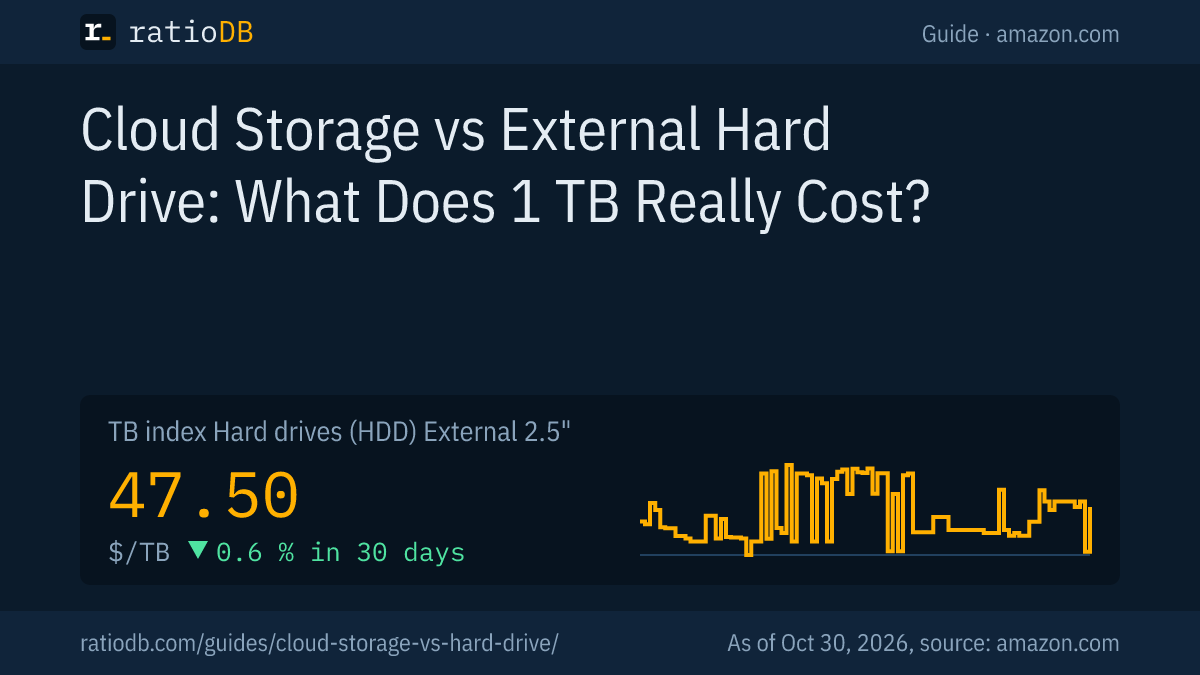
For very large amounts, external 3.5-inch drives are cheaper per TB right now: their TB index on amazon.com is $43.75 per TB, versus $47.50 for 2.5-inch models (as of Oct 30, 2026 at 7:17 PM UTC). Which external drive is worth buying is covered in Best external hard drive.
How should you combine cloud and hard drive?
The safest setup combines both under the 3-2-1 rule: 3 copies of your data on 2 different media, with 1 offsite. The drive gives you a fast, cheap copy at home, and the cloud or a second drive at another location gives you the offsite copy.
3 proven combinations:
- Drive plus cloud: everything on an external drive, and your most important files in a small cloud plan too.
- 2 drives in rotation: one stays home, the other sits with a friend or at the office, swapped regularly. That matches the BSI advice to keep a medium away from the computer.
- NAS plus cloud: a NAS at home for every device, backed up to cloud storage such as Backblaze B2.
The rule in detail, with costs for different amounts of data, is covered in 3-2-1 backup rule.
Is a NAS a good alternative to cloud storage?
A NAS (network attached storage) is a small private cloud at home. It pays off when several people and devices share large amounts of data. 2 internal 3.5-inch 4 TB drives for a mirrored pair cost from $359.98 on amazon.com right now, plus the enclosure.
A NAS sits at home, gives you network access and, if you want, remote access. It does not replace an offsite copy: in a fire or burglary the NAS and your data are gone together. Mirroring 2 drives (RAID 1) protects against a single drive failure. Files you delete by accident are gone from both drives, though. The cheapest internal 3.5-inch 4 TB drive right now is WD Blue 4 TB at $179.99. Which drives belong in a NAS is covered in Best NAS hard drive. All models are under internal 3.5" hard drives.
How does ratioDB calculate the costs?
ratioDB checks amazon.com prices for all listed hard drives regularly and converts them to price per TB, with 1 TB equal to 1,000,000,000,000 bytes. For this comparison we divide the price of the cheapest new drive per size by 5 years.
We read the cloud prices on 10/26/2026 on the pricing pages of Apple, Google, Microsoft and Backblaze. They do not update automatically, while drive prices update with every price check. US cloud prices are shown as listed, before any sales tax. The drive tables only include new single drives from known brands. Used and renewed offers never count toward the index. All rules are on the methodology page. The lists are at external 2.5" hard drives, external 3.5" hard drives and hard drive prices per TB, and 4 TB models at 4TB external hard drive. Daily index values are on the hard drive price history page.
Cloud storage vs hard drive FAQ
Is cloud storage or an external hard drive cheaper?
Per TB, the external drive is far cheaper over several years. The cheapest 2 TB external drive on amazon.com costs $127.00 right now, while iCloud+ with 2 TB costs $119.88 a year according to Apple (as of Oct 30, 2026 at 7:17 PM UTC).
Is one external hard drive enough as a backup?
Not as your only copy. A drive can fail, get stolen or burn. Germany's BSI advises keeping a physical medium in a different place than the computer. Add a second drive or a cloud backup.
Is cloud storage safe?
It depends on the provider. CISA recommends a carefully vetted cloud service, and the BSI suggests checking a provider's reputation first. Look at where the data is stored and how it is encrypted.
How much does 1 TB of cloud storage cost per month?
Backblaze B2 costs $6.95 per TB per month and Microsoft 365 Personal with 1 TB costs $99.99 a year according to the providers. iCloud+ and Google AI Plus both charge $9.99 a month for 2 TB. All prices read on 10/26/2026.
How long does a 1 TB cloud backup take?
At 40 Mbit/s upload it takes about 56 hours in theory, at 100 Mbit/s about 22 hours, without protocol overhead. The first backup takes longest. After that, only new and changed files are added.
Should I combine cloud storage and a hard drive?
Yes. The 3-2-1 rule asks for 3 copies on 2 media, with 1 offsite. An external drive at home plus cloud storage for your key files meets it with little effort.
Sources
- Apple: iCloud+ plans and pricing (Apple Support)
- Google: Google One plans and pricing
- Microsoft: OneDrive and Microsoft 365 plans
- Backblaze: B2 Cloud Storage pricing, Computer Backup pricing, Drive Stats for 2025
- CISA: How to Protect the Data that is Stored on Your Devices
- BSI: World Backup Day press release, 03/30/2026 (German)
- ratioDB: amazon.com prices, Methodology